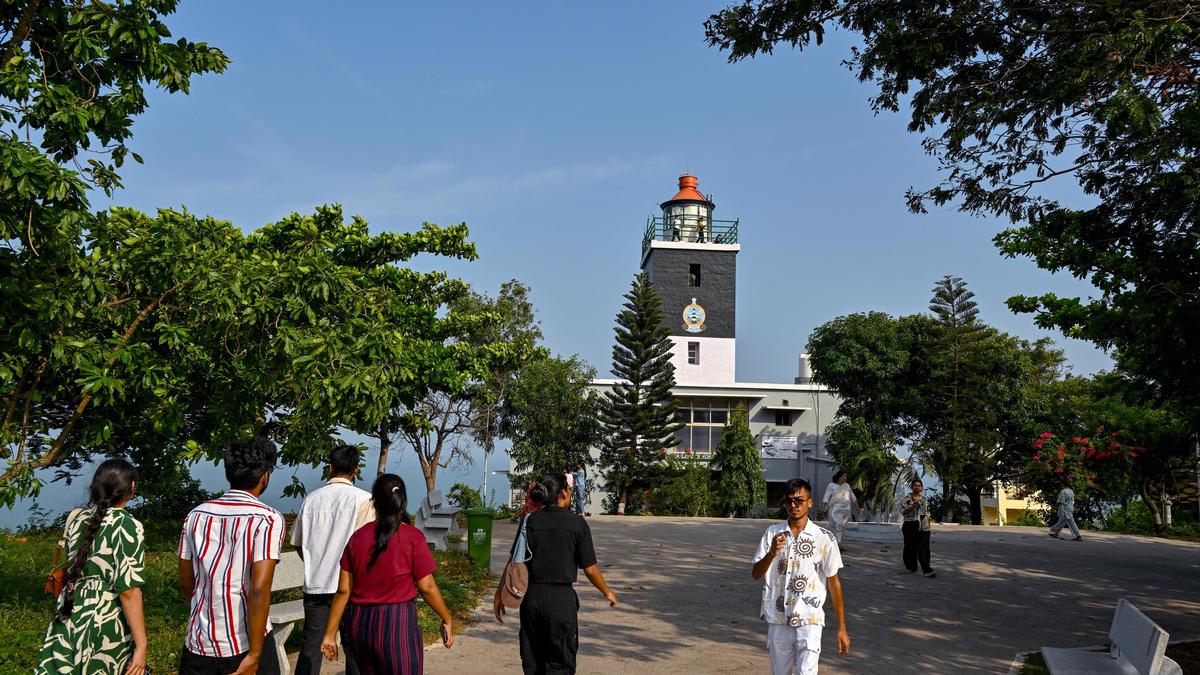
Tourists entering the Lighthouse on Dolphin Hill in Visakhapatnam on Friday, August 21, 20266. The Lighthouse operated by Directorate of Lighthouses and Lightships of Ministry of Shipping is open to public between 3 p.m. and 5 p.m.
| Photo Credit: KR DEEPAK
The road to Dolphin Hill changes the character of Visakhapatnam in a way. As I drove towards the lighthouse, the familiar city gradually gave way to stretches of hill, industrial installations and glimpses of the sea. The route towards Yarada Beach passes through an area where the presence of the Navy and the port is hard to miss, adding a sense of purpose to what otherwise feels like a leisurely drive.
I am here to visit the Dolphin’s Nose Lighthouse, perched on the hill top beside Yarada beach. The headland gets its name from its distinctive shape, which resembles a dolphin’s nose. The lighthouse stands high above the coast and remains an important navigational landmark for vessels approaching Visakhapatnam Port.
Inside the compound, the lighthouse appears fairly understated. A landscaped space surrounds the structure, providing a spot to sit before or after the climb. I make my way towards the tower and begin climbing the narrow staircase. With every turn, the outside world appears in brief glimpses through the openings. The higher I go, the more the view opens up.
A panoramic view of Visakhapatnam’s coastline from the Dolphin’s Nose Lighthouse on Friday, August 21, 2026. Operated by the Directorate of Lighthouses and Lightships under the Ministry of Ports, Shipping and Waterways, the lighthouse is open to visitors daily between 3 p.m. and 5 p.m., offering sweeping views of the city, harbour and the Bay of Bengal.
| Photo Credit:
KR DEEPAK
At the top, the scale of Visakhapatnam becomes apparent. The harbour stretches below me, with ships and port infrastructure occupying the seaward side. Beyond it, the Bay of Bengal extends towards the horizon, while the hills and the city spread across the other side. From this height, the port, coastline and city appear as one continuous landscape.
The breeze is stronger here, and I linger for a while simply taking in the view. The lighthouse offers a perspective of Visakhapatnam that is difficult to get from the city’s beaches or roads.
A light with a long history
The story of the lighthouse began well before the present tower. A display at the lighthouse records a flagstaff being erected on the fort in 1902 to raise storm warning signals. A light is subsequently placed on a 15-metre circular masonry tower near the flagstaff. In 1926, lighthouse expert Alan D. Stevenson examined Dolphin’s Nose as a possible location for a major lighthouse. Dolphin’s Nose was recommended because of its position overlooking the harbour entrance.
The first light at the present site came into operation in 1940. The present lighthouse was commissioned on June 15, 1957, and inaugurated by Lal Bahadur Shastri, who was then the Minister of Transport and Communications. The tower is a 19-metre square masonry structure painted in black and white bands. Its powerful beacon guides ships entering Visakhapatnam Port and has a luminous range of about 32 nautical miles.
The lighthouse is also more than a light tower. The information panel records a series of technological additions over the years. Radio beacon equipment from Japan became operational here in 1961. A solid-state version replaced it later and the station began transmitting Differential Global Positioning System corrections in 1998. Radar transponder equipment, Automatic Identification System technology and other modern aids to navigation were subsequently added.
The hill remembers more
Dolphin Hill carries a military history as well. The British Army used the hill as a military camp before Independence. The area is also associated with the Battle of Vizagapatam in 1804, when British and French forces clashed near the hill.
The visit is especially enjoyable for those who like to combine a little history with a view. The open space around the lighthouse makes it possible to slow down and spend some time here. Photography is another obvious draw, particularly from the higher levels where the harbour and coastline provide a wide backdrop. However, visitors should remember that Dolphin Hill lies in a security-sensitive area and follow the instructions given at the entry point.
The lighthouse works best as part of a half-day outing. I would combine it with Yarada Beach, which lies further along the same route. The two experiences are quite different: the lighthouse gives a high vantage point over the coast, while Yarada brings you down to the water.
Location: Dolphin’s Nose Lighthouse, Dolphin Hill, on the route to Yarada Beach
Visiting hours: 3pm to 5pm. The limited window is worth keeping in mind while planning the trip.
Entry fee: ₹10 per person
Published – September 08, 2026 10:14 am IST