The Department of Women and Child Development (WCD) has submitted a proposal to the Public Works Department (PWD) for an integrated 8-acre residential facility in Alipur to house at least 700 children in conflict with law (CCL) and asked the PWD to prepare a cost estimate.
A CCL is a person below the age of 18 who is alleged or found to have committed an offence.
The proposed facility in the north-west Delhi suburb has been envisioned as a modern residential unit with classrooms, skill development and vocational training centres, sports and recreational facilities, healthcare services, digital learning facilities and dedicated counselling spaces.
As per the WCD proposal, the integrated facility, which would house at least 700 children aged seven and above, would have 52 dormitories and 10 classrooms with digital facilities. “As per our estimate, around 175 people, including 28 educators and 14 psychologists and counsellors, would be needed to run it,” a WCD official said.
The official added, “The inmates will be enrolled in various skill development and diploma courses offered by the Delhi Institute of Hotel Management and Catering Technology.”
Chief Minister Rekha Gupta had announced such a facility during a speech in February. “It will not be a punitive institution but will rather be developed with the objective of providing a safe environment, a dignified life and opportunities for reform,” Ms. Gupta had said.
Comprehensive care
WCD Secretary Rashmi Singh said, “The proposed facility will have a dedicated mental health unit with qualified counsellors, psychologists and other mental health professionals to provide comprehensive psychosocial care and rehabilitation support.”
She added that the residents will be grouped by age (7-12, 13-15 and 16-18) and gender (male and female) to avoid conflicts and vulnerabilities.
To support the rehabilitation of the occupants, the WCD has partnered with the Khadi and Village Industries Commission to provide vocational training in air conditioner and refrigerator repair, pottery, papad and spice making, and signed an MoU with an NGO to promote adolescent development through structured sports and life skills programmes, as well as outreach activities.
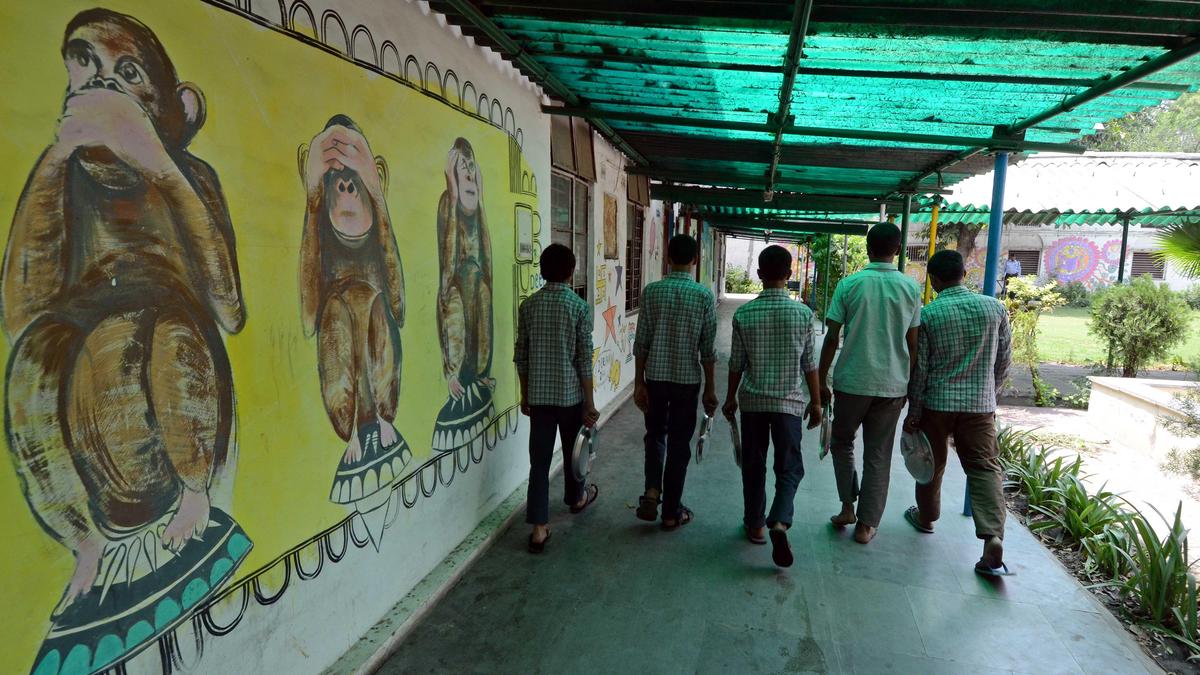
Currently, Delhi has five ‘observation homes’, two ‘places of safety’ and one ‘special home’ for CCL. These are located at Sewa Kutir Complex, Delhi Gate Complex, Majnu Ka Tila and Nirmal Chhaya Complex.
An observation home is a temporary residential facility where CCL are held while their case is heard before a Juvenile Justice Board (JJB). A special home is where juveniles who are found to have committed an offence are sent for rehabilitation and reform. A place of safety is where those aged 16 to 18 who are found to have committed heinous crimes are kept.
Significant challenges
People working with the children at these homes said such facilities face significant challenges. “Overcrowding is a challenge. There is a shortage of social workers, psychologists and educators. Psychological first aid and counselling services need to improve significantly,” said Ravi Kant, the national convener of Just Rights for Children that runs an Observation Home in Delhi.
Under the Juvenile Justice Rules, 2016, the prescribed staff strength is about 15 personnel, including a superintendent, a medical officer and a nurse, trained counsellors or psychologists, and other staff, including rehabilitation-cum-placement officers, educators, probation officers, child welfare officers, case workers and PT-cum-Yoga instructors.
“Due to staff shortage, the quality of care and counselling provided is basic. Moreover, the employees at such facilities are not sensitised or trained to deal with children who need special care, such as those facing trauma,” said Rita Singh, a former member of the Delhi Commission for Protection of Child Rights.
As per official data, Delhi has a Special Juvenile Police Unit in almost every district, with over 400 Child Welfare Police Officers serving at 225 police stations. The city also has nearly 800 Probation Officers.
Delhi has seven JJBs across seven districts. “The JJBs are overloaded with cases. With just seven JJBs in 11 districts, you can imagine how much time each child must be given,” Ms. Rita Singh said.
Published – August 03, 2026 09:10 pm IST