“Thirty Below: The Harrowing and Heroic Story of the First All-Women’s Ascent of Denali”
By Cassidy Randall; Abrams Press, 2025; 275 pages; $28.
In 1970, a team of six women climbed to the top of Denali — and, significantly, made it safely back down. This little-known expedition has finally been exceedingly well researched and told by author Cassidy Randall. For her examination of the women’s lives as well as the climb itself, Randall accessed notes and journals kept by the women, other records, interviews with the two living members of the team, and additional interviews with their children and other climbers.
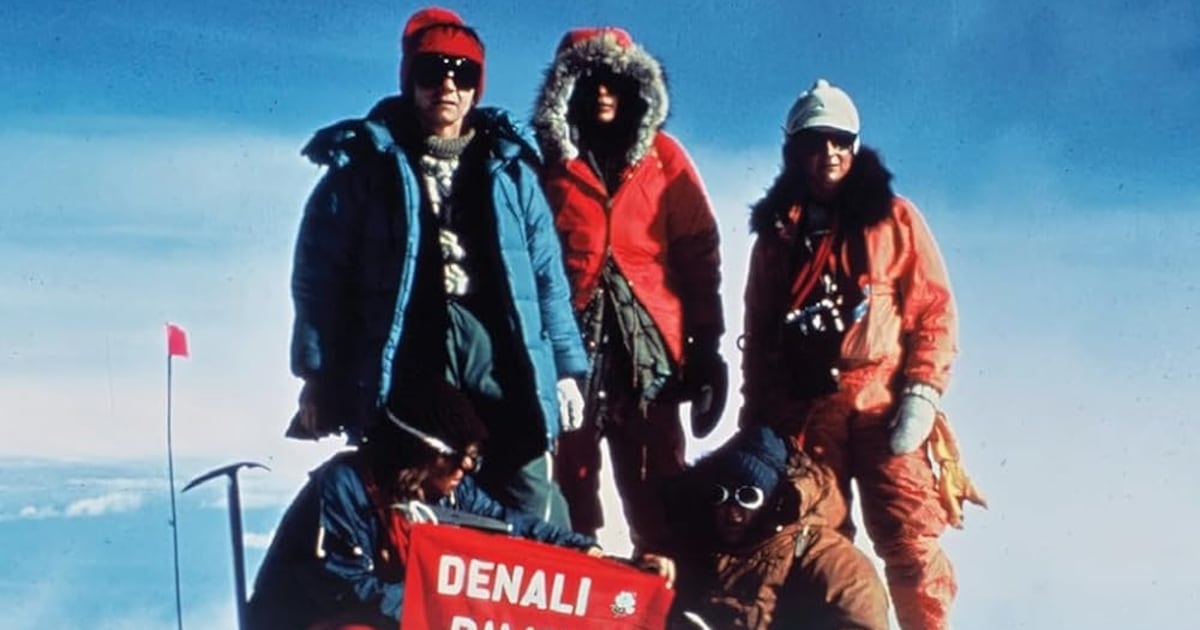
Grace Hoeman is likely a name known by many Alaskans. She and her husband Vin were prominent members of the Alaska climbing community in the 1960s. Vin died in an ice avalanche in the Himalayas in 1969. A medical doctor with two daughters, Grace had long battled for equal treatment in both society and the climbing world. After two failed attempts on Denali and being rejected from expeditions on other mountains, she determined to put together an all-women team to prove that women climbers could be just as capable as men. At the age of 48, Hoeman led the 1970 International McKinley Women’s Expedition in its successful climb up the West Buttress route. The team was also known as the Denali Damsels — a name the group chose for its ironic value.
The other women on the team, hailing from California, Australia, and New Zealand, were Arlene Blum, Dana Isherwood, Margaret Young, Faye Kerr, and Margaret Clark. They were all scientists or science students ranging in age from 24 to 37 and were chosen for their extensive climbing experience and expected compatibility. Blum and Clark, still living in 2025, cooperated with the author to tell the story.
Randall sets the stage with a chapter about a fateful Denali climb in 1967. As a member of the Mountaineering Club of Alaska expedition, Hoeman suffered from what was likely altitude sickness and backed off a summit attempt. Another team, the Wilcox expedition, was caught in a terrific storm on top and lost seven members — to date the biggest single tragedy in Denali’s history. Hoeman helped with the rescue and care of survivors. Her determination is put on display here, along with the author’s questioning of climbers’ reasons for risking their lives. Recent studies have identified a particular dopamine receptor gene as a driver for seeking adventure and taking risks.
A recurring theme throughout the book is the obstacles — in careers as well as climbing — that all the women encountered. For readers in 2025, it may be surprising — even shocking — to remember or learn the extent of discrimination that existed for women as recently as the 1960s. Women were not only barred from mountaineering clubs, where they were repeatedly told that they were too weak or emotional to participate. They also faced roadblocks from entering medical and science programs and to finding jobs in those fields.
Early chapters visit the backgrounds of all six women. Each life was remarkable in its own way, completely aside from impressive mountaineering feats. Hoeman grew up in Holland and attended medical school in Berlin during World War II. After her first husband was killed in combat, she escaped Germany with two small children. She contracted both a heart ailment and tuberculous, married and divorced a second husband, faced hiring discrimination from hospitals, and moved to Alaska to work at Providence Hospital. She began climbing mountains, first by herself and then with Vin.
Arlene Blum, who became the expedition’s deputy leader, was discouraged from sports as a child because they weren’t “ladylike,” but eventually began climbing in the Pacific Northwest and studied volcanic gases as a way to work in the mountains. She became the sole woman in graduate chemistry studies at MIT before transferring to Berkeley and continuing to climb in the West and Alaska.
Others fought against discrimination, rejected the “masculine” language of assaulting and conquering peaks, and found partners with whom to climb and share their lives. They repeatedly proved themselves against men who said things like, “Women either aren’t good climbers or they aren’t real women” — as Blum was told by a male guide.
Although none of the women approached the Denali climb as a “women’s liberation” cause, they all knew that failure was not an option. Sure, women had climbed Denali — Barbara Washburn was the first, 20 years earlier, with her husband — but the narrative had always been that men did the hauling and leading while women were less than equal partners. For the Denali Damsels, failure would just prove to their doubters that they weren’t as capable as men.
The expedition could so easily not have happened. In the lead-up months, Blum suffered a spiral leg fracture in a skiing accident, Margaret Clark was involved in a dramatic rescue and then diagnosed with multiple sclerosis, Hoeman had sinus surgery, Margaret Young fell a thousand feet down a mountain, and all of them dealt with traumas related to climbing accidents and deaths. In addition, fundraising for the expedition was a major challenge, and the logistics for getting to and spending three weeks on the mountain were daunting. One help to fundraising came from the Institute of Arctic Biology at UAF, which paid stipends to the women to participate in a program of high-altitude physiology and psychology studies they were conducting for the U.S. Army. The author notes that she tried diligently to learn the results of the studies, but even a Freedom of Information Act request went unanswered.
The second half of the book covers the expedition’s final preparations and then the climb itself, day by day beginning on June 22. While there’s nothing dull in the first 137 pages, the drama rachets up in what amounts to a nearly step-by-slow-step account of the team’s progress up the mountain. Armchair adventurers will get their money’s worth of learning what high-altitude, cold-temperature, avalanche-prone, and gale-force-wind conditions feel like and how they affect bodies, brains, and life-and-death dependencies. The high-drama of the descent makes for edge-of-the-seat reading.
Finally, an epilogue follows the six women in later years, when they continued to climb. Tragically, Hoeman died the following year in an avalanche on Eklutna Glacier. Margaret Young was paralyzed in 1977 when thrown by a horse; she went on to study solar energy, design solar heating systems, and serve on a National Science Foundation panel before dying of colon cancer in 1979.
Faye Kerr died of a perforated ulcer while trekking in India in 1980. Dana Isherwood became an expert in radioactivity and, as a congressional science fellow, advised Congress about environmental and health effects of building nuclear weapons — while continuing with major expeditions throughout the world; she died of breast cancer in 2021. Margaret Clark finally learned that her multiple sclerosis diagnosis was in error and is still living in New Zealand. Arlene Blum, founder and director of the Green Science Policy Institute, still hikes around the Berkeley Hills; she is the author of “Breaking Trail: A Climbing Life” and “Annapurna: A Woman’s Place.”
[Book review: What one sees, and learns, managing Denali’s Kahiltna Glacier basecamp over the years]
[Enlivening Knud Rasmussen’s explorations, author Kenn Harper focuses on the quest for knowledge]
[Book review: ‘Alaskan Woman Biologist’ navigates professional peril and makes scientific strides]
[Book review: An experienced Arctic adventurer returns to a changed landscape]