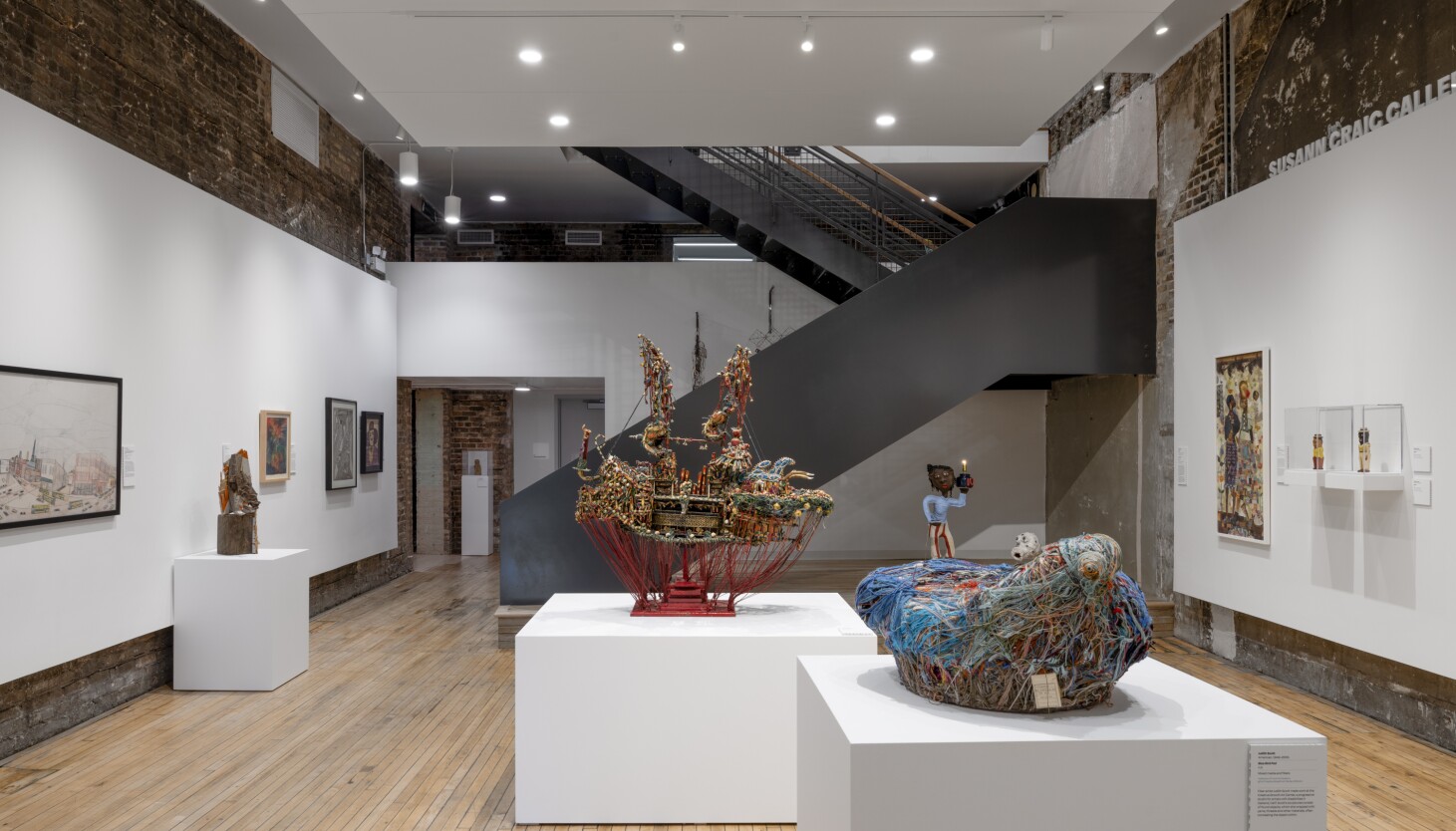
When the Intuit Art Museum announced its reopening Friday following an $11.5 million renovation and expansion, an immediate question arose: Would the institution still have the rough, unpretentious feel that gave it character and made it seem comfortable and welcoming? Or would it be turned into just another sleek, white-walled exhibition space?
I’m happy to report that while the West Town museum has tripled in size, with about 12,000 square feet of exhibition space and enhanced lighting and other improvements, the architectural heart and soul of its two main, interconnected 1874 and 1875 manufacturing buildings remains intact.
The 34-year-old museum, formerly known as Intuit: The Center for Intuitive and Outsider Art, was already one of the most respected institutions devoted to self-taught or outsider art in the United States, and its profile should get a major boost from this impressive makeover.
Intuit now boast features that it never had before, including a room devoted to its gift shop and entry, an educational and art-making studio, and a first-floor, centerpiece gallery housing rotating displays from its permanent collection of 1,500 to 1,600 objects.
Indeed, one of the pleasures of this reimagined museum is walking through the shop into this prominent new gallery and encountering 25 highlights from Intuit’s holdings — works that were only sporadically seen previously as part of special exhibitions.
“Catalyst: Im/migration and Self-Taught Art in Chicago,” is now on display at the Intuit Art Museum.
On view are some genuine treasures, none more eye-grabbing than an exuberant relief painting, “The Statue of Liberty” (1986) by William Hawkins, a renowned folk artist who lived most of his life in Ohio. At the center of a swirl of images of New York buildings, an Air France jet and a British sailing ship is a partly painted, partly sculpted depiction of the famed statue capped with a small American flag jutting above the top edge of the composition.
Other works in this inaugural permanent collection display include “Yes, We Will Find Peace, My Sister” (2024), a stunningly intricate 4-by-2-foot collage on Masonite by Milwaukee-based Della Wells, and Kevin Sampson’s “Port Wine Stains” (2007), a 4-foot-tall, found-object sculpture of a sailing ship that dominates the center of the room.
Exit surveys have shown that nearly 50% of Intuit’s visitors come to see the museum’s re-creation of the one-room Lincoln Park apartment and studio of Henry Darger, a hospital custodian who has become a superstar in the world of outsider art since his death in 1973.
The recreation of the one-room Lincoln Park apartment and studio of Henry Darger is permanently on display at the Intuit Art Museum.
Darger is best known for his epic 15,145-page unpublished novel, which tells the epic story of the Vivian Girls, seven young princesses from the Christian nation of Abbieannia. The arresting and highly inventive illustrations that accompany it combine tracings with freehand drawing.
In 2000, Darger’s former landlords, Nathan and Kiyoko Lerner, donated the contents of Darger’s living and working space to the museum, including architectural elements, furnishings like a dresser, table and typewriter, as well as clippings and other source material for his art.
“Catalyst: Im/migration and Self-Taught Art in Chicago,” is now on display at the Intuit Art Museum.
Another big question surrounding Intuit’s renovation was how it would treat the Darger room, and, again, the museum has come through in a highly satisfying way. Visitors first enter a new Darger gallery on the first floor that will offer rotating presentations of works by him.
After getting a taste of his artistry, visitors then descend a stairwell that takes them directly and dramatically into the relocated room on the basement level — its isolation giving it a fittingly special, meditative feel.
About 75% the size of Darger’s original dwelling, this reinstalled, semi-immersive space is larger and more representative than the earlier version tucked to the side of the museum’s former rear gallery. Two of the walls are adorned with mural-size 1970s photos of the artist’s room by Michael Baruch that add to the ambience, and in 2022, Kiyoko contributed a small stained-glass window from Darger’s space that she had kept, and it now has pride of place in this new presentation.
Carlos Barberena, active in the United States, and born in Granada, Nicaragua, 1972. “Riding the Beast,” from the “Rostros de la Migración” series, 2012. Linocut on Graphic Chemical heavyweight paper, edition of 30, 16 x 15 inches.
Rounding out the opening art offerings is “Catalyst: Im/migration and Self-Taught Art in Chicago,” which is billed as the first major exhibition to look at issues surrounding migration and immigration in outsider art. More than 90 paintings, sculptures, original prints and mixed-media works are featured in the museum’s new second-floor galleries — all by 22 Chicago artists, 14 of whom have never before been shown at Intuit.
Highlights include “Untitled” (ca. 1947), a limestone relief carving by Marion Perkins, who moved to Chicago in 1916 as part of the Great Migration; Genya “Jennie” Siporin’s “Yoshke Goes Away” (1937), a Marc Chagall-like watercolor based on a Yiddish folk song, and Nicaraguan-born Carlos Barberena, who carries on the rich tradition of Latin American printmaking with his blunt, sociopolitically charged linocut “Riding the Beast” (2012).
Genya “Jennie” Siporin, American, born Łódź, Russia (now Poland), 1891-1973. Yoshke Goes Away, 1937. Watercolor, 28 1/4 x 22 1/4 in. Collection of Rachel Siporin.
The future of the Intuit Art Museum was largely determined in 2016, when the second level of the main buildings it occupies became for sale, and Debra Kerr, Intuit’s president and chief executive officer, and other museum leaders had to decide whether to buy it or look for another building if they wanted to expand. They opted for the former.
While a new building would offer certain obvious advantages, the leadership liked this location’s proximity to downtown and its accessibility to public transportation. Plus, the space had a quirky, lived-in feel that seemed to fit the kind of art the museum shows.
The Intuit Art Museum is located at 756 N. Milwaukee Ave. in the West Town neighborhood.
Tyler Pasciak LaRiviere/Sun-Times
A comprehensive refurbishment was discussed, but nothing got serious until 2022 when the museum applied for and received a $5 million community development grant from the city of Chicago as part of then-Mayor Lori Lightfoot’s COVID-19-related Chicago Recovery Plan.
To obtain the grant, the museum had to fast-track a design, and it turned to Doyle & Associates, a Chicago architectural firm that specializes in adaptive reuse of existing buildings. (Steve Thompson, Kerr’s husband, had worked with the architects at the Lincoln Park Zoo, where he served as senior vice president from 1988-2019.) The museum closed in September 2023 for the reconstruction.
William Hawkins, (American, 1895-1990). “The Statue of Liberty,” 1986. Painting, collage, enamel and found object on plywood, 73 x 84 1/4 x 5 3/4 in. Collection of Intuit Art Museum, gift of Lael and Eugenie Johnson, 2004.37.1. © Estate of William Hawkins, courtesy of Ricco/Maresca Gallery.
Doyle got this new design just right. While there are plenty of upgrades like white wall panels to appropriately display the art, the original, indented wood floors on the first floor remain, and the brick and concrete walls, with their worn, overlapping layers of paint and often uneven surfaces are still visible and give the rooms edginess and personality.
At the same time, the architects came up with smart connections — what Kerr calls “adjacencies” — between rooms and imaginative ways to maximize limited space, like expanding the once-cramped mezzanine between the two main floors and adding a handsome new open-air stairway in the middle of the building that is both utilitarian and a striking architectural feature.
This highly successful renovation and expansion allows Intuit to show more art than ever before, reaffirms its values as an institution and goes far in enhancing its place as one of the city’s essential visual art institutions.