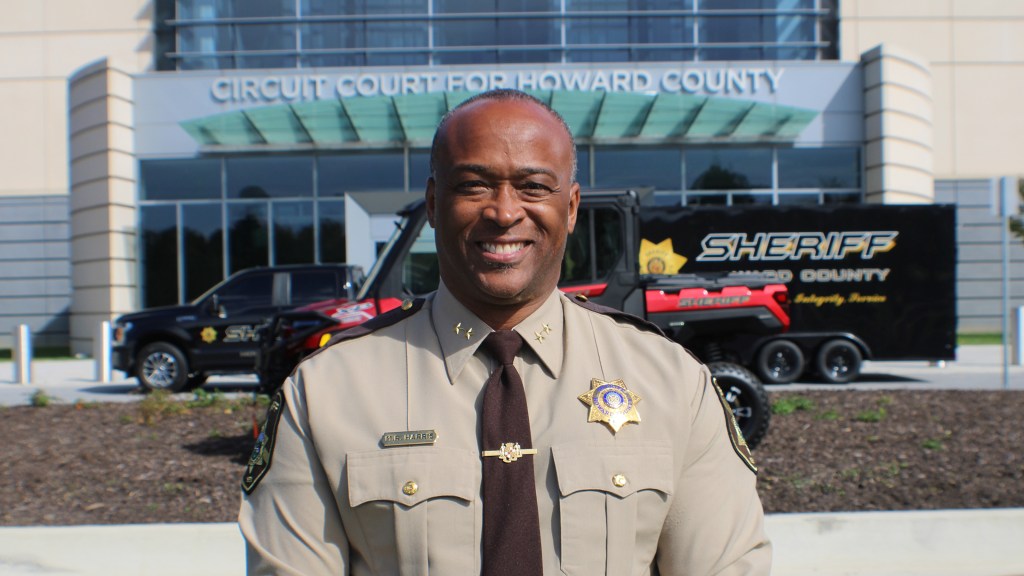
Sheriff Marcus Harris has filed to run for reelection because he doesn’t think his work in Howard County is finished.
A native of Havre de Grace, Harris, 56, has a degree in sociology from the University of Maryland, College Park. He has lived in Ellicott City with his family for the past two decades.
Harris is the first Black sheriff in Howard’s history, first elected in 2018 and reelected in 2022 with more than 60% of votes cast.
Before his work in Howard County, he was a police detective in Baltimore County for 15 years; he left in 2008 when he tore his quadriceps off his kneecap chasing a suspect. He then opened a home health care business and launched a private security company before winning the sheriff’s post in 2018.
The sheriff’s office provides courthouse security and prisoner transportation, handles domestic abuse cases, conducts patrols and serves warrants. As its leader, Harris oversees 75 sworn deputies and 22 civilian staff. The sheriff’s annual salary is $171,263, according to Meaghan McKelvey, an administrative analyst in the sheriff’s office.
Harris does not yet have any opponents in the 2026 race.
This interview has been edited for brevity and clarity.
This would be your third term in office. Why are you running again?
I think most importantly is the support I’ve received from the people, the deputies here at the sheriff’s office, the support staff here at the sheriff’s office. … The first time in 2018, I didn’t have the support of the sheriff’s office, but then when I ran again, in 2022, they actually endorsed me two years early prior to that election. We have the [Fraternal Order of Police] — which is basically our union. They’ve endorsed me early, two times in a row now, which tells me that they like the job I’m doing. And the community, you know, I’ve received a few awards from the community. In 2021, I was voted one of the top best police officers in the county, and then also in 2024. I’ve received several awards since my time in this position. So I feel like I’m doing a good job, and I think the support that I’m receiving from the community and my office would say that. … We’re [also] going through the [Commission on Accreditation for Law Enforcement Agencies]. That’s so that we can become an accredited agency, and that allows oversight on our policies and how we do things here. It’s called CALEA, and that’s a two- to four-year process, and we’re only halfway through that process. So [I] definitely wanted to run again to make sure we get across the finish line with becoming an accredited agency.
What challenges were you seeing when you first started in office, and how have you addressed them?
One of the things we’ve really had to work on was changing the culture. When I took over in 2018, I didn’t feel like we were functioning as a law enforcement agency. I felt we were more like a security guard company. … So I had to change the culture and then work extremely hard on educating the community, on what it is we actually do here at the sheriff’s office. … And then we had to work on things like equipment. We needed to modernize this office. … I didn’t feel like we had all the tools that we needed, all the equipment that we needed. … We have some great county partners who have helped us to modernize this office — [including] our partnership with the Howard County Police Department. We have a partnership with the U.S. Marshals and the [state’s attorney’s office] now. Those were some of the types of things we needed to do to modernize the office and get us to the point we’re at now.
You’re an advocate for community outreach. Do you think you’ve strengthened those connections? How do you hope to continue to do so?
I feel like we’ve definitely strengthened those. When I took over in 2018, we actually did not have a community outreach unit, so now I have a community outreach unit. We’ve definitely strengthened it. From doing food banks to creating a [memorandum of understanding] with the Howard County school system; we’ve adopted Thunder Hill Elementary as one of our schools. … We raised money to supply book bags to students that are less fortunate. We actually have a great community outreach unit now. … One of the reasons I ran in 2018 was because I knew by becoming an elected official it gave me a platform. And we’ve been able to use that platform to do great things in the community.
What have been your biggest accomplishments as sheriff?
One of the things we had to do was be able to hire. Working with the county, we were able to enhance our benefits package to attract qualified applicants. … I think when I took over in 2018 we had approximately 52 deputies. Now we have 74. We’ve increased our support staff number — we’re right around 100 employees now. Howard County does nothing but grow every year, and what I found when we took over, we weren’t keeping up with that growth. So by enhancing the benefit package and being able to bring in more qualified people, we were able to increase our strength in numbers. The next [thing] I would say is we have [a] strong relationship with our county partners. I feel that that was extremely important. Most people don’t realize that the sheriff’s office is a state agency, and the Howard County Police Department is a county agency. So we are partners with the county executive. So it was important for me. I didn’t feel like when I took over in ’18 we had a strong partnership with the county and now we do. I would also say enhanced training. … And then also … going through this process with CALEA — I just think that’s extremely important.
What efforts are you taking to address the problem of youth violence to ensure community safety and deter young people from crime? What do you see as the root cause of it?
When I say community outreach and youth engagement, that’s what we’re looking to do. We have several programs out here in the county that I advocate for. I think the county executive has programs that he’s put in place. … [The] Howard County Sheriff’s Office [tries] to support [youth-focused] nonprofits. We simply try to be involved as much as possible. And we’re needed. I think that we have to basically provide things for our youth to do. I think that we need to try to listen to what their issues are and their problems are, and let them know that we are here. And not try to tell them what their problems are, but really listen to what their problems are. I think that’s important. We have to have the programs and places for these kids to go to where they feel they can be themselves. I think that we are working hard to provide the things that I’m talking about here in our county. I think we’re working extremely hard to figure out the issue. And I also want to make it clear I don’t have all of the answers, so I tend to do a lot of listening and try to help where I can.
Are there any other specific issues that you think still need to be addressed in the county?
That question can be difficult because we’re not the primary law enforcement agency. We’re the secondary. One thing we have increased is our traffic. If we see something, if you listen to the state’s attorney talk, he’ll talk about [how] we have a big problem with road rage. … We have increased the number of traffic stops we do. That’s a real problem. We have to make sure people know what it is we are able to do here in Howard County. A lot of people didn’t know we could do traffic stops, right? So one of the things we’ve also done is we’ve increased the number of traffic stops we’ve done, and hopefully that will help with the road rage situation.
What do you think is the balance between having a community presence and overpolicing?
It’s a tough balance. Because we do have a job to do. But I think the balance is not hard. I think that we have to treat everyone fairly. And we’re the professionals, right? So we have to be very good at … attempting to de-escalate — to not make a situation worse. The other side, we have to prove to [the] community that we are here for them. Because we don’t just only get called when we have to lock someone up. People need help. If there’s a car accident, we show up and we try to save people. So for me, it’s not overly tough. We have to treat people fairly. Let them know that we’re here for them, and when I say treat them fairly, we have to prove to them also that we’re going to treat them fairly. One thing I like about body-worn cameras is film doesn’t lie, right? We all went to body-worn cameras a few years ago, which I was extremely supportive of and happy that we were able to go to body-worn cameras. We didn’t have to have body-worn cameras until 2025, but our county executive got us in body-worn cameras at the same time that the [police department] went to body-worn cameras. I think if we do our job properly, everything else falls into place. So as you know, I’m big on community outreach. And that’s being supportive of the community and proving to everyone that we’re going to do our job properly and fairly. And I think if you have those two things, that’s the balance. I think we get the community support. That’s why community outreach is so important, right? You get to see us, you get to know us, you get to talk to us. It’s just not when times are bad.
What has been your biggest lesson while in this position, and how did you grow from it? How will you take that experience into a new term?
I love my job. In this position, because it’s an elected position, it gives me a platform. And I think I said this earlier, but I didn’t know how big of a platform it would give me, and because of the platform, we’ve been able to do some really good things. I would say that I’ve grown, and I think the platform has been more than I expected it to be. I feel that I’m able to go to my partners and get things done. I had to become educated in this political piece. It’s my first stint at it. I never thought I would be doing a political thing, and for me, it’s been a very positive experience. A lot of times we only hear about the bad side of politics, but here in Howard County, I feel like we have a lot of people that care, that I work with. I won’t say it was surprising to me, but it was very refreshing to know that a lot of people really do care. I have a good team around me. I listen to their input. Obviously, I have to make the decisions. Going into the next term, we’ve already sat down to decide on what direction we want to go in, some of the things we need to accomplish [and] how are we able to grow as an agency. The experience that I have now, I feel like when you first start something that you’ve never done, it’s like you’re a little nervous and you don’t know how things are going to turn out, or if you’re going to have the support. Now, I feel like I have the support of the county partners, and I have the support of my team here at the sheriff’s office. So for us, I think sky’s the limit. I’m pretty excited about the next term. I think we continue to create something here that’s better than I thought it would be, and I’m just looking forward to continuing the work that we’ve done — making it better.
Have a news tip? Contact April Santana at asantana@baltsun.com or at 443-834-7525.