The harbor’s status as a public asset is at odds with the state’s long-term goals for private management boating facilities.
The harbor’s status as a public asset is at odds with the state’s long-term goals for private management boating facilities.
Cory Lum/Civil Beat/2018
A major rate hike for users of Hawaiʻi’s small boat harbors in 2019 was touted as an overdue adjustment that would ensure boat owners paid fair-use fees and fund critical maintenance projects.
Everyone – except many boat owners – seemed to be behind the rise.
The revenue would reduce taxpayer subsidies of a lifestyle enjoyed by a relative few, supporters said, and chip away at an estimated $300 million harbor repair backlog inherited by the Division of Boating and Ocean Recreation when it was established in 1991.
Six years later, some improvements have been made including dock repair and removal, sidewalk repairs, fencing and electrical upgrades at Ala Wai Small Boat Harbor, the state’s largest.
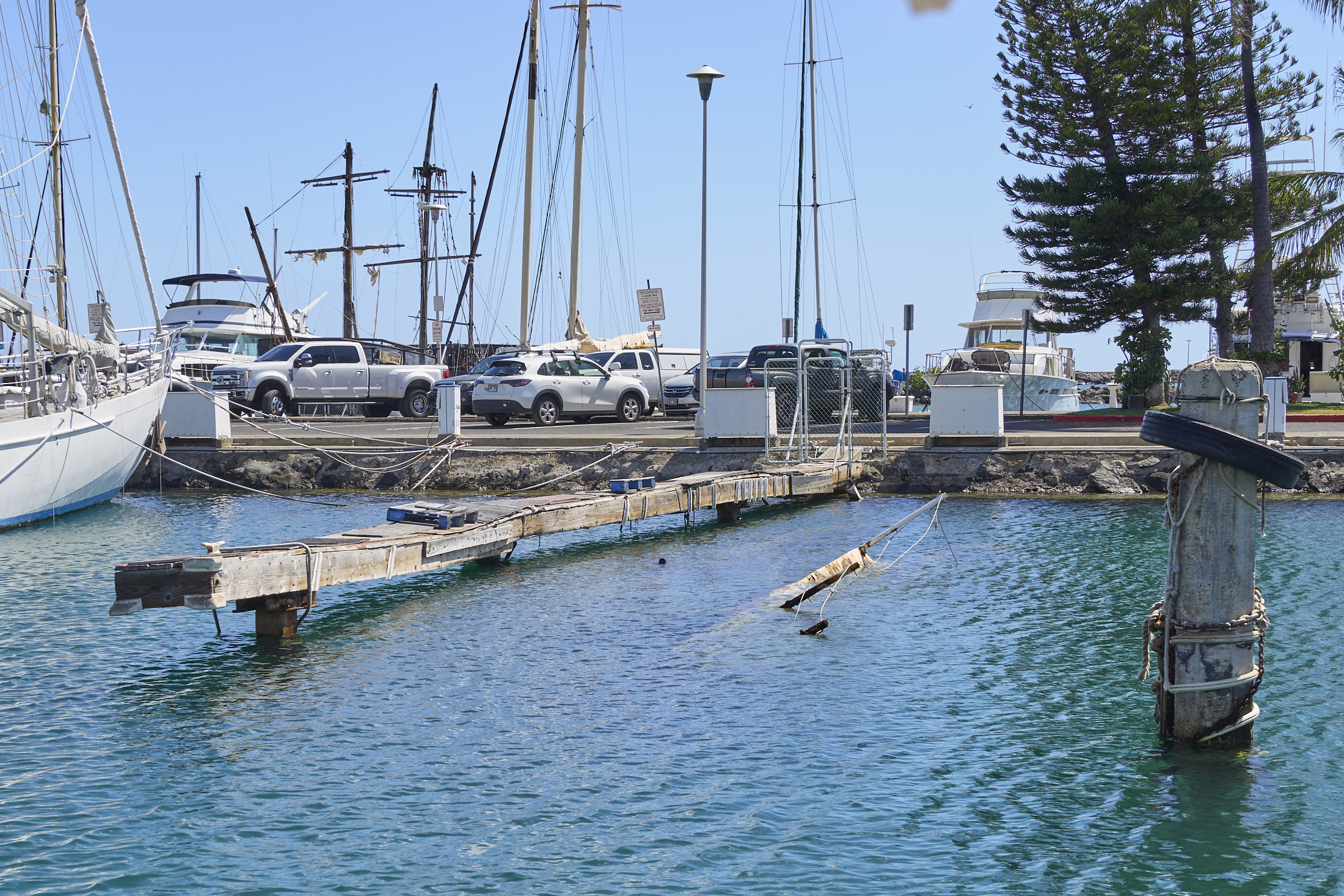
But a recent waterborne tour also showed many problems remain, including numerous derelict harbor slips, an unrecovered wreck that sank in 2022, overflow parking where the harbor’s fuel dock and boat repair slip used to be, and law enforcement officers occupying what used to be the harbor’s general store.
An 80-foot boat that sank in 2022 has still not been salvaged. The slips next to the wreck are scheduled for repair under a new capital improvement project. (David Croxford/Civil Beat/2025)
Commercial dive boats blared dance music, a handful of decrepit party boats were moored and listing, and parking lots were pockmarked. The two public boat ramps there are sinking, and will soon be replaced.
So, work has been done at Ala Wai, but the report card is decidedly mixed.
A Cash Cow
In legislative testimony in February, Department of Land and Natural Resources Chair Dawn Chang said the department has worked to decrease deferred maintenance but remains hampered by underfunding.
For that reason, DLNR “strongly supported” a pair of bills this session that would have given the Board of Land and Natural Resources the power to “lease the Ala Wai small boat harbor in its entirety.” The 20-year pilot would sunset in 2045.
The department’s interest in private management models is reinforced by looking at its latest balance sheet that shows $1.1 million in net income losses for the third quarter of the 2025 fiscal year for the harbors division. Many of those losses show up in the balances of the stateʻs 50 small boat harbors and ramps.
Ala Wai harbor has historically been a cash cow generating an average of $2.6 million in net income for the Ala Wai Boating Special Fund. Those funds can’t just be spent at Ala Wai, but also subsidize the loss-making harbors elsewhere in the state.
While plans for private management of the harbor go back decades, opposition against the plan also remains strong.
Numerous testifiers described the latest attempt for an Ala Wai private management plan as a challenge to the constitutional public trust doctrine that presumes the state has an obligation to “protect, control and regulate the use of Hawaii’s water resources for the benefit of its people.”
Testimony for the environmental group Hawai’s Thousand Friends, summed up the concerns: “Privatization of this public trust resource without public oversight could lead to lack of affordable vehicle access, exclusionary slip launch ramp fees, and lack of public access.”
The bills died in committee.
Revenue and expenses data from the Division of Boating and Ocean Recreation for 2011-2022 show an uptick in repairs and maintenance at Ala Wai in 2020, the year after the slip fee increase. That year DOBOR spent $550,000, more than twice the average. But by 2022 the division was back to the annual average of $230,000 and since then revenues have essentially remained flat.
Infrastructure Woes
A review of capital improvement projects based on state procurement data shows $3.2 million in contracts for work at the harbor have been issued in the past five years. Half of that was spent on improving water systems serving the 699 slips and other services.
A $6.2 million pending contract posted at the end of April for repairs to two dozen piers would be the largest investment in eight years.
Ala Wai boaters who spoke to Civil Beat say DOBOR has underinvested in the infrastructure there.
“The boating support facilities that were closed down 15 years ago still haven’t been replaced, and yet our slip fees were literally doubled in 2019,” said Kate Thompson who has rented slips at Ala Wai for 27 years. She questioned why the department couldn’t just work on a limited three- to five-year improvement plan for Ala Wai harbor.
Division of Conservation and Resources Enforcement staff now occupy the site of the former Ala Harbor general store. (David Croxford/Civil Beat/2025)
Sen. Sharon Moriwaki, whose district covers Ala Wai, said she plans next session to reintroduce the failed legislation to overhaul the management of the Honolulu harbor. She said the plan was “not privatization. It’s a private lease management program. So, the state still controls the land.” Lessees also would be required to provide yearly reports to the Legislature.
Legislation passed in 2001 allowed the Board of Land and Natural Resources to issue leases for all the state’s small harbors and boating facilities including Ala Wai, subject to the approval of the governor and Legislature.
That was meant to open the door to public-private partnerships that enable state agencies to access private sector expertise while still retaining regulatory authority.
But one of the early attempts at Ala Wai was a spectacular belly flop.
The “Waikiki Landing” project on the three acres used for boat repairs and a fuel dock were supposed to be replaced with retail and office space, restaurants and wedding chapels. But the project floundered over financing in 2015 and was shelved.
One lasting result, Thompson said, is that boaters at Ala Wai still have to refill their fuel tanks at Keʻehi Marine Center, 5 miles away. That’s also the closest dry dock.
The site of the failed “Waikiki Landing” development a decade after the project was shelved. The site used to house a fuel dock and boat haul-out facilities but is now used for overflow parking. (David Croxford/Civil Beat/2025)
The Push For PPP
Despite that inauspicious start DOBOR doubled down on the public-private partnership model in its 2019 Strategic Management Plan: “public-private partnerships hold the key to a strategic redesign that enables harbors to operate at their maximum potential while staff engage in managing ocean recreation.”
Chang didn’t respond to a request for an interview. In her legislative testimony in February, the DLNR director Chang said four boating facilities on Oʻahu are already managed under public-private partnerships: the Waikīkī and Hawai’i yacht clubs at Ala Wai harbor, the La Mariana Sailing Club and Keʻehi Marine Center.
The lease rental agreement between DOBOR and Ke’ehi Marine Inc. generates $777,750 annually and DOBOR earns $420,000 a year in rent from its lease with the Hawaiʻi Yacht Club. DLNR did not respond to a request for additional information about the current lease terms.
But Chang testified that she considered another small harbor at Kewalo Basin the “prime example of a State-owned harbor under a P3 management model.” That one is managed by Howard Hughes Corp. for the Hawaiʻi Community Development Authority under a 35-year lease with an option to extend for another 10 years.
The deal involved $550,000 up front and annual rents estimated to be worth $14.4 million over 30 years. The corporation would also carry out repairs at the cost of $20 million.
Kewalo Basin Harbor is managed by the Howard Hughes Corp. in a lease with the Hawaiʻi Community Development Authority. DLNR says a similar model could be used for the Ala Wai small boat harbor. (David Croxford/Civil Beat/2025)
The End Of The Liveaboard Lifestyle
The increase in slip fees in 2019 took the base rental slip rate at Ala Wai and Keʻehi from $6.50 a foot to $13 a foot based on an evaluation by CBRE that boat owners say to this day was deeply flawed.
Around the same time DOBOR stopped issuing liveboard permits for those harbors and never restarted. The department said via email it was only renewing existing legal permits which indicates that the liveaboard era on Oʻahu will eventually draw to a close.
Scott Allen hangs on as one of the dwindling legal liveaboard residents and has had a slip at Keʻehi since 2015. He also lived on a boat at Ala Wai harbor for three years before that, has a background in urban planning and works as economic planner for the state.
Dwindling Houseboats: The Boat People Of Ala Wai Fear They’re Getting Forced Out
Allen said the fee hike and the ban on new permits cut the number of boat owners who use Keʻehi in half. It has more than 200 moorings. Legal liveaboards at Ala Wai have dropped to around 40 from the maximum 125 permitted after the state stopped issuing new permits in 2019.
Allen says overall there has been a lack of public consultation by DOBOR and he has submitted testimony in several sessions opposing the privatized management of state boat harbors.
He said that recreational users at Keʻehi Marine are still dealing with the impact of the 2011 tsunami that took out one of the docks at the La Mariana Sailing Club. When it rains the car park is under two foot of water, the harbor toilets close early and all the facilities that harbor users pay their slip fees for are in poor repair, he said.
It’s unclear what impact the private management of Ala Wai would have on the smaller loss-making harbors elsewhere in the state. In its 2019 action plan the department said it was aiming to have “a rigorously evaluated, robust public-private partnership-based management system across all harbors under its jurisdiction” by this year.
While that goal remains a pipe dream, the emphasis on private lease management ignores other solutions that could be more appropriate for Ala Wai and the state, Allen said.
“While I think many harbor users would welcome better management, there are ways that can be achieved within the public domain,” he said Thursday.
Keʻehi Boat Harbor, 5 miles from Waikīkī\, has the closest fuel depot and dry dock for boat owners who use the Ala Wai Small Boat Harbor. Ala Wai has been without those facilities since 2009. (Cory Lum/Civil Beat/2021)
Those include more selective leases for specific services like fuel, using community-based public-private partnerships that include a permanent citizen advisory council or, a publicly managed model like the one in place at the Port of Seattle.
That’s a self-funding public commission that collaborates with the City of Seattle, King County and Washington state agencies on regulatory and development matters, with commissioners who are elected for five-year terms.
And if an example of public interest in the future of the harbor was needed, a plan to reduce the amount of free parking at the harbor in 2023 united a large coalition of surfers, swimmers boaters, local residents and others around the need for public access. 300 free spaces ended up being retained around the Ala Moana Bowls.
This ongoing series explores where Hawai‘i’s economy is headed and whether it can grow beyond tourism.
Asked whether private management would enable a few developers to gain a permanent foothold in a valuable public asset, Moriwaki said she was confident in DLNR’s commitment to protecting public resources.
But Thompson expressed concern that the length of private management leases – which can run up to 55 years or more – could leave a few companies with contracts that last beyond the oversight of the lawmakers and agency staff working today and therefore could pose a threat to public access.
“Basically the corporations will over time move more and more into thinking they ‘own’ the place and lose their commitment to the public serving portion,” she said. “It’s like a reverse mortgage. Nothing will be left for the next generation.”
Hawaiʻi’s Changing Economy” is supported by a grant from the Hawaiʻi Community Foundation as part of its work to build equity for all through the CHANGE Framework.