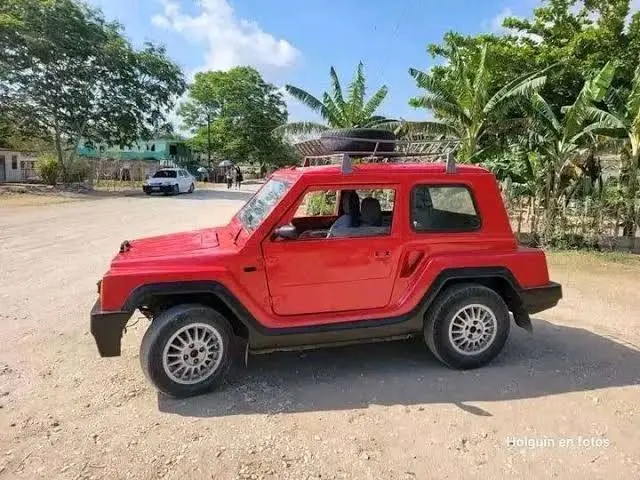
A made in Cuba Montuno vehicle.
By Angry GenXer
HAVANA TIMES – Few remain, and little is known about them: there is hardly any information on the Internet. Few people remember their existence. Their technical specifications remain a mystery even to many automotive experts.
I saw a Montuno jeep in front of the Museum of the Revolution (formerly the Presidential Palace) and was overcome by a strange nostalgia.
Younger generations, and many members of older ones, probably do not even know about this brand of automobile, the only light vehicle designed and produced in Cuba: Montuno, a name taken from a popular variation of the Cuban musical genre known as Son. The word Montuno also refers to the wilderness: a wild and mystical space associated with magic of African origin, Cuban rural folklore, and Cuba’s struggles for freedom.
There are still a small number of Montuno’s visible in Cuba.
Cuba’s Only Light Vehicle Was Designed and Produced in the 1980s
The Montuno was intended precisely to become an affordable vehicle for traveling between the countryside and the city. It was marketed as a jeep-style, all-terrain vehicle. Its origins remain hidden in some ministerial archive.
It is not known exactly how many units rolled out of the gates of the Narciso Lopez factory in Havana, but production began in July 1983 and apparently continued until 1989.
The owners of Montunos still on the road know they are behind the wheel of an exclusive relic: these vehicles are a genuine rarity. Their maximum speed is 115 km/h (71 mph). They resemble a somewhat flattened Willys jeep sitting low to the ground, with a fiberglass body and a VW Beetle engine imported from Mexico. Other parts came from the socialist bloc. The design and mechanics, however, were not copied from any other automobile. Moreover, by that time it was already common for cars from practically any country to contain imported parts.
The design was Cuban, and the vehicle was proudly proclaimed to be “Made in Cuba.” Apparently, several versions existed, with or without doors, or with a convertible top.
Little information is available about other technical specifications or how many Montunos are still in circulation. From time to time, I am lucky enough to see one. Almost all are red, and some have been modified to suit their owners’ tastes.
It is said that before 1959, some United States-brand automobiles were assembled in Cuba, but these were isolated cases involving preexisting designs; there was no mass production. Since 1959, Cuba has industrially assembled substantial numbers of heavy vehicles (buses and trucks) using imported parts, but their designs were generally replicas of prototypes from the socialist bloc, Spain, and later Russia. Alternatively, complete imported chassis were fitted with locally manufactured bodies. This approach was never used to produce light vehicles, which, until the appearance of the Montuno, were almost entirely imported.
Thus, to this day, the Montuno remains the only light vehicle designed and built in Cuba. For many automotive enthusiasts, it is a source of pride; photographs of the Montuno even appeared in a German calendar.
A convertible Montuno.
Symbols of a Bygone, Unreal Future
My generation experienced the 1980s as years of hope and light: the old, “updated” dream of a developed Cuba seemed to be coming true. This would include a dramatic expansion of the country’s industrial capacity.
The Montuno, a car MADE IN CUBA, arrived alongside genetic engineering, widespread computer education, videocassette recorders (in privileged households and public video screening rooms), and a loosening of ideological control, at least regarding art and religion. There was a certain degree of social well-being and a sense of shared moral values that had not yet been shattered by the crisis that followed.
Construction began on the Havana Metro and the Juraguá nuclear power plant: two projects emblematic of a country “marching toward the year 2000.” A year 2000 that never came—not for the Metro, not for Juraguá, and not for Cuba.
Yet a handful of Montunos are still driving around.
The high-end cars belonging to Cuba’s new capitalists, which today invade the country’s nearly empty streets and highways, speak to us of a future desired by many but growing more uncertain by the day.
Our country’s vehicle fleet remains saturated with pre-1959 US American cars and pre-1991 Soviet ones, many proudly displaying stickers bearing the Stars and Stripes or the hammer and sickle, respectively.
The sounds of their engines bring us voices from two pasts separated by the tectonic fault line of 1959, two pasts that, from their unreachable distances, still exert a powerful attraction on so many people here. More than means of transportation, they are symbols of two decidedly different bygone Cubas, still capable of stirring ambivalent memories and feelings of nostalgia in so many hearts.
The few remaining Montunos, some proudly displaying a MADE IN CUBA sticker, speak to us of a radically different kind of nostalgia: that of the impossible future of a generation called upon to inhabit a Cuba that never existed.
Read more from Cuba here on Havana Times.