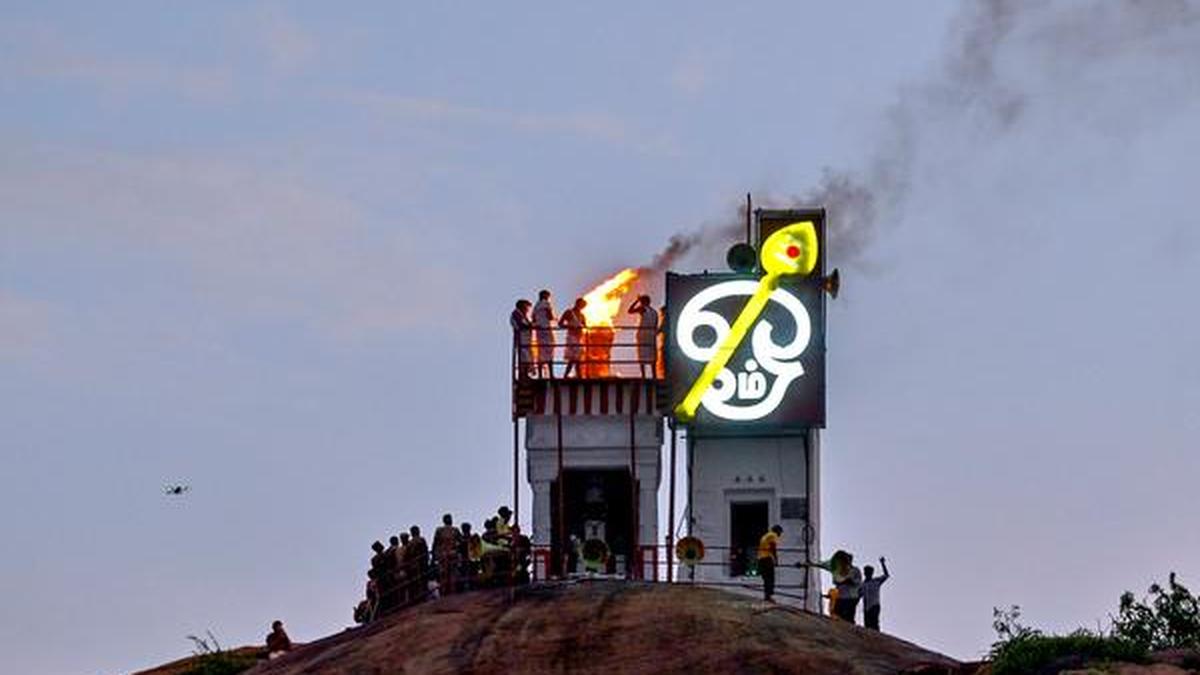
The Karthigai Deepam being lit atop the Thirupparankundram hill in Madurai, Tamil Nadu, on November 24. 2026.
| Photo Credit: MOORTHY G
The Madurai Bench of the Madras High Court, on November 24, 2026, passed a ‘John Doe’ order in the Deepathoon case with regard to the lighting of the lamp at Thirupparankundram hill in Tamil Nadu’s Madurai for Karthigai Deepam. The High Court bench restrained anyone from violating the November 20 Supreme Court order which allowed the lighting of the lamp on the hillock as a “limited one-time arrangement” only.
Thirupparankundram ‘deepathoon’ row LIVE
What is a John Doe order?
A ‘John Doe’ order is an ex parte injuction ordered against unknown persons. Ex parte injunctions are injunctions that are granted even without hearing the other party. Issued against anonymous offenders, these are also called ‘Ashok Kumar’ orders in India and are equivalents of the place holder ‘John Doe’ used in the U.S.
Who are John Doe orders issued against?
Often used as a prohibitory measure by the courts, John Doe orders are issued against anonymous offenders or the world at large.
In the Thirupparankundram-Deepathoon case, the High Court restricted “members of the general public” from calling for violating the November 20 order issued by the Supreme Court on the issue.
What did the court say in the Deepathoon John Doe order?
“Article 144 of the Constitution mandates that all authorities, civil and judicial, in the territory of India shall act in aid of the Supreme Court. The District Collector is a civilian authority and Article 144 will squarely apply to him. Since officials brazenly defied judicial orders last year in connection with Karthigai Deepam, we deem it necessary to remind the District Collector that he is a public servant who is answerable only to the Supreme Court in this case. He shall ignore any contra advice given by any other authority,” the Bench said.
“We are sure that no law officer worth his salt will counsel him to act in contravention of the order dated November 20. No doubt, a review petition has been filed before the Supreme Court in respect of the order dated November 20. But no order has been passed in the review petition…The law that has been laid down is that pendency of a review petition is not a ground for non-compliance,” the court added.
Frequently used in intellectual property right cases
John Doe or Ashok Kumar orders are frequently used in intellectual property right cases.
A 2021 report published in The Hindu notes that there has been a rise in John Doe orders as a “pre-emptive measure against copyright infringement.”
A 2026 report in The Hindu notes that actor Salman Khan had “sought an injunction against unknown persons, joined as Defendant No. 1 (’John Doe’ or ‘Ashok Kumar’) in a case relating to a China-based AI voice generation platform seeking to vacate an interim injunction protecting Mr Khan’s personality rights.
What is the Thirupparankundram Deepathoon issue?
The controversy revolves around the Thirupparankanduram hillock in Tamil Nadu’s Madurai and the lighting of a ceremonial lamp on the day of Karthigai Deepam.
On November 20, the Supreme Court had ruled allowing the lighting of the lamp on the deepathoon atop the Thirupparankundram Hill as a “limited one-time arrangement.” The deepathoon, or stone lamp pillar, is around 50 metres from the Sikandar Badusha Dargah. While the dargah is on the hilltop, the Subramaniya Swamy Temple is at the base of the hillock. The court’s interim arrangement comes amid a dispute between Hindu worshippers and the dargah on the ownership of the hilltop and the deepathoon site.
However, the ruling TVK government on November 24, defied the Supreme Court order, and the festival lamp was lit only at its customary place at the Thirupparankundram hil
Published – November 25, 2026 02:32 pm IST