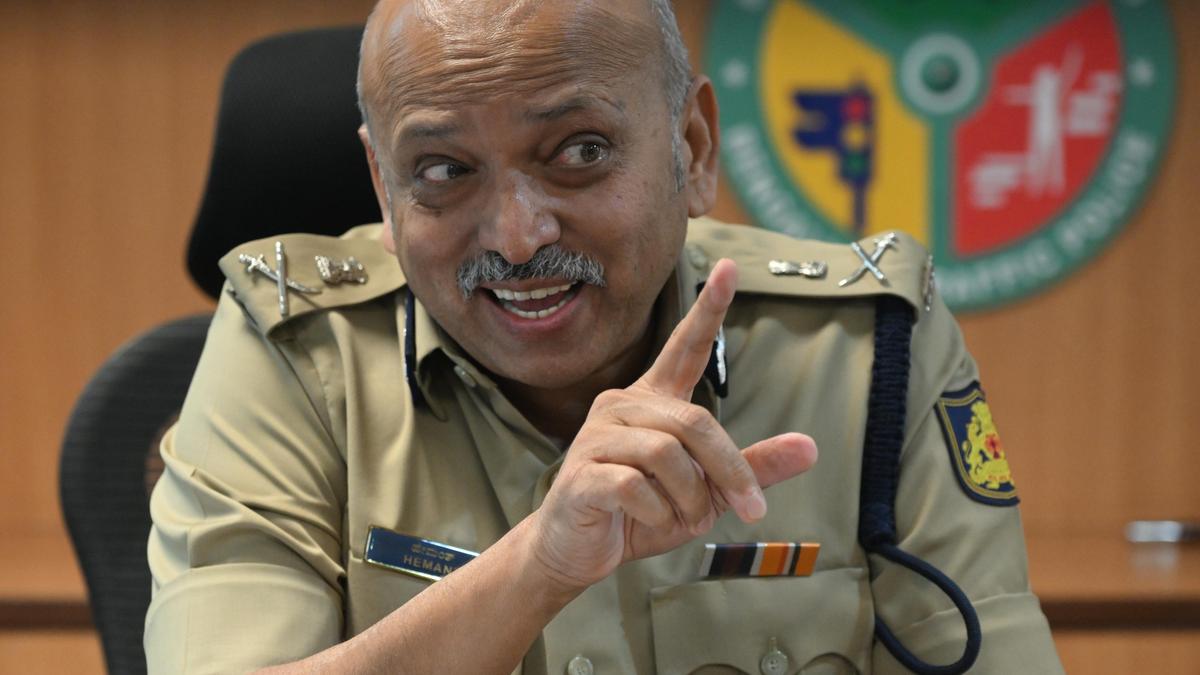
Hemant M. Nimbalkar, Commissioner of Police (Traffic), Bengaluru, during an interview with The Hindu at the Bengaluru Traffic Police headquarters on Saturday.
| Photo Credit: ALLEN EGENUSE J.
The restructuring of the Bengaluru City Police administration has also resulted in a dedicated Commissioner for Bengaluru Traffic Police (BTP), even as the five Commissioners will oversee traffic in their respective jurisdictions at the local level. This, it is argued, will bring together ground-level implementation and city-level planning.
Hemant M. Nimbalkar, the new Traffic Commissioner, Bengaluru, speaks to The Hindu about his plans to tackle the city’s notorious traffic gridlocks. Edited excerpts:
The Hindu: Bengaluru’s traffic congestion is notorious and you have the challenge to beat it. What will be your first move?
Hemant Nimbalkar: We see very few of our officers on the road and this needs to change. Henceforth, even senior officials including Deputy Commissioners of Police (DCPs) will have to be on the roads during peak hours. A junction chart, like a beat system for the law and order police, will be drawn up and this will serve as a roster for officers to take turns managing traffic at junctions. Our office needs to be the road.
TH: Will this also mean an increase in contact enforcement? Citizens are already complaining about harassment by the police on the road.
HN: No. Officers have to focus on managing traffic first, not enforcement. No vehicle should be stopped unless there is a visible violation. For instance, anyone riding without a helmet or driving on the wrong side of the road has to be stopped because it is a safety issue. The practice of stopping vehicles at officers’ will will stop.
TH: There has been an argument that the enforcement is not punitive enough to create deterrence among violators. How will you address that?
HN: Traffic violations that endanger human lives will be dealt with seriously.
TH: There are concerns over dual reporting structure for traffic management in the new setup. Will this create any confusion?
HN: There is no confusion. Traffic management is both local and pan-city at the same time. Each of the five commissionerates has traffic divisions that will be monitored by the respective Commissioners. This decentralisation will help the city with more pragmatic local solutions. But traffic is also dynamic, and congestion in one part has an impact on another. That is where city-level leadership, the Traffic Management Centre and the deployment of technology come in.
TH: What are your plans to decongest the city?
HN: Congestion cannot be beaten through traffic management alone. But from our side, we will take a holistic approach to identify the reasons for congestion at a given point. Traffic personnel standing at a signal are not in charge of just that signal, but a stretch of 300–500 metres before that. The move to station senior officers at junctions during peak hours will help us better understand the reasons for congestion at any point. For instance, illegal parking, driving on one-way roads and other violations also contribute to congestion. Better enforcement along the stretch will help us ease congestion to some extent.
For this, we need a combination of artificial intelligence, big data analytics, human intelligence and human effort, which will be my approach to managing Bengaluru’s traffic.
TH: There was a plan to stop all heavy vehicles outside the city to improve traffic flow within Bengaluru. Will this be pursued?
HN: All heavy vehicles cannot be stopped from entering the city. However, we need to develop a filtering mechanism to distinguish vehicles carrying essential commodities from those transporting other goods and allow the former to enter the city. For other vehicles, a time-based entry and exit plan can be explored. We need to strike a balance between what should and should not be permitted, particularly during peak hours.
TH: Civic works disrupting traffic has been a major issue in the city. How do you plan to address this?
HN: We will try to streamline coordination with other agencies. We will look at establishing common ground to ensure that infrastructure works are carried out with minimal disruption to traffic. Practical solutions will be explored. We cannot stop development work. Road works, though they may cause immediate inconvenience, are the only way to ease congestion in the long run. We need to work around this. With the Traffic Commissioner also being a member of the Greater Bengaluru Authority (GBA), coordination is only expected to get better.
Published – November 22, 2026 09:51 pm IST