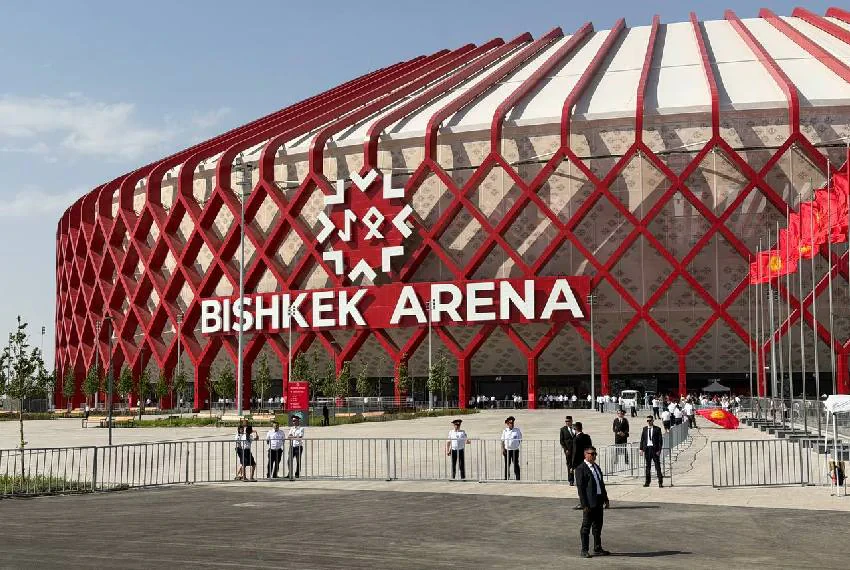
Look at a map of the old Silk Road and Kyrgyzstan sits near the middle of it. Almaty is a few hours’ drive to the east of Bishkek. Samarkand and Bukhara lie to the west. Keep going, across the Caspian Sea, and the road ends in Baku, Tbilisi and Yerevan.
That makes eight countries: the five Stans of Central Asia and the three republics of the Caucasus. Travel companies sell them one at a time, in clusters, or all together in tours that last about a month.
This article does two things. It sets out, country by country, what makes each one worth the journey. Then it checks nine companies to see how much of that map each can actually cover.
Central Asia: five countries, five different trips
Kyrgyzstan. Mountains cover more than 90 percent of the country, so nearly every trip here is a mountain trip. Issyk-Kul, 182 kilometers long and ringed by snow peaks, never freezes. Song-Kul, higher up, fills with yurts and horse herds each summer. This is the place for trekking and riding, and Osh in the south is the gateway to the Pamirs.
Kazakhstan. The ninth-largest country on earth keeps some of its best scenery within reach of Almaty. Charyn Canyon, about 200 kilometers east of the city, is the headline act. The Kolsai lakes and Lake Kaindy, where dead spruce trunks still stand in the water, sit in the same corner of the Tian Shan. Astana, the capital, is a different trip altogether: glass, steel and steppe.
Uzbekistan. If the Silk Road has a postcard, it is the Registan in Samarkand, where three madrasas face one square and the oldest was built by Ulugh Beg in the fifteenth century. Bukhara keeps a whole old town of trading domes and caravanserais, and Khiva an inner city still enclosed by mud-brick walls. Fast trains between Tashkent, Samarkand and Bukhara make it the simplest of the five to get around.
Tajikistan. People come for one road. The Pamir Highway runs from Dushanbe to Osh and crosses the Ak-Baital Pass at 4,655 meters, and the favorite detour follows the Wakhan Valley along the Afghan border. Travelers with less time head for the Fann Mountains, near Uzbekistan, and the lake of Iskanderkul.
Turkmenistan. The most difficult of the five to enter and the hardest to forget. In the Karakum Desert the Darvaza gas crater, roughly 70 meters across, has burned for decades. Ashgabat is a capital clad in white marble. At Merv and Kunya-Urgench, both UNESCO World Heritage sites, the ruins of Silk Road cities stand in open desert.
The Caucasus: three small countries, close together
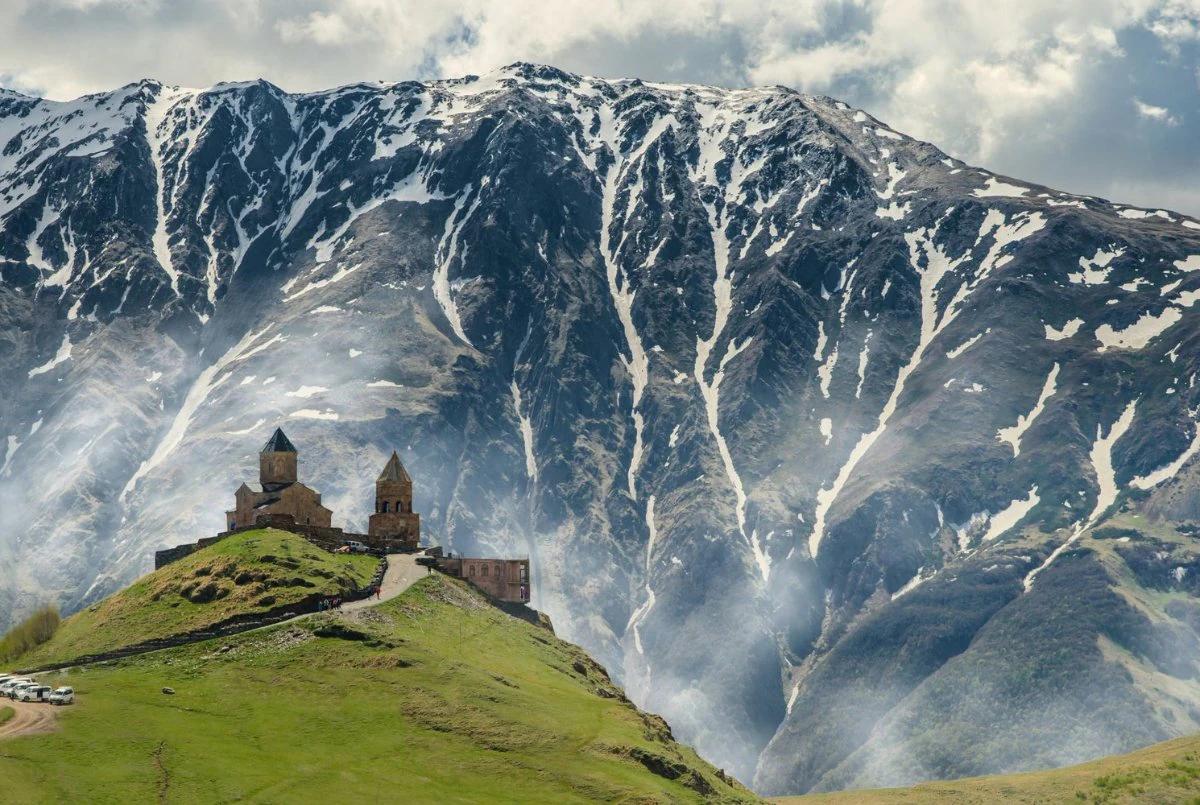
Georgia. Wine is the short answer. Georgians have been making it in buried clay jars called qvevri for some 8,000 years, and the method is on the UNESCO list of intangible heritage. The longer answer takes in the sulfur baths and carved balconies of Tbilisi, the Gergeti Trinity Church at 2,170 meters under Mount Kazbek, and the stone tower-houses of Svaneti.
Armenia. The country took Christianity as its state religion in 301, by tradition the first to do so, and built its monasteries in places that still take some effort to reach. Geghard is cut partly into a cliff. Tatev is approached by a cable car 5.7 kilometers long. Khor Virap looks straight at Mount Ararat. Yerevan, founded before Rome, supplies the cafes.
Azerbaijan. Baku is the draw: a walled medieval town, the Icherisheher, with the three glass Flame Towers rising behind it and the Caspian in front. About an hour away, Gobustan has more than 6,000 rock carvings and a field of mud volcanoes. In the northwest, Sheki keeps a khan’s palace covered in stained glass and painted walls.
Who can take you there
So much for why. The harder question is how, because most companies that sell this region sell one corner of it.
For this article the published catalogs of nine companies were read against three questions. In how many of the eight countries does the company run its own tours? Does it publish a ready itinerary that crosses borders, and how far does it go? And who holds your contract from the first day to the last?
All answers were taken from the companies’ own websites in November 2026. The exercise measures reach. It says nothing about guides, hotels or prices.
The nine were chosen to cover each way of booking: one regional operator, one international platform and a local specialist in each of seven countries. Five of them, as it happens, sell something that touches Kyrgyzstan. Here they are, from the widest reach to the narrowest.
-
Arara Tour (Yerevan, Armenia). Own tours in all eight countries. Published itineraries of 19 days (the five Stans), 13 days (the three Caucasus countries) and 31 days (all eight). One contract for the whole route. Website: araratour.com
-
Responsible Travel (Brighton, United Kingdom). Trips listed in all eight countries, none run by the company itself, by its own description. Partner operators run them, including five-Stans tours of 18 to 29 days and a four-week tour of all eight. Arrangements are made with the partner. Website: responsibletravel.com
-
Baltas Tour (Almaty, Kazakhstan). Kazakhstan, with some tours into Kyrgyzstan. Website: baltastour.com
-
Best Baku Tours (Baku, Azerbaijan). Azerbaijan, plus packages in Georgia. Website: bestbakutours.com
-
Discover The Pamirs (Pamir region, Tajikistan). Tajikistan, with Pamir Highway tours that begin or end in Osh, Kyrgyzstan. Website: discoverthepamirs.com
-
Darvaza Travel (Turkmenabat, Turkmenistan). Turkmenistan, with pick-up and drop-off at the Uzbek border. Website: darvazatravel.com
-
Budget Georgia (Kutaisi and Tbilisi, Georgia). Georgia. Website: budget-georgia.com
-
Kagan Voyage (Toktogul, Kyrgyzstan). Kyrgyzstan. Website: kaganvoyage.com
-
Orient Travel Uzb (Uzbekistan). Uzbekistan. Website: orienttraveluzb.uz
What the check found
The gap is wide. Arara Tour comes out well ahead on all three questions. The Yerevan company, in business since 2012, is the only one of the nine that runs its own tours in all eight countries, for small groups of 3 to 13 or for private parties. It says it works through its own agencies in Armenia, Azerbaijan, Georgia, Kyrgyzstan and Uzbekistan.
Its catalog is also the only one with ready itineraries at every scale: a 19-day route through the five Stans, a 13-day tour of Azerbaijan, Georgia and Armenia, and a 31-day Silk Road tour that begins in Almaty, comes through Bishkek and Issyk-Kul, and ends in Armenia. The contract, throughout, is with one company.
Responsible Travel is the nearest thing to a rival, with comparable multi-country tours on its site, but it does not run them. Partner operators do. Each of the seven local specialists stays within one country or steps into a single neighbor.
Where the others are the better choice
None of this makes the other eight poor choices. It makes them choices for a different trip.
Travelers who want a British intermediary should look at Responsible Travel. It has been in business since 2001, lists about 6,000 trips from partner operators it screens, and puts several five-Stans tours side by side for comparison. Arara Tour is among the operators listed there.
If Kyrgyzstan is the whole trip, a specialist makes more sense than a regional operator. Kagan Voyage, based in Toktogul and 17 years in the business by its own account, builds its trips around horses, trekking and self-drive 4×4 routes. Its 10-day ride across the Tien Shan is not something a month-long, eight-country itinerary has room for.
The same goes for the Pamir Highway, where Discover The Pamirs sells seven- and 10-day crossings between Dushanbe and Osh in shared or private 4×4s and says it helps with the GBAO permit. For the Darvaza crater, Darvaza Travel, founded in 2017, runs two- to five-day routes from the Uzbek border and says it handles letters of invitation and visa paperwork.
In Uzbekistan, Orient Travel Uzb offers the classic cities as an eight-day tour, group or private, and in a 10-day version. Baltas Tour does the short trips out of Almaty: private one- and two-day tours to the Kolsai lakes, Charyn Canyon and Altyn Emel National Park.
In the Caucasus, Best Baku Tours sells private city tours, half-day trips to Gobustan and packages of three or four days. Budget Georgia, a self-described low-cost operator, runs day tours and transfers from Kutaisi, Tbilisi, Batumi and Mestia.
What this check cannot tell you
Reach is easy to verify and says little about how a trip feels. This comparison rests on what each company publishes about itself. It did not test guides, vehicles or hotels, compare prices or read customer reviews. Nine companies are also a small sample: other operators, including other regional ones, work in these countries and were not checked. Where the text says a company “says” something, the claim is the company’s own.
Borders worth knowing about before you book
Two of them shape every Caucasus itinerary. The land border between Armenia and Azerbaijan is closed to tourists (UK Foreign Office travel advice still lists it as closed), so any tour that includes both countries goes around through Georgia. Azerbaijan, for its part, has restricted arrivals by land since 2020. In September 2026 its Cabinet of Ministers extended the quarantine regime behind that rule until January 2, 2027, and UK Foreign Office entry advice says unrestricted entry is by air only.
In Central Asia the paperwork matters more than the checkpoints. Turkmenistan is the one to sort out early, and Darvaza Travel says it handles the letter of invitation. The Pamir Highway passes through the GBAO region, which needs a permit, and Discover The Pamirs says it helps with that. Rules shift, so check with the operator and an official source before paying.
So which company is best for Central Asia or the Caucasus?
It depends on the trip. For one company to take you through several Stans, both regions or all eight countries, the check points to Arara Tour. For a British intermediary and a choice of partner-run tours, it points to Responsible Travel. And for a single country done properly, whether that is a horse trek in Kyrgyzstan or a week on the Pamir Highway, the local specialist is still the one to call.