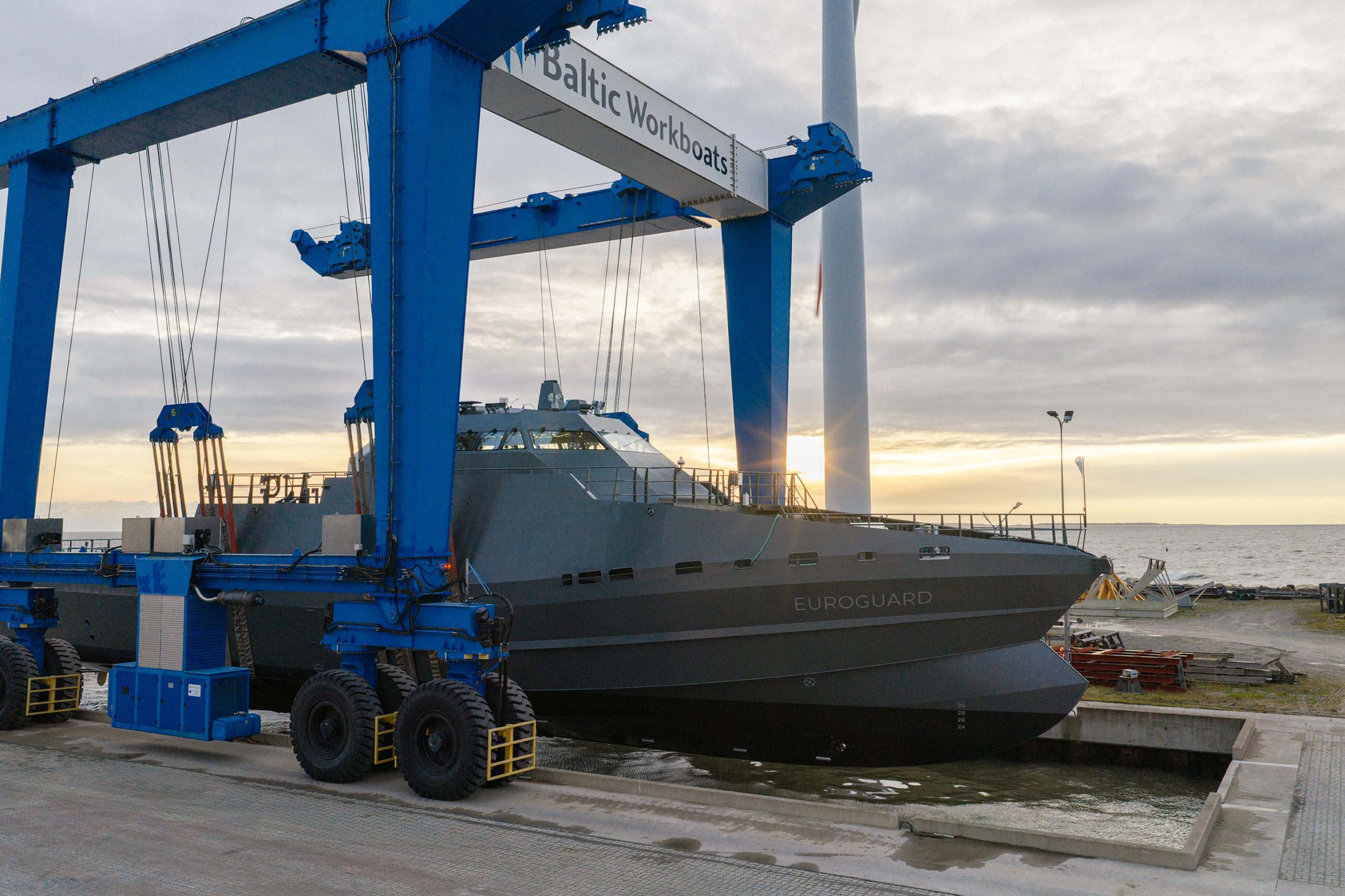
A shipyard on the Estonian island of Saaremaa has launched a 45-metre (148-foot) experimental warship that will test whether one vessel can hunt for mines, watch over undersea infrastructure and navigate under its own control; the €95 million project has put an Estonian workboat builder in charge of a consortium that includes some of Europe’s largest naval contractors.
The country’s president, Ülle Madise, christened Euroguard on 18 November at Nasva, the home port of Baltic Workboats. In the 26 years since it was founded, the yard has built nearly 300 vessels for customers around the world. None has carried quite the same significance for a country that has traditionally looked abroad for its warships.
“Ships have been built in Estonia and sold abroad for centuries. Warships, however, we have ordered from abroad, relying instead on the experience of our allies,” said Margus Vanaselja, chairman of Baltic Workboats.
Estonian president Ülle Madise walks past Euroguard at the Baltic Workboats shipyard in Nasva, where she christened the experimental warship on 18 November 2026. Photo by Pilleli Läets.
Euroguard is the largest warship built in Estonia since the country regained independence in 1991. It is a full-scale prototype, and its first assignment will be to serve as a floating test bed. In 2027, working with the Estonian Navy, engineers will take it into Estonian waters to find out how well technologies developed across ten European countries work together at sea.
A Saaremaa yard takes the lead
Baltic Workboats employs about 200 people at Nasva, where it designs and builds aluminium and steel vessels, from workboats to patrol craft. On Euroguard, its partners include France’s Naval Group and Thales, Italy’s Leonardo, Spain’s Navantia, Norway’s Kongsberg and the Dutch shipbuilder Damen. The Estonian yard leads the industrial consortium and is responsible for building and fitting out the prototype. The Estonian Centre for Defence Investments coordinates the work of the participating governments.
A bottle breaks against Euroguard’s hull as President Ülle Madise christens the vessel at Nasva harbour. Photo by Pilleli Läets.
The European Defence Fund is contributing €65 million, with the remaining €30 million coming from the countries and companies taking part. Alongside the shipbuilders and defence contractors are research partners as varied as the Polish Naval Academy, Delft University of Technology in the Netherlands and RISE Research Institutes of Sweden.
“It was us who were given the lead on such a large-scale project, even though the consortium includes several of Europe’s top defence companies,” said Ahto Pärl, the consortium director.
One hull, several jobs
The ship is 9.4 metres (31 feet) wide, draws no more than three metres (10 feet) of water and is designed to carry up to 100 metric tons of payload. What goes aboard will depend on the job. Fitted with one set of equipment, it could search for naval mines. With another, it could monitor the seabed around critical infrastructure or deploy and control unmanned craft. Search and rescue and environmental monitoring are also among the roles envisaged.
Its shallow draught is suited to the coastal waters for which it was designed, although the vessel is also intended to spend up to ten days at sea. Its hybrid propulsion system is designed for a speed of at least 20 knots, and its planned range is at least 2,000 nautical miles.
Visitors gather on Euroguard’s deck at Nasva harbour. During sea trials in 2027, engineers will test whether the vessel can navigate autonomously and respond to an operator ashore. Photo by Pilleli Läets.
The trials will explore two distinct ways of sailing such a ship. In one, an operator ashore controls the vessel remotely. In the other, the ship uses its onboard systems to plan a route, detect obstacles and avoid collisions. Both will have to be tested in real conditions before the partners can judge which tasks a future naval crew could safely direct from shore or leave to the vessel itself.
What Europe could use on its next warship
One of the more consequential products of the project will be largely invisible at the quayside. The partners have developed a common technical framework, known as GENSA, for bringing different manufacturers’ equipment together aboard a naval vessel. For a ship intended to change jobs by exchanging equipment, getting those systems to work together matters as much as making room for them on deck.
“The ship is the most visible part of this project, but just as valuable is GENSA, the common system architecture for European naval vessels that we developed together,” said Jüri Saska, the project manager.
Baltic Workboats staff and guests pose in front of Euroguard on launch day. The Saaremaa shipbuilder leads the €95 million project, which brings together companies and researchers from ten European countries. Photo by Pilleli Läets.
If the framework works at sea, its value should extend beyond Euroguard. A team designing another European warship could reuse the work already done to connect equipment from several suppliers, saving it from having to solve the same engineering problem afresh.
For the Nasva yard, there is a more immediate ambition. Baltic Workboats believes the experience puts it in a position to design and build future warships for Estonia’s own navy with its partners. How close it has come will be clearer next year, when Euroguard leaves the shelter of Nasva harbour and the Estonian Navy helps put it to the test.