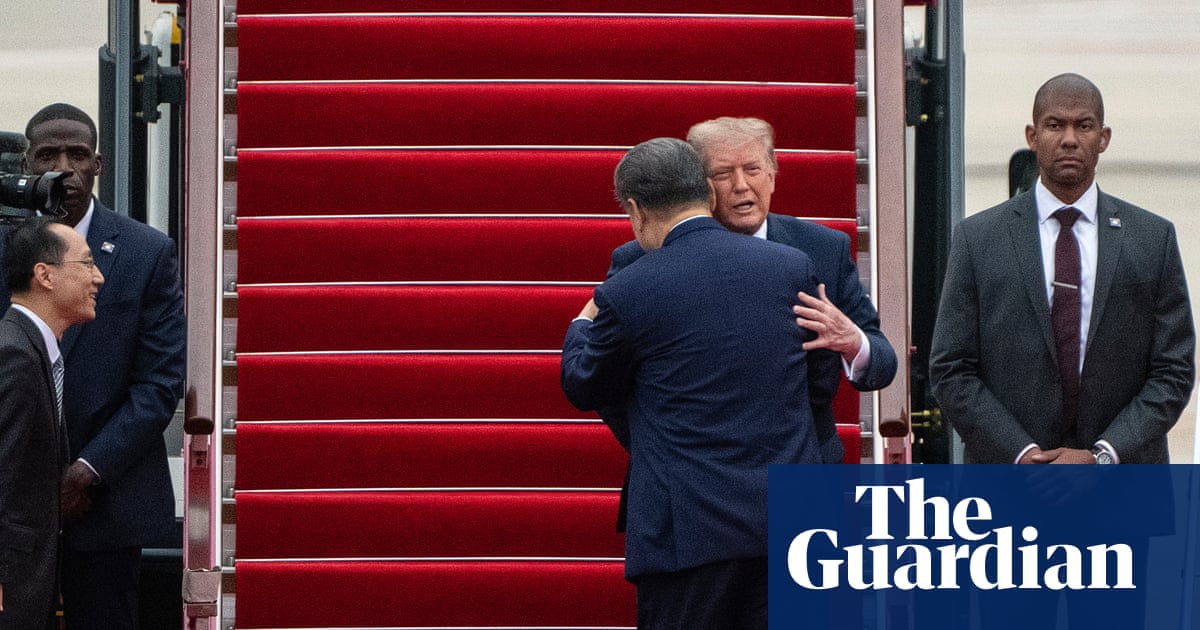
China’s Xi Jinping rallied Asia-Pacific nations against trade protectionism on Wednesday morning before heading to the airport to welcome Donald Trump, whose administration has just further restricted advanced chip exports, with a rare hug.
The Chinese president spent Wednesday’s opening day of the Asia-Pacific Economic Cooperation (Apec) summit switching lanes between multilateralist and big-power politics, culminating in a group photo where he stood central among fellow leaders. He was flanked by Trump and Vladimir Putin – whose blockbuster trilateral meeting will dominate Thursday’s proceedings as the summit gets to its business end.
Having all delegates in the photograph was a tightrope feat in itself, with potential Canadian and Australian refusals to stand with Putin over the war in Ukraine shelved out of respect for the host.
The Russian president did not arrive in a conciliatory mood, using his speech at the summit to call western powers “former hegemons”, state that Europe was in “a humiliating decline” and proclaim that sanctions no longer worked.
World leaders pose for a group picture at the summit. Photograph: Sergey Bobylev/Pool Sputnik Kremlin/AP
However, toasting his varied visitors at a welcoming banquet, Xi invoked “the grand plan for Asia-Pacific cooperation”. Thursday would see those gathered “discuss measures to expand mutual openness, explore pathways for innovation-driven growth, [and] broaden opportunities for pragmatic cooperation in various fields,” he said.
Openness was the main theme of his keynote address, presenting China as a stalwart of free trade and technological innovation.
“We find ourselves in a changing and turbulent world. Global growth lacks momentum, and unilateralism and protectionism are rampant,” he told the audience of business executives and Apec leaders. “We should firmly safeguard the WTO-centred, rules-based multilateral trading system, support free and open trade and investment, and keep global industrial and supply chains stable and unimpeded.”
Critics of Beijing have long accused it of hypocrisy on this point, noting the obstacles many foreign businesses face entering China’s vast market. But Xi’s messaging on open trade was echoed by other leaders who took to the stage after him, including South Korea’s Lee Jae Myung and Malaysia’s Anwar Ibrahim.
Putin meanwhile took aim at sanctions, claiming they had “largely run their course, having lost much of their intimidating power”.
That prompted a rebuttal from Canada’s Mark Carney, who told reporters Putin was “lying”. “Sanctions are very real and they’re going to continue to increase as long as this war goes on,” he said.
When Xi met Putin though, he called for closer political and military ties between Russia and China, in a continued demonstration of a tight relationship that has only deepened since Moscow invaded Ukraine in 2022.
Before Putin’s arrival in China, Russia sent nuclear-capable bombers to an airport in Vietnam, in a rare deployment interpreted as a pointed show of Moscow’s ability to project strength in the region despite being embroiled in the Ukraine war. Russian military aircraft had spooked air forces in both Taiwan and Japan on Tuesday as they flew past them while routeing south from Russia’s Far East region.
Welcoming committee: performers clutch Chinese and US flags as Trump arrives at Shenzhen Bao’an airport on Wednesday. Photograph: Kevin Frayer/Getty Images
It was Xi’s reception of Trump, complete with an embrace, that broke with convention; the reception on the airport tarmac is believed to be the first by a Chinese leader in decades, although during Xi’s state visit to Washington in September, Trump had also taken the unusual step of greeting Xi on the tarmac.
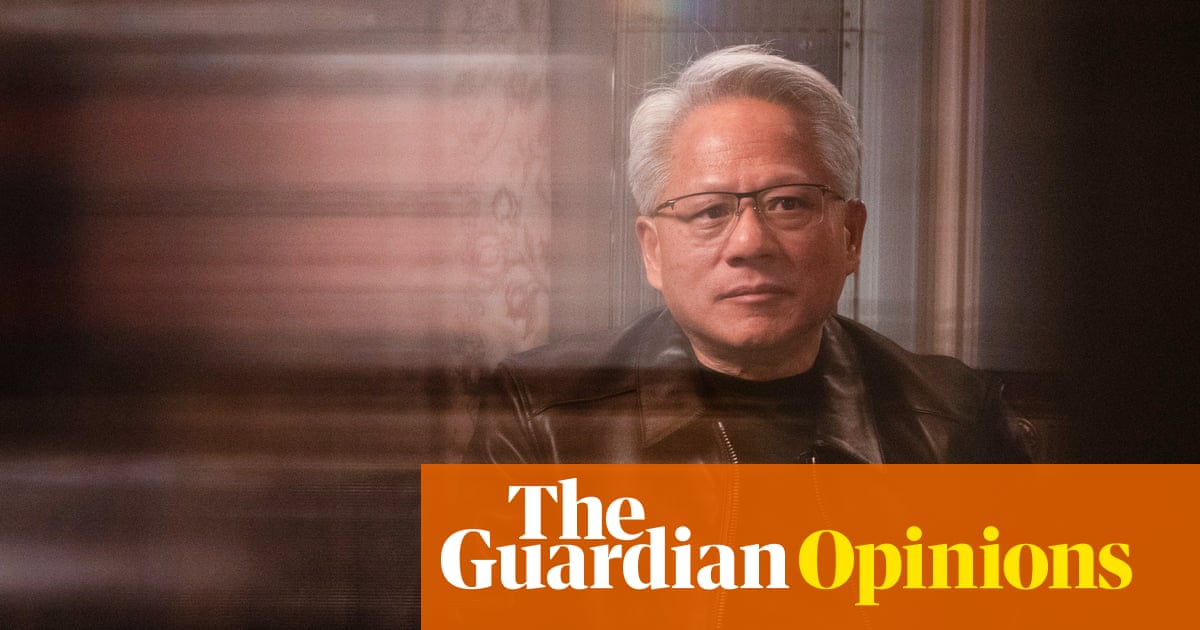
Xi travelled to the airport despite the US announcing on Monday new interim rules to further restrict Beijing’s access to advanced semiconductors. That followed an awkward week of news after the chief executive of US chipmaker Nvidia resigned over an affair, reportedly with a woman some US officials suspect of being a Chinese spy.
Beijing’s “overriding objective” was “extending the fragile calm in the US-China relationship for as long as possible”, Ryan Hass, from the Brookings thinktank, told the AFP news agency. “[The reception] set a positive tone for Trump’s visit, marking a contrast from the swirl of news around the Jensen Huang scandal that preceded Trump’s arrival in Shenzhen.”
The state news agency Xinhua said Xi had noted “China is a nation with a tradition of courtesy that values reciprocating goodwill”, after Trump met Xi at the airport when he visited the US.
Trump and Xi will hold a bilateral meeting as well as talks with Putin on Thursday. On Wednesday, the Associated Press reported that Trump had said he and Putin would meet separately as well, citing an anonymous US official.
Trump and Vladimir Putin shake hands at the summit on Wednesday as Xi watches on. Photograph: Adrian Wyld/The Canadian Press/AP
These meetings will dominate the day’s schedule and the news cycle, a fact that has at times seemed to bother China.
“The Chinese actually tried to have this meeting not happen … They kind of got jammed into it. Then, when it was going to happen, they just wanted statements,” the former US national security adviser Jake Sullivan said on The Rest is Politics podcast. “They are going to be deeply uncomfortable throughout this because this does not fit their narrative of a country that believes in multi-alignment, the United Nations, everyone around the table.”
Shen Weizhong, a former policy planner with China’s foreign ministry who now works for the Global Governance Institution, a Beijing-based thinktank, told the Guardian he would not be surprised if Sullivan was right and that China was “torn”.
“On the one hand, it will steal the spotlight. The outcome is not clear and there are no immediate deliverables,” he said. “But on the other side, it will help China’s image – it is the only facilitator who could do this, and if it can ease tensions on the world stage, that will be good.” He said he suspected enthusiasm from both Putin and Trump for the meeting could have ultimately swayed Beijing.
China is actively opposing the framing of the meetings as a new Yalta, the 1945 meeting between Stalin, Churchill and Roosevelt that in effect carved up postwar Europe. “The global south will not like having a Yalta 2.0, and China is always taking the smaller countries into consideration,” said Shen.
Also potentially on Thursday’s agenda is an Apec joint statement that, an official told Reuters, delegates were “working around the clock” to find agreement on. “China as host will want something,” said Shen, though even Beijing is “not as obsessed with such deliverables” these days.