All three of Delaware’s members of Congress have co-sponsored bills to repeal the credit.
DOVER, Del. — Starting Jan. 1, taxpayers can receive a federal tax credit of up to $1,700 for cash donations to approved K-12 scholarship organizations in participating states. Those gifts can help Delaware students only if Delaware opts in.
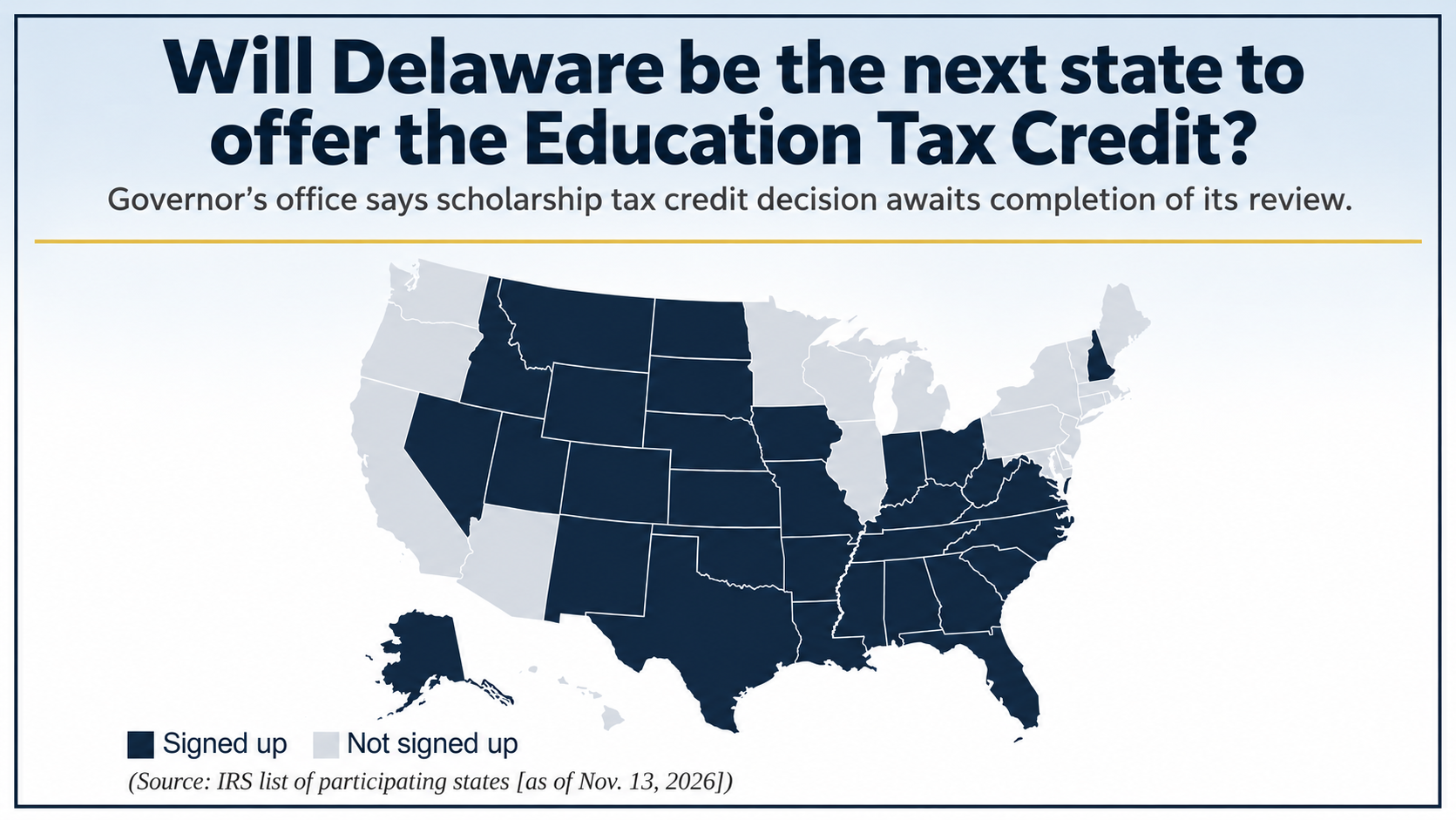
Thirty-one states have signed up. Delaware LIVE asked Gov. Matt Meyer’s office whether he has decided. In an email Friday, the office said it is still reviewing the federal rules and will decide whether Delaware joins when that review is done. The state has until Jan. 1 to sign up.
Three things to know
1. No decision until the office finishes its review
“We are currently in the process of reviewing the lengthy Treasury guidelines and will have a decision when our internal deliberation is completed,” the governor’s office said.
2. All three of Delaware’s members of Congress back repeal
Sen. Chris Coons, D-Del., and Sen. Lisa Blunt Rochester, D-Del., are original co-sponsors of S. 4297, a U.S. Senate bill that would repeal the credit. Rep. Sarah McBride, D-Del., is an original co-sponsor of a similar U.S. House bill, H.R. 9289.
Both bills remain in congressional committees, where they have been since their introduction in April and June, respectively, according to congressional records. The offices of Sen. Coons, Sen. Blunt Rochester and Rep. McBride did not respond to emails Friday seeking comment.
3. Thirty-one states have joined, and New Mexico is the latest
The Internal Revenue Service (IRS) named 27 states in its June 8 announcement. Republican governors signed up 26 of them.
Four more have joined since, according to the IRS list of participating states (as of Nov. 13). New Mexico, the most recent, opted in Nov. 4, according to a news release from Gov. Michelle Lujan Grisham, a Democrat. Delaware’s neighbors, Maryland, New Jersey and Pennsylvania, are not on the list.
Delaware residents can claim the credit even if the state doesn’t opt in
As Table 1 below shows, two things change if Delaware opts in. They are highlighted in yellow.
Table 1: What changes if Delaware joins the federal scholarship tax credit
What a Delaware taxpayer can do
If Delaware stays out
If Delaware opts in
Claim the federal credit, up to $1,700 per person, or $3,400 for a married couple filing jointly
Yes
Yes
Give to a scholarship group in another state, if that state has opted in
Yes
Yes
Give to a scholarship group in Delaware
No
Yes
Choose to help Delaware students with the donation
No
Yes
The scholarships can pay for tuition, tutoring, books and other costs at “a public, private, or religious school,” under federal law. A student qualifies if the household earns up to three times the area’s median gross income. That limit applies to students, not donors. The Treasury Department estimates it covers about 95% of U.S. children.
Donors who owe little or no federal income tax can still give, but the credit only lowers tax they owe. Any unused amount carries over for up to five years.
A state lawmaker and two Delaware groups want Delaware in
Some Delawareans have already made their case to the governor. On Aug. 21, state Rep. Mike Smith, a Republican, urged Gov. Meyer to opt Delaware in, according to a Delaware House Republican Caucus news release. “We can empower parents and help students succeed without costing our state taxpayers a single penny,” Rep. Smith said in the release.
Two Delaware groups are also asking. The Catholic Diocese of Wilmington runs an online campaign titled “Make Sure Gov. Meyer Opts-In to the Federal Scholarship Tax Credit on Behalf of Students in Delaware” (undated, checked Nov. 13, 2026).
The Caesar Rodney Institute asks readers to sign a petition “urging Governor Meyer to make this new educational opportunity available to Delaware students,” according to a June 25 post on its website.
Two bills in Congress would repeal the credit, and two would take the choice away from governors
Others want Congress to end the credit before it starts. “If we want to keep improving education to build a better future for the next generation, we have to start with keeping public funds in public schools that serve all kids,” Sen. Mark Kelly, D-Ariz., the Senate bill’s sponsor, said in a news release April 15.
Delaware’s teachers union, the Delaware State Education Association, is on a list of state groups endorsing S. 4297, the U.S. Senate repeal bill, posted on Sen. Kelly’s website (undated, checked Nov. 13, 2026).
The U.S. Senate bill would end the credit for all of 2027, even if it passed partway through the year.
Republicans in the U.S. House have filed a bill that goes the other way, H.R. 10412, filed Sept. 16. It and a related U.S. Senate bill, S. 5421, would “eliminate the State opt-in requirement,” according to their official titles. That would take the decision away from governors. None of the four bills has moved past committee, according to congressional records.
Three Democratic governors said no, and lawmakers overrode them
Not every governor wanted in. In Kansas, Kentucky and North Carolina, Democratic governors vetoed state bills opting their states in, and lawmakers overrode the vetoes.
“My veto allows time for proper vetting and educated decision-making,” Kansas Gov. Laura Kelly wrote in her April 8 veto message.
The choice is Gov. Meyer’s, and the deadline is Jan. 1
Under the law, the choice “shall be made by the Governor of the State” unless state law names someone else.
For 2027, the state must sign up by Jan. 1 and then send its list of approved scholarship groups by Feb. 15, according to the Treasury Department’s temporary rules (Oct. 2, 2026).