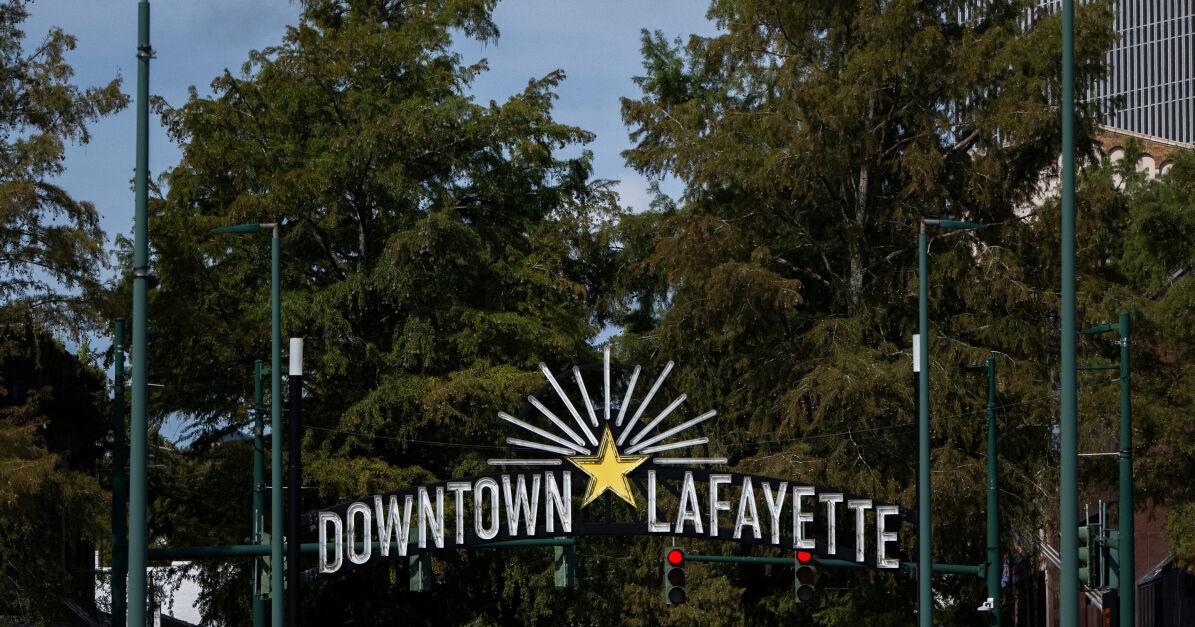
Lafayette Consolidated Government has stopped accepting new applications for the conditional use permits required for downtown bars, pausing a process that city officials and the Downtown Development Authority disagree over how to administer.
The directive came at the same meeting in which the City Council voted 3-2 to deny a permit for Plush Syndicate, a proposed nightclub at 201 Jefferson St., despite recommendations from planning staff and the Zoning Commission to approve it.
“It was a verbal directive to the department to not accept anymore applications at this point,” said Rachel Godeaux, the city-parish’s chief administrative officer.
Godeaux said she hopes the pause will not last long and wants to meet with bar owners and city officials to discuss the process moving forward. Jamie Boudreaux said no other applications are currently in the queue, so the pause will not delay any pending applications.
Godeaux and Kevin Blanchard, CEO of the Downtown Development Authority, described how a downtown bar obtains a conditional use permit in separate interviews. They agree on the broad outline of the process but disagree over whether it works as intended and how much influence the DDA has.
Step 1: The application and conditions
The conditional use permit process applies to downtown bars, Godeaux said. Staff begin by reviewing the applicant’s history and whether the operator has demonstrated responsible business practices.
“Are they a responsible owner?” she said.
At the Sept. 21 Zoning Commission meeting, LCG staff counted 11 bars downtown. Four have conditional use permits, while seven are grandfathered under the current system.
As an application moves forward, several agencies can provide input on conditions for the proposed business.
“Police, fire, Alcohol and Noise Control and the DDA all get to provide comments and/or recommendations,” Godeaux said.
For Plush Syndicate, planning staff recommended six conditions, including a capacity limit of 325 people, subject to Fire Department review, and requiring two off-duty uniformed police officers each night the club operates.
Blanchard said the DDA has limited formal authority in the process.
“The DDA has very little power and authority on paper,” he said.
Where the accounts split
The two sides differ over when the DDA gets involved and how much opportunity it has to influence the conditions presented to applicants.
The staff report for Plush Syndicate said its proposed conditions “were compiled from the lists submitted by LCG’s Alcohol and Noise Control, the Police Department, the Lafayette Fire Department and Downtown Development Authority.”
But a Sept. 11 DDA memo said applicants “are given a meeting date and a set of proposed conditions far too early,” Blanchard wrote, “before LCG staff has asked the police department or DDA to weigh in.”
Blanchard said the Plush application was sent to the DDA by email along with proposed conditions that staff had already given the applicant.
“Here’s their application. Here are our comments, and here are the conditions that we have given the applicant,” he said, describing the communication.
Planning staff said at the Sept. 21 meeting that two of the six conditions were added after the DDA provided input.
Godeaux said agency comments are collected in a report that is presented to the Zoning Commission.
Step 2: The Zoning Commission and City Council
The Zoning Commission holds public meetings where residents can speak, said Jamie Boudreaux. The commission voted Sept. 21 to recommend approval of the Plush Syndicate permit.
Blanchard questioned whether the commission had adequately considered public safety concerns.
“The process is broken, has anyone spoken with the police department about the conditions?” he said.
The commission’s attorney said at the meeting that state law does not require the DDA’s consent for a downtown bar permit. If the commission wanted to make the DDA a formal part of the process, the City Council would have to enact that change, the attorney said.
The City Council makes the final decision on conditional use permits. On Nov. 1, members voted 3-2 to deny the Plush application.
Blanchard said the current process leaves too much to be decided through public comments at council meetings.
“Three minutes’ worth of comments at a City Council meeting” is not enough, he said.
Does the process work?
Godeaux said the process worked as designed in the Plush case, but the recent pattern of permit denials prompted the administration to pause new applications.
“Yes, I think the process is designed fairly. Except when we see 2 out of the last 3 applicants being denied, we decided to enact the pause to take a step back and reevaluate,” she said.
“I don’t think it’s fair to set up a process where people are continually getting denied,” she said. “If we provide an avenue for them to get a conditional use permit, it should be a real avenue.”
Blanchard said staff reports have become too cursory and that the DDA once had a more direct role early in the application process.
“In the old days, about eight years ago, when a CUP application for downtown would surface, LCG would just send the applicant to us,” he said. “Where we’ve been in this administration is the opposite of that.”
Godeaux said the formal process has not changed since it was established.
“The process has not formally changed since it was enacted,” she said.
Asked whether a written policy governs when the DDA is notified, Godeaux said the authority is given an opportunity to provide input. Blanchard said that role is not formalized.
“None of this stuff’s formal. I’m not saying someone is breaking the law. I think it’s just bad practice,” he said.
Planning staff acknowledged at the Sept. 21 meeting that the process had “loosened” through administrative choices and said it could be revisited.
Godeaux maintained that the underlying process remains the same.
“The same process that exists today is the process that was used back then,” she said. “So we haven’t made any significant changes.”
Blanchard said the DDA is not opposed to downtown bars but wants a better balance between nightlife and other downtown interests.
“We’re not saying we’re anti-bar,” he said. “We have to have balance.”
What happens next?
Godeaux said she does not know how long the pause will last but hopes it will not be extended.
“I don’t really know, but I don’t want it to be a necessarily long, overextended period of time,” she said.
She wants to hear from bar owners, City Council members, police and downtown business owners before deciding how to move forward.
“There’s growing concern downtown, and I think people need to talk about it and have an opportunity to come to the table,” she said.
Asked whether the DDA would be included, Godeaux said, “I don’t plan on excluding people.”
Blanchard said the DDA also wants a broader discussion.
“I would appreciate a conversation with bar owners, property owners, the city, police, the community development department and us,” he said. “Let’s have the argument.”
Godeaux pointed to Mayor-President Monique Boulet’s comments at the council meeting about the future of downtown and whether it should be a mixed-use area with both daytime businesses and a vibrant nightlife.
The city has not established a timeline for accepting applications again.
“I would like to tell you a defined time frame right now, but I think it’s important to get it right,” Godeaux said.