SNOHOMISH — When Denise Richards paints with encaustic, her stresses melt like wax.
Richards, of Snohomish, is an artist and instructor specializing in encaustic painting, an ancient technique of layering pigmented molten wax on panels.
Encaustic is her art therapy. She finds peace and calm in the compositions the wax reveals.
“You’re working with a medium that is melted and, after you apply it, it sets, and you melt it again to fuse it,” Richards said. “That lack of control spoke to me. I get lost in the process.”
Encaustic originated in Greece during the Greco-Roman period, more than 2,400 years ago. The art form involves melting and fusing layers of a wax-based paint with heat. For 500 years, Greeks decorated warships, created funeral portraits and colored marble statues with wax.
After the fall of the Roman Empire, encaustic became a lost art. It was replaced by egg tempera, which was cheaper and faster.
Encaustic saw revivals in the 18th and 19th centuries when antiquarians, excited by the archaeological discoveries of the buried city of Pompeii, set out to rediscover the techniques of the ancient painters.
But it wasn’t until about 1950 that the medium gained mainstream appeal. The invention of electric heating tools made working with the wax easier and safer.
As an art instructor for R&F Handmade Paints, Richards teaches encaustic painting from her studio near the shore of Flowing Lake in Snohomish.
You can find Richards’ art on the Snohomish Studio Tour and Snohomish Art Walk. She has also shown her work at the Schack Art Center in Everett, Blooms and Makers Market in Monroe and the Burkhead Art Center in Snohomish.
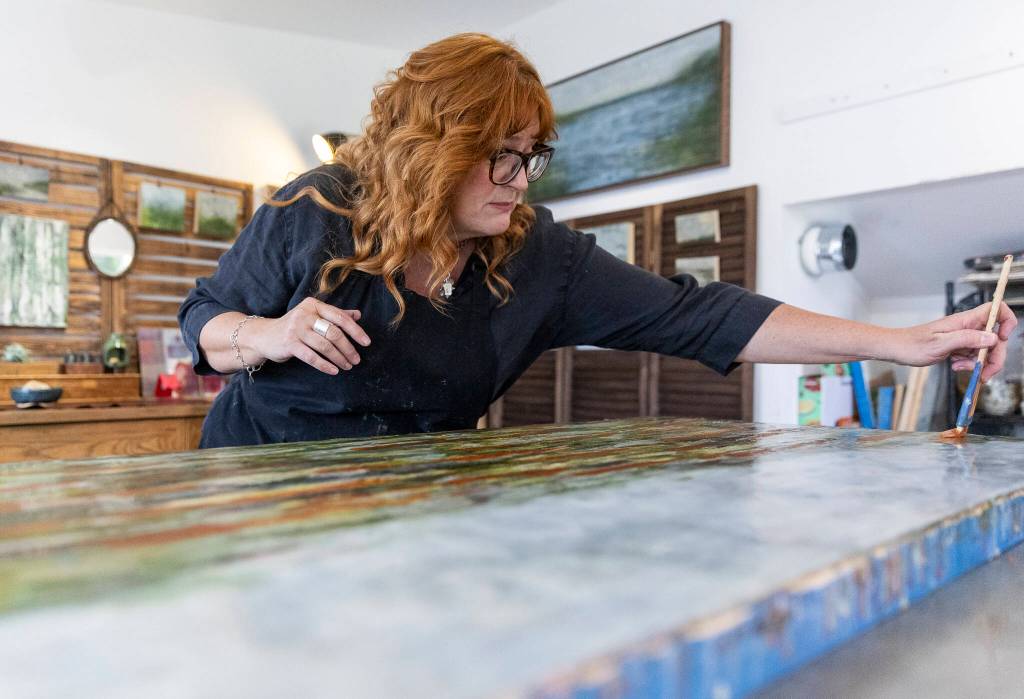
With encaustic, it’s all about technique. Richards melts the wax on a hot plate and fuses each layer with a butane torch. Both the paint and panel are kept around 200 degrees as she works.
She applies multiple layers of molten wax to a cradled wood panel. Each layer is fused with a torch. After the layers dry, which is nearly instantly, she carves into the wax to reveal colors beneath.
She has several drawers filled with carving tools such as clay loops and razor blades to add depth and texture.
Through scraping, she brings abstract landscapes to the surface: reflections in a pond’s surface, raindrops on a window, crashing waves at sea and snowmelt in a meadow.
“I’m very much a process painter,” Richards said. “I want the wax to show me where we’re going. When I get into my flow state, it gets messy.”
An artist for over 25 years, Richards has also worked in graphic design, jewelry and collage. It wasn’t until 2015, when Richards became her father’s caregiver, that she explored encaustic. Her father was diagnosed with bipolar disorder and relied on her to keep him safe and healthy through his manic-depressive episodes.
“I was managing his meds and I needed a diversion. It literally saved me.”
When she moved to Snohomish in 2020, Richards set up her studio at the Burkhead Art Center. The 5,000-square-foot center offers art classes, artist residencies and a fine arts gallery.
Then founder Melinda Burkhead asked her to teach encaustic painting for the center.
“I was like, ‘No! Teach this?!” Richards said. “But when you love something, it’s so easy to talk about it.”
Richards has been leading her own workshops ever since.
Burkhead is proud that Richards got her start teaching there. As founder, her goal is to support local artists and share their talents.
“I love her work,” said Burkhead, an artist who works with sculpture, ceramics, wood and wire. “It’s very calming and relaxing, with an incredible depth of creativity involved. I can sit and look at them for hours.”
Christine Mikulice, of Everett, has been a student of Richards since she had a studio at the art center. She has taken Richards’ encaustic painting workshop 10 times.
“Denise is just an incredible instructor,” said Mikulice, a retired water treatment engineer. “It’s an art that continues to evolve, so as she learns new skills, she teaches them to her students.”
Right now, Richards is working on a series of abstract landscapes inspired by a collection of vintage cabin and lake paintings hung in the bedroom.
“I can make my encaustic paintings look old,” she said. “By using pastels, it gives it this faded look, or even by doing brushstrokes that are crossed, it creates a textile pattern.”
Contact writer Sara Bruestle at slbruestle@gmail.com.
Editor’s note: This story originally appeared in Sound & Summit magazine, The Daily Herald’s quarterly publication. Explore Snohomish and Island counties with each issue. Subscribe and receive four issues for $18. Call 425-339-3200 or go to soundsummitmagazine.com
Learn more about Denise Richards’ art at deniserichardsartist.com