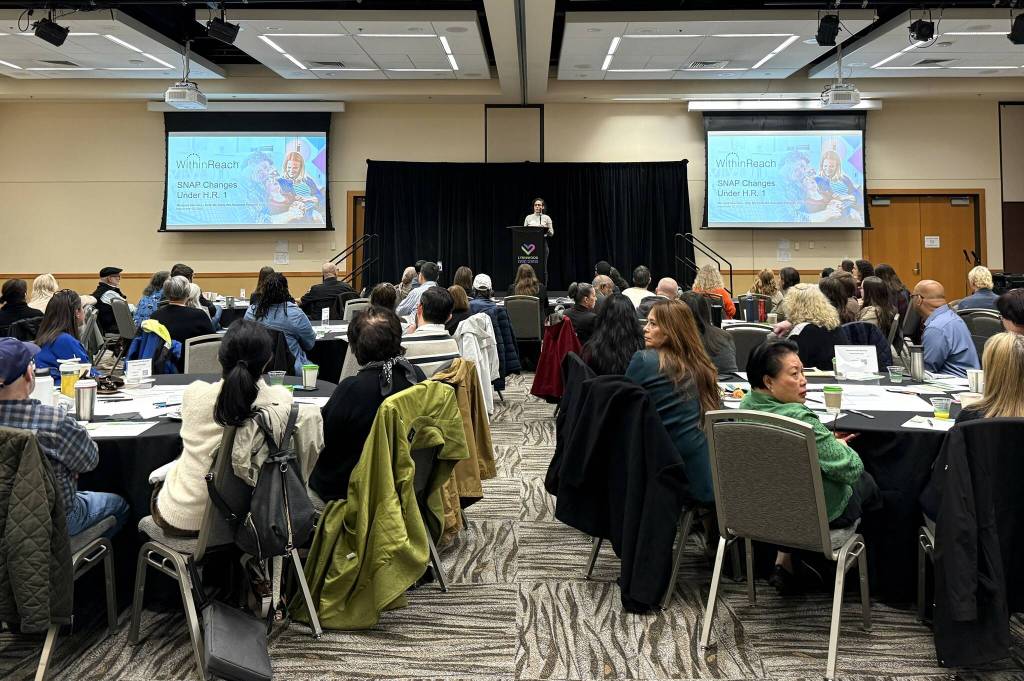
LYNNWOOD — More than 100 people working for community organizations gathered at the Lynnwood Event Center on Tuesday to learn more about cuts to Medicaid and the Supplemental Nutrition Assistance Program, also known as SNAP.
Attendees of the event, hosted by Verdant Health Commission, collectively serve tens of thousands of people in Snohomish County, according to Verdant spokesperson David Lee.
“Don’t lose sight of the people you’re sitting with,” Mountlake Terrace Mayor Steve Woodard said at the start of the event. “Teamwork makes the dream work.”
In July 2025, Congress passed a spending bill that included sweeping cuts to Medicaid and SNAP. Some of the cuts have already taken effect, while some work requirements will go into effect Jan. 1.
An overarching theme from community leaders on Tuesday was making sure people know they may still have options for medical coverage and food assistance despite the cuts.
Giselle Zapata-Garcia, equity and community engagement manager for Public Health – Seattle and King County, walked the group through upcoming changes to Medicaid.
In Washington, those enrolled in Apple Health for Adults will need to either make at least $580 in monthly income, enroll in an educational program for at least half-time or participate in a work program or community service for at least 80 hours per month. Several people will be exempt from the work requirements, including those who are pregnant, foster youth or former foster youth under age 26 and disabled veterans, among other exemptions. A full list is available at hca.wa.gov.
In 2027, clients will be able to self-attest that they meet a work requirement exemption. In 2028, the state will use available data sources to verify exemptions. If they’re unable to verify, then they will request additional documentation from the client. Most people will need to renew their Medicaid eligibility every six months.
At least 200,000 people in Washington are expected to lose coverage by the end of 2027, according to the Washington State Health Care Authority. In October, an estimated 10,000 Washingtonians lost Medicaid coverage after changes to eligibility requirements went into effect for refugees, asylees and other lawfully present immigrants.
In addition, lawfully present immigrants will no longer be eligible for advance premium tax credits, which helps reduce monthly premiums.
Some people who don’t meet Medicaid requirements have other healthcare options in Washington, Zapata-Garcia said, including Emergency Medical, Pregnancy Medical, After Pregnancy Coverage and Medical Care Services.
People also have the option to purchase a medical and dental plan with the Washington Healthplanfinder. Open enrollment is currently open and runs through Jan. 15.
“We want to make sure folks are aware that there are options out there, and to at the very least check in with a certified health insurance navigator to look at what your options are,” Zapata-Garcia said.
On Nov. 21, King County is holding an open enrollment event at Connect Casino Road in Everett. More information is available on the King County website.
The Medicaid cuts come as people are already navigating changes to SNAP. While people aged 55 or older or caring for a child under 18 were previously exempt from requirements to work 80 hours per month, the exemption now only applies to people aged 65 or older or caring for a child under 14. Military veterans and people who are homeless also lost the exemption.
Certain immigrants are transitioning from federal SNAP to state-funded food assistance, but no reapplication is required, and benefit amounts are expected to remain the same, said Maricruz Sanchez, assistant director of Help Me Grow Washington. Help Me Grow Washington helps families, including many in Snohomish County, navigate SNAP and other public benefits.
The spending bill also includes changes to utility reductions, particularly related to the Low-income Home Energy Assistance Program. As a result, some households may see a reduction in SNAP benefits, Sanchez said.
Sanchez said that she is concerned that people will decide not to apply for or renew SNAP after hearing about the cuts when many people could still be eligible.
“Sharing accurate information right now is critical, helping to counter some of the misinformation that might be going around,” Sanchez said. “Again, not everyone is losing benefits.”
Some of the event also focused on housing and utility billing assistance. After the local 211 hotline began operating out of Seattle at the end of 2025, Volunteers of America Western Washington launched VOAWW Connect, and its own phone line — 360-VOA-HELP — to maintain local support. Part of VOAWW Connect is coordinated entry, a program that helps connect people who are homeless or at risk of being homeless with housing.
“You can’t have a conversation about things that make you healthy and not talk about housing,” Verdant Superintendent Alison Poulsen said.
Missy Wilch, energy assistance program manager at Snohomish County PUD, spoke about how, in addition to bill assistance, PUD is working on raising awareness of other cost-reducing measures, such as conservation and weatherization. She also encouraged strong partnerships between Snohomish County PUD and other community organizations.
“Those 385,000 meters that are in those homes, we’re the only entity that I see that’s in every single one of those homes,” Wilch said. “… We are literally the connection point. We’re the grid. So I think we’re in a very unique position to try to make these partnerships to connect every single one of those homes.”
Jenna Peterson: 425-339-3486; jenna.peterson@heraldnet.com; X: @jennarpetersonn.