1
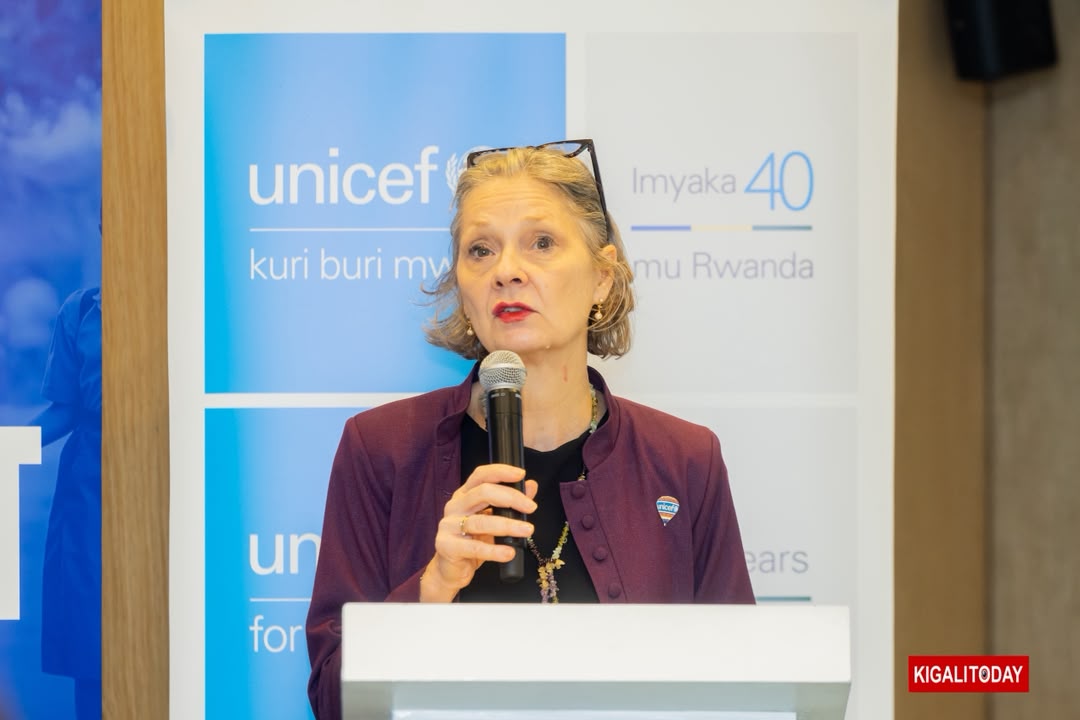
UNICEF Rwanda Representative Lieke van de Wiel
Kigali – As grants decline and domestic financing takes over the biggest share of its budget needs, the United Nations is urging the government to protect and sustain funding for children’s sectors.
The call is contained in the FY2026/27 Budget Brief launched on Thursday by UNICEF Rwanda in collaboration with the Ministry of Finance and Economic Planning (MINECOFIN). The report examines public spending on education, health, social protection, and water, sanitation and hygiene (WASH).
The brief says Rwanda’s economy remains resilient, with the national budget rising to Frw 7,796.3 billion for 2026/27, a 12.1 per cent increase from the revised 2025/26 budget. Domestic resources now finance 67.6 per cent of public spending, while external grants account for 7 per cent.
But spending on services that directly benefit children is growing much more slowly.
The combined allocation to education, health, social protection and WASH has increased by only 4.2 per cent to Frw 1,711.3 billion, equivalent to 22 per cent of the national budget. This is below projected inflation of 10.5 per cent, meaning the sectors could have less purchasing power despite receiving more money.
Their share of the national budget has also fallen from 26.8 per cent to 22 per cent over five years. In real terms, the allocation is now lower than it was in 2023/24.
The report warns that this comes at a time when households are facing higher food, energy and housing costs. Food alone accounts for nearly two-thirds of spending among poorer households.
UNICEF Rwanda Representative Lieke van de Wiel said sustained investment in children had already produced measurable results.
“Rwanda has shown what sustained investment in children can achieve. Fewer children are dying before the age of five, more children are completing primary school, and more families have moved out of poverty,” she said.
She said protecting these investments as the government prepares its 2027/28 budget would help build a healthy and skilled workforce needed to achieve Rwanda’s Vision 2050.
Education receives the largest allocation
Jeanette Rwigamba, the Head of National Budget Department at the Ministry of Finance and Economic Planning. Economic Planning
Education receives Frw 907.3 billion, making it the largest-funded of the four sectors. About 88 per cent of its budget comes from domestic resources.
However, the brief points to gaps in early childhood education. Pre-primary education, despite recording the fastest growth in enrolment, receives the smallest allocation. One in five primary school pupils also repeats a grade.
UNICEF recommends that countries allocate at least 5 per cent of GDP or 20 per cent of their national budgets to education.
Health faces funding pressure
The health sector has been allocated Frw 500.2 billion, a 0.3 per cent decline from the previous year in nominal terms.
Donors still finance 48.4 per cent of the health budget, leaving the sector exposed to changes in external support. Funding for maternal, child and adolescent health has fallen by more than half since 2024/25.
Social protection loses ground
Social protection receives Frw 157.3 billion, making it the only one of the four sectors with an allocation below its 2022/23 level.
Donor funding has fallen by about one-third, forcing the government to increase domestic financing to fill part of the gap. The report warns that this may not be sustainable without deliberate efforts to protect programmes serving vulnerable children and households.
WASH remains dependent on aid
Water, sanitation and hygiene records the strongest budget growth, with its allocation rising by 15.8 per cent to Frw 146.5 billion.
However, about 61 per cent of the sector’s funding still comes from donors, making it the most dependent on external support among the four sectors.
Even with the increase, inflation-adjusted spending per person remains about one-third of what is estimated to be needed to meet the Sustainable Development Goals by 2030.
The report also examines climate-related spending, which amounts to Frw 761.8 billion. But only a small share reaches child-focused sectors. Climate-related allocations account for about 2 per cent of the education budget, less than 1 per cent of social protection and none of the health budget. WASH is the exception, with nearly half of its allocation linked to climate spending.
Government promises to protect investment
MINECOFIN says it wants to strengthen child-focused budgeting and ensure public resources are used to meet children’s needs and protect their rights.
Jeanette Rwigamba, the Head of National Budget Department at the Ministry of Finance and Economic Planning. Economic Planning
Jeanette Rwigamba, the ministry’s Head of National Budget Department, said the report would help guide decisions as the government prepares the 2027/28 national budget.
“Investment in people remains one of the key pillars of Rwanda’s development agenda. This report, which we prepared together with UNICEF, provides us with evidence-based information as we prepare the 2027/28 budget. We are committed to working with different ministries and partners to ensure that every franc is used in a way that benefits children,” she said.
The report also points to progress in reducing poverty and improving child health. Poverty fell from 39.8 per cent in 2017 to 27.4 per cent in 2024, while extreme poverty declined from 11.3 per cent to 5.4 per cent.
Stunting among children under five fell from 33 per cent in 2020 to 27 per cent in 2025. Under-five mortality declined from 45 to 36 deaths per 1,000 live births between 2019/20 and 2025.
Pre-primary enrolment also more than doubled, rising from 24.2 per cent in 2021/22 to 50.3 per cent in 2024/25.
Despite these gains, about three in ten children still live in poverty, while 11 districts report stunting rates above 30 per cent.
As preparations for the 2027/28 budget continue, the brief calls for stronger domestic financing for social protection and WASH, continued support for maternal and child health, early childhood education and nutrition programmes, and greater attention to children’s needs in climate-related investments.
It also calls for a balance between spending on economic infrastructure and investment in children, arguing that education, health and social protection are essential to building the skilled and healthy workforce needed for Rwanda’s long-term development.
Visited 1 times, 1 visit(s) today