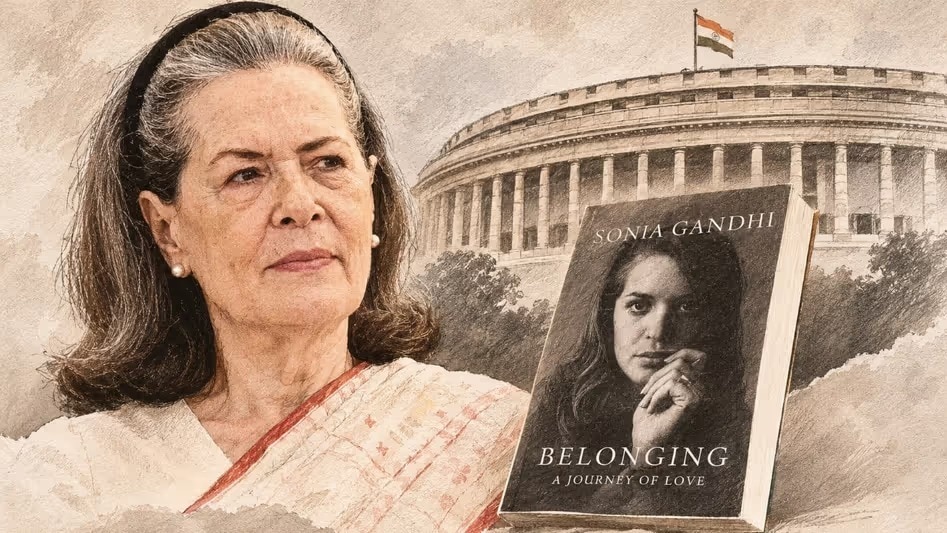
Sonia Gandhi, who has spent more than two decades in Parliament and now sits in the Rajya Sabha, makes a rather surprising assertion in her memoir. Describing India’s parliamentary system, she writes that Lok Sabha members are elected while Rajya Sabha members are nominated. In fact, the 238 Rajya Sabha members are indirectly elected by state legislatures. Only 12 are nominated by the President. It is a basic constitutional distinction, and an unexpected error from someone who has been at the centre of Indian parliamentary politics for so long.
That is hardly the only factual slip in Belonging: A Journey of Love, Gandhi’s much-awaited memoir, released on November 10. The book offers an intimate account of her journey from a small Italian town to India’s most prominent political family, her marriage to Rajiv Gandhi, the assassinations of her mother-in-law and husband, and her eventual emergence as one of the country’s most powerful political figures. Its principal value lies in her personal recollections, many of them moving and revealing. Yet the political and historical narrative that accompanies those memories is dotted with mistakes, some elementary, others substantial enough to alter the understanding of events.
An expanded examination of the book has flagged 55 factual and contextual issues. Of course, not all are of equal significance. But these errors establish that the manuscript needed more rigorous scrutiny before publication.
Consider some straightforward examples. Gandhi writes that the Rashtriya Swayamsevak Sangh (RSS) was founded in 1921. It was established by KB Hedgewar in Nagpur in 1925. Her account of Ahmed Patel, her long-serving political secretary and one of her closest confidants, places his death from Covid-19 in 2022. Patel died on November 25, 2020. In describing the 2002 Gujarat riots, she calls Ahmedabad the state capital, although Gandhinagar has held that position since 1970. She also says four coaches of the Sabarmati Express were set on fire at Godhra, whereas the fatal blaze involved coach S-6.
Such errors may be dismissed individually as failures of memory or editing. Collectively, they raise a more serious question about how carefully the historical material was checked by the editors of the book.
There are other mix-ups too. She correctly states that the BJP won 282 Lok Sabha seats in 2014 but puts the National Democratic Alliance’s tally at 353. The NDA actually won 336 seats that year. The figure of 353 belongs to the 2019 election. The memoir thus conflates the results of two general elections separated by five years. In its account of the 1984 election, the book also gives Congress 405 seats in one passage and 404 in another.
The account of the 1999 Kargil conflict is particularly problematic. Gandhi writes that Prime Minister Atal Bihari Vajpayee was being hosted in Islamabad by Nawaz Sharif when Ladakhi shepherd Tashi Namgyal spotted Pakistani infiltrators along the Line of Control. Vajpayee’s historic peace visit was to Lahore on February 20–21, 1999. Namgyal spotted the intruders on May 3, more than two months later.
It then says Indian soldiers regained the occupied territory over the following 10 months. The Kargil conflict unfolded between May and July 1999, with India marking July 26 as Kargil Vijay Diwas. In the same discussion, Gandhi describes the fall of Vajpayee’s government in April 1999 as a defeat on a no-confidence motion. Technically, his government lost a confidence motion, by 269 votes to 270. The distinction matters because it was the government itself that had sought the House’s confidence.
The account of Rahul Gandhi’s criminal defamation case contains inaccuracies. Sonia Gandhi writes that the case was brought in 2023 over remarks made three years earlier and that the Gujarat High Court sentenced her son to two years in prison. The remarks were made during a campaign speech in April 2019, and the complaint was filed that year. A magistrate’s court in Surat delivered the conviction and sentence on March 23, 2023. The Gujarat High Court subsequently declined to stay the conviction.
The memoir further states that Rahul was restored to Parliament a year later after the Supreme Court suspended his prison sentence. In fact, the Supreme Court stayed his conviction on August 4, 2023, and his Lok Sabha membership was restored three days later. Less than five months had passed since his disqualification. Staying a conviction and suspending a sentence are legally distinct actions, with different implications for parliamentary membership.
Errors also surface in the memoir’s treatment of international affairs. Gandhi dates Nelson Mandela’s visit to India to receive the Bharat Ratna to 1991, although it occurred in October 1990. She identifies the leader of India’s delegation to Mandela’s 1994 presidential inauguration as President R.K. Narayan. The delegation was led by Vice-President K.R. Narayanan. The 1985 Commonwealth Heads of Government Meeting in Nassau is described as the 49th such summit. It was the eighth. Deng Xiaoping is called China’s president during Rajiv Gandhi’s landmark 1988 visit, although Yang Shangkun held that office. Deng was China’s paramount leader and chairman of the Central Military Commission.
Even the opening account of her romance with Rajiv raises a chronological question. The memoir describes Sonia as 19 and Rajiv as 21 when they first met in Cambridge. Yet it places their meeting before June 1965 and recalls a January encounter. If that meeting occurred in January 1965, Sonia, born in December 1946, would have been 18 and Rajiv, born in August 1944, would have been 20. Either the ages or the chronology needs clarification.
There are also passages where the problem is less a demonstrable error than an incomplete presentation of history. Gandhi writes that the Supreme Court’s 2001 ruling effectively upheld Rajiv Gandhi’s position on the Muslim Women (Protection of Rights on Divorce) Act of 1986, enacted after the Shah Bano controversy. The court did uphold the Act’s constitutionality, but it also interpreted the law to require a reasonable and fair provision for a divorced woman’s future extending beyond the iddat period. Omitting that crucial qualification gives a misleadingly simple account of a complex judicial settlement.
None of this necessarily diminishes the emotional force of Gandhi’s account of love, loss and political responsibility. Her memories of Rajiv, her relationship with Indira Gandhi and her personal struggles after successive family tragedies offer a perspective unavailable to most historians. Indeed, those first-person experiences are what make the book valuable. The difficulty arises when recollection moves from the private to the public realm, where dates, records and the actions of institutions can be independently established.
A memoir is not expected to be a history textbook. Memories can be selective, and even the most careful authors make mistakes. But Belonging is more than a personal story. It also recounts defining moments in India’s political history through the eyes of someone who witnessed many of them at close quarters. That proximity gives the memoir its value but also makes factual accuracy all the more important.
The errors do not necessarily suggest deliberate misrepresentation. They do, however, reveal a pattern of avoidable mistakes involving historical facts and public records that could easily have been verified. A more rigorous fact-check would have ensured that inaccuracies in the historical narrative did not distract the personal story Sonia Gandhi set out to tell.
– Ends