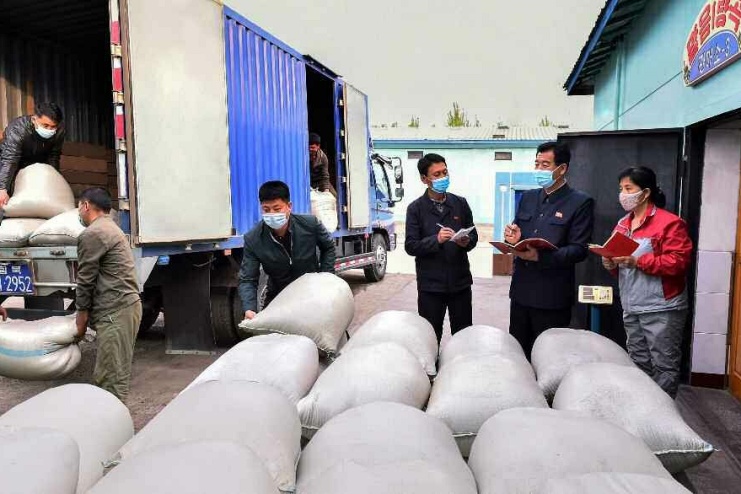
A photo published by North Korean media in January 2023 of bags of grains being unloaded on a truck in front of a grain selling facility. (Rodong Sinmun-News1)
For decades, the price of a kilogram of rice at the market has served as the single most important gauge of North Korea’s economy. That yardstick has grown far less reliable in 2026, as state-run grain stores now sell rice alongside private markets at prices that sometimes undercut the market, sometimes trail it and occasionally exceed it.
After the economic crisis of the 1990s gutted the state ration system, informal markets known as jangmadang spread across the country and drove North Korea’s marketization. The rice prices North Koreans actually paid were set in these markets rather than by the state’s official fixed prices. As the jangmadang grew into state-sanctioned general markets, the market price of rice became the real cost of food for ordinary people.
Early in Kim Jong Un’s rule, market prices followed a relatively simple structure centered on rice prices and market exchange rates. Rice was the most important commodity in daily life, while dollar and yuan exchange rates served as a benchmark for imported goods and a wide range of other products. This arrangement can be described as North Korea’s “market 1.0” pricing system.
Rice prices moved with the volume of grain arriving from farming regions, wholesale prices, transport costs and local supply and demand. Merchants tracked prices in other regions along with exchange rates, and retail prices followed whenever wholesale prices rose.
Authorities tried at times to control market prices, but because most people bought their food at general markets, market prices ultimately shaped daily life and food security. That explanation alone, however, no longer captures how rice prices work in North Korea today.
The biggest factor is the rise of state-run grain stores. Since authorities began selling grain through state distribution channels, North Koreans can buy the same rice at general markets, from neighborhood rice traders or at grain stores. The relationship between grain store prices and market prices, however, is anything but simple.
Grain stores undercut markets in Sinuiju, but not in Pyongsong
Recent Daily NK reporting on food distribution in Sinuiju, North Pyongan province, and Pyongsong, South Pyongan province, found clear differences between the two cities.
In Sinuiju, grain stores generally sell grain about 5% to 7% below market prices, and use of the stores has risen as a result. A local source estimated that Sinuiju residents buy roughly 60% of their food at general markets and about 40% at grain stores.
In Pyongsong, by contrast, sources said prices at markets and from neighborhood rice traders are actually slightly lower than at the stores. People living near grain stores do use them, but the stores lack enough grain to meet demand, so most shoppers in the city still turn to markets and neighborhood traders.
In one city, grain stores act as a check on market prices, while in the other, short supplies limit their influence on what food costs.
This marks a clear break from the past, when the price of rice at the market was simply what North Koreans understood rice to cost. Now a second price, set at the grain store, sits alongside it and does not work the same way across the country.
The way grain stores now operate says even more about where North Korea’s food economy is headed. When the stores first appeared around 2021, they drew attention as a tool for the state to intervene in food distribution and reduce reliance on markets. Recent reporting shows, however, that market players and market-style pricing are now moving inside the state’s own distribution network.
Daily NK reported in August that in some areas, donju who once ran large grain trading businesses in the markets had begun handling procurement and sales for grain stores. Donju, meaning “masters of money,” are newly wealthy entrepreneurs who finance much of North Korea’s private commerce. State agencies manage the stores on paper, but merchants with capital and trading networks play a major role in actually securing grain.
That shift appears to be narrowing the price gap between grain stores and markets. Grain store prices that started well below market rates have recently closed to within about 5% of market prices in some areas.
Reporting in Sinuiju also found wholesalers supplying grain to grain stores, while some grain bought at the stores flowed back into general markets. That overlap makes it hard to treat state distribution and market distribution as two separate systems.
When grain store rice prices top the market
The shift has begun to show up in grain store prices themselves, not just in who supplies the stores. In September, grain stores in parts of South Hwanghae province sold rice at 56,000 North Korean won per kilogram while market prices hovered around 50,000 won.
Rice at the grain stores, which are supposed to stabilize market prices, ended up costing more than 10% above the market. Some stores reportedly raised the price again to as much as 60,000 won, showing that grain store prices are not set independently of the market the way the state’s official fixed prices once were.
North Korea is issuing “grain purchase vouchers” through a smartphone electronic payment app that can be used at some grain stores. (Google generative AI model Gemini)
Like any merchant, grain stores also have to secure their own grain before they can sell it. What they paid farms or producers, intermediate supply costs and the amount of grain available locally all affect what they charge. In other words, a state signboard over the door does not free the stores from the pull of market supply and demand.
Early in Kim Jong Un’s rule, the drivers of rice prices were relatively clear. Rice from farming regions passed through long-distance haulers, wholesalers, middlemen and market retailers before reaching general markets, and the wholesale prices and supply conditions formed along the way set consumer prices.
That basic market supply chain still works in Sinuiju today. Sources said grain moves from farming regions through long-distance haulers to local wholesalers, then on to middlemen and finally to retailers.
Grain stores and state agencies have now entered the picture as new players, joined by the donju and wholesalers who supply the stores. As a result, North Korean rice prices can no longer be split neatly into market prices and official state prices, as they once were.
The current structure looks more like grain store prices layered on top of the existing chain running from farm-gate prices to wholesale prices to market prices. That layering explains why grain store prices sometimes check the market, sometimes follow it and sometimes even push market prices higher.
Lim Soo-ho, a senior research fellow at the Institute for National Security Strategy, said grain store prices are not set uniformly by the central government. The institute is a Seoul-based think tank affiliated with South Korea’s National Intelligence Service.
“In principle, local authorities set grain store prices slightly below the market, reflecting market prices in their area,” Lim said. “As the state suppresses market sales, gaps in market prices between regions can widen, and that can create differences in grain store prices, which use those market prices as a benchmark.”
Lim also noted that local government finances can affect prices. “With local authorities facing heavier financial burdens from projects such as regional housing construction, they have no choice but to consider fiscal issues when setting prices,” he said. “If they have room in their budgets, they can lower prices, but a shortage of funds can push prices up.”
Exchange rates no longer explain rice prices on their own
The relationship between exchange rates and grain prices also deserves attention. In the past, rising exchange rates in North Korean markets tended to lift the prices of imported goods, with prices of key commodities moving in the same direction, but that link has recently started to weaken.
Daily NK’s regular survey of North Korean market prices offered a clear example of this split in September. A kilogram of rice in Pyongyang cost 41,100 won on Sept. 13, down 8.9% from two weeks earlier. Rice prices also fell 8.8% in Sinuiju and 8.6% in Hyesan over the same period.
The won-dollar market exchange rate in Pyongyang, however, rose 1.9% to 69,500 won, and Sinuiju and Hyesan showed a similar trend. The dollar gained ground against the North Korean won, yet rice prices moved in the opposite direction.
Analysts attributed the decline to improved food supplies, as state agencies and enterprises handed out more grain ahead of Sept. 9, the anniversary of North Korea’s founding, and the Chuseok harvest holiday, while freshly harvested corn reached the markets at the same time.
That suggests exchange rate swings alone can no longer explain North Korea’s rice prices. Even when a rising exchange rate puts upward pressure on prices, rice can move the other way depending on grain supply factors such as harvest volumes, holiday distributions, grain store supplies and wholesaler stockpiles.
Through the grain stores, North Korean authorities have stepped back into food distribution. The result, however, does not look like a return to the state supply system that existed before the markets took hold. The state built the grain stores, but it relies on market donju and wholesale networks to secure grain and set prices, while markets in turn respond to grain store supplies and prices.
If markets once filled the void left by the state, the state is now pulling markets into its institutions and absorbing their pricing mechanisms along the way. Checking what rice costs at the market will no longer be enough to read the state of North Korea’s food economy.
Observers will also need to track what grain stores charge, who secures their supplies, whether more grain is flowing to markets or grain stores, and how wide the price gap between them is. Those questions are where the outlines of North Korea’s “market 2.0” under Kim Jong Un are likely to come into clearer focus.
“Beyond rations, the authorities are trying to absorb the grain trade that took place in existing markets into the state distribution network,” Lim said. “Given the low share of grain store use, procurement through state purchasing and imports still does not seem to be working as intended.”
“If the state could supply enough grain through grain stores to meet food demand, it would have some room to control prices,” Lim added. “Given that market prices keep rising, however, supplies do not appear to be sufficient, and the upward trend in rice prices is likely to continue for the time being.”
Read in Korean
About This Translation
This article was originally written in Korean and translated with the help of generative AI tools. It was then edited by a native English-speaking editor. All AI-assisted translations are reviewed and refined by our newsroom.
Reporting from Inside North Korea
Daily NK operates networks of sources inside North Korea who document events in real-time and transmit information through secure channels. Unlike reporting based on state media, satellite imagery, or defector accounts from years past, our journalism comes directly from people currently living under the regime. We verify reports through multiple independent sources and cross-reference details before publication.
Our sources remain anonymous because contact with foreign media is treated as a capital offense in North Korea — discovery means imprisonment or execution. This network-based approach allows Daily NK to report on developments other outlets cannot access: market trends, policy implementation, public sentiment, and daily realities that never appear in official narratives.
Maintaining these secure communication channels and protecting source identities requires specialized protocols and constant vigilance. Daily NK serves as a bridge between North Koreans and the outside world, documenting what’s happening inside one of the world’s most closed societies.