An emergency effort to rescue tens of thousands of orchids from being razed for a road-building projects in southern India has been hailed a success in a recent study.
Many species of orchids are classified as epiphytes, which means they grow on trees, using them as physical support frames. When these host trees are killed, the orchids can die along with them. Researchers in the state of Kerala collected more than 27,000 such orchids from trees that had either been felled or were scheduled to be cut down for road development. The rescued orchids were then planted on trees in two public wetlands and a beach. About two years later, nearly three-quarters of those orchids were still alive, researchers found.
Among the rescues were 12 orchid species endemic to the region. Eleven of those 12 aren’t even listed on the IUCN Red List, meaning their conservation status isn’t known.
“There is a kind of silent extinction going on with some of these orchids,” Viswambharan Sarasan, study co-author and an expert in orchid conservation at the Royal Botanic Gardens, Kew, in the U.K., told Mongabay in a video call. “We don’t know how many of these orchids are being lost to road-building program over the last 15-20 years.”
Kerala is an orchid hotspot, with 271 known species. Many grow on trees in forests, roadsides, and tea and coffee plantations in the biodiverse Western Ghats mountain range.
Sarasan and his colleagues planted the 27,324 rescued orchids in three public areas: Kappad Beach; Sarovaram Bio Park, an urban mangrove wetland; and Malabar Botanical Garden, also an urban wetland. After 12-24 months, more than 19,500 orchids, nearly 71%, had survived. Of the 6,126 endemic orchids, nearly 55% survived.
Sarasan said many of the endemic orchid species grow in cold, hilly areas, so translocating them to warmer areas, near sea level, was risky. But they not only survived, many also flowered and produced seed capsules. “That was a really big surprise,” he said.
The researchers also used the opportunity to generate public awareness about orchids. At Sarovaram, they tagged 10 orchid species with a QR code that visitors could scan to learn more about the plants and how they ended up there. The park receives nearly 511,000 fee-paying visitors annually, the authors say, and the 10 species generated more than 126,000 QR-code scans over two years. Sarasan said that to his surprise, the QR code traffic was equally good for orchids with very tiny non-showy flowers, as for those with visually striking ones.
The study shows that “rescue translocation can transform orchids facing otherwise inevitable destruction during infrastructure development into living conservation assets,” the study authors write. However, they caution that rescue translocation should be “a last resort when orchid-bearing trees cannot be retained.”
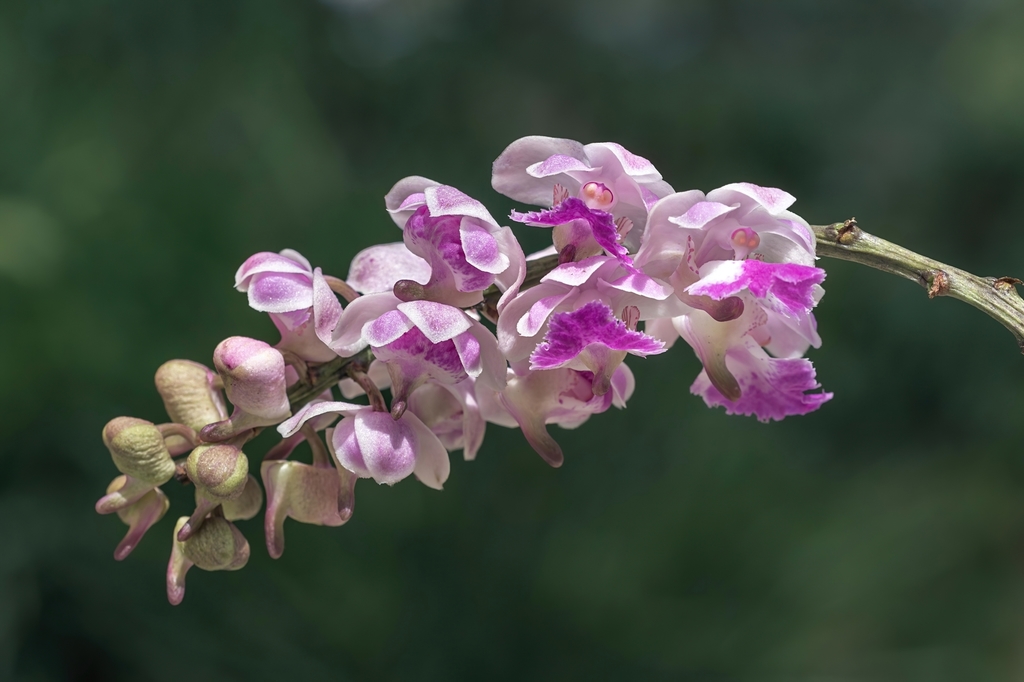
Banner image: Aerides crispa, an orchid species endemic to the Western Ghats, was among those rescued. Image © tspkumar via iNaturalist (CC BY-NC 4.0).