EVERETT — State transportation officials unveiled a preferred design for a replacement of the US 2 trestle during a state Senate committee meeting on Wednesday in Everett.
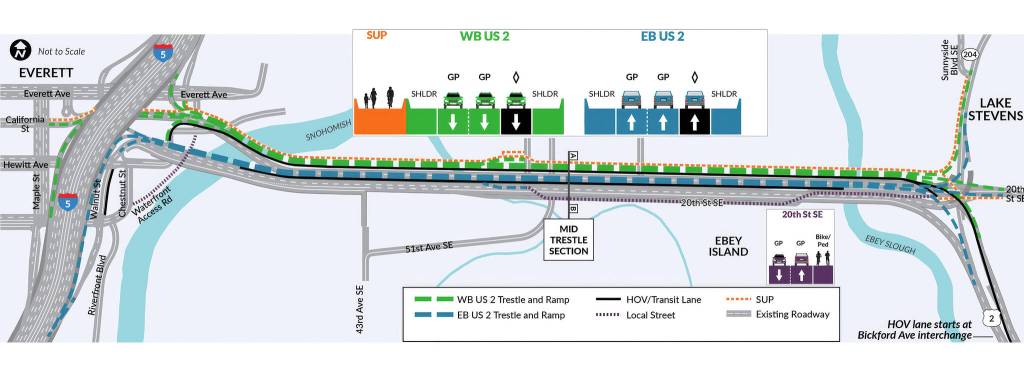
The design plans, which will be released to the public as part of an open house in December, call for three lanes along both directions of the US 2 trestle, along with full-width shoulders and a path for cyclists and pedestrians on the north side of the westbound highway. One lane in each direction will be a High Occupancy Vehicle lane, or HOV lane, set aside for transit vehicles and carpooling drivers.
The plans also include three westbound off ramps into downtown Everett, connecting drivers to California Street, Everett Avenue and Hewitt Avenue, said Cameron Kukes, an assistant regional administrator at the Washington State Department of Transportation.
One of those ramps will include an HOV lane with access to Everett Station for transit users. The ramps connecting the trestle to I-5 will also both be rebuilt to include two lanes to relieve traffic, Kukes said.
The east side of the trestle will see new lanes added between the trestle and 20th Street Southeast, as well as onto US 2.
Kukes said those connections between the bridges and the neighboring roadways and highways will provide the biggest benefit for drivers and transit users.
“What we found was that it didn’t really matter how many lanes you put on the new trestle itself if you didn’t address the connections to the surrounding transportation network,” Kukes said. “It wasn’t going to provide the benefits that we really need here.”
The trestle is made up of the series of bridges and other structures that connect east Snohomish County to Everett and I-5. It faces significant congestion during peak hours and is subject to risk of instability if a major earthquake were to occur, according to WSDOT. The agency has spent years and millions of dollars to study potential options to replace the aging trestle.
WSDOT will release its draft planning and environmental linkages study, which includes the preferred design after having analyzed numerous options for how the new trestle could be built, in December. It will be open to public comment through January, Kukes said.
The complete cost of the trestle upgrades could range between two to four billion dollars, said Allison Krutsinger, a director of external affairs at WSDOT, but she stressed those numbers are “very, very preliminary.”
Along with federal, state and local funding, it’s possible the Legislature could add tolls to the trestle as a way to help pay for the project, though no decisions on tolling have been made yet, Krutsinger said. The agency is also considering a public-private partnership to
After further design work, the construction could begin in 2032, but that date is contingent on finding enough funding to start building the new trestle, a large hurdle to clear for a state that also has to fund a massive $14 billion bridge replacement project over the Columbia River between Vancouver and Portland, Oregon. Construction could take six to 10 years to complete.
Ray Stephanson, the former mayor of Everett and the CEO of Economic Alliance Snohomish County, spoke at the committee meeting Wednesday and said that finding a fix for the trestle is “not just a Snohomish County issue, this is really a Puget Sound regional issue.”
“All of these people from all over the Puget Sound region come into Everett to build the world’s best airplanes,” said Cassie Franklin, Everett’s mayor. “If we don’t proactively invest in this infrastructure now, the challenges are only going to get more expensive and more disruptive over time.”
For Ric Ilgenfritz, the head of Community Transit, the design options included two-way HOV lanes for transit vehicles will be “Critical to effective transit” in the corridor,” he said Wednesday.
“The potential of two-way transit functionality in this corridor is really exciting,” Ilgenfritz told the committee Wednesday. “It’s not only a pathway to providing effective and fast and high quality service in that corridor … it releases us from some constraints that limit our ability to grow service countywide.”
Will Geschke: 425-339-3443; william.geschke@heraldnet.com; X: @willgeschke.