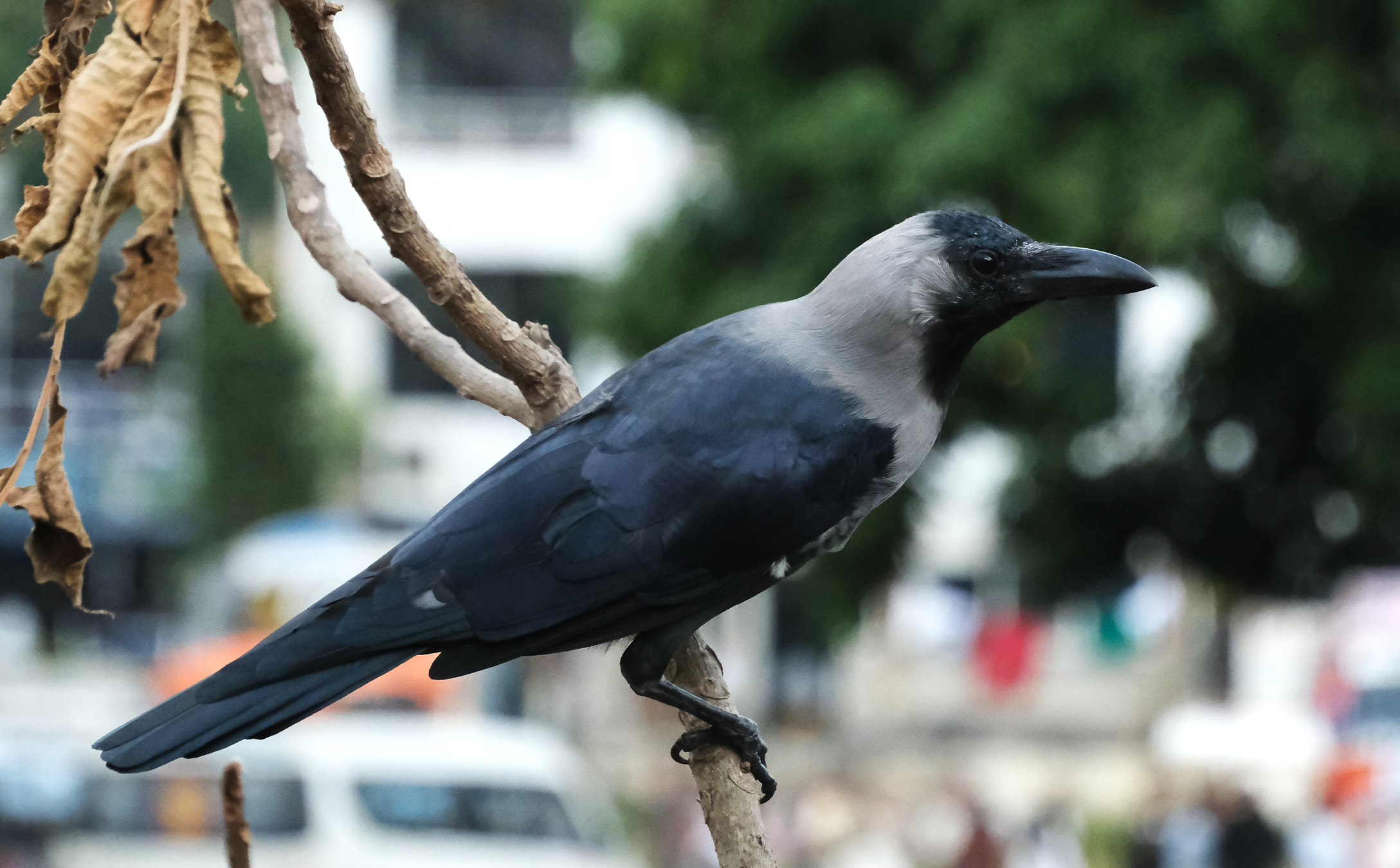
- In Nepal’s capital Kathmandu, house crows are venerated as messengers of god and ecologists praise their role as nature’s scavengers, but people are increasingly wary about their presence.
- A Valley-wide study found crows to be the most common species at urban sites and while no published trend shows their numbers rising, anecdotal evidence suggests a positive trend.
- Urban sprawl, fewer old trees and plentiful food waste favor generalist birds, like house crows and black kites, which now nest on power lines and poles.
- After an avian influenza outbreak at the city’s Central Zoo involving crows, a Department of Livestock Services veterinary officer has called for closer surveillance of the birds, but ecologists say poor waste management and habitat loss are the real problems.
See All Key Ideas
KATHMANDU — Ramesh Dulal was 13 years old when he began “communicating” with crows. He started making sounds resembling the crows, who would respond by gathering around him, he recalls.
Popularly known as kagé, crows are called kaag in Nepali, and Nepal observes an annual day of the crow, called Kaag Tihar, which falls around the Hindu festival of Deepawali, or Diwali. On this day, Dulal, now 35, organizes what he calls the Crow Conference every year. This year, it was on Saturday last week, Nov. 7.
At the event every year, Dulal, a folk music singer and activist, holds a microphone and produces a series of guttural calls, “caw … caw … caw,” imitating a crow. As his calls echo through powerful speakers, flocks of crows gather from surrounding trees, rooftops and electrical poles. After several minutes, he stops and addresses the people who have come to witness the event. He speaks about the religious significance of crows and their ecological role.
Then the conference ends.
While Dulal wholeheartedly welcomes crows to his event, many residents in Kathmandu would rather shoo them away, especially after the birds were blamed for a bird flu outbreak at the Central Zoo. But crows are thriving in the city as trees disappear and waste piles up, and birds that live on scraps are gaining ground over those that need trees.
A house crow looks on during the morning prayers at the Buddhist Bodha Stupa, Bodha, Kathmandu. Image by Wonderlane via Flickr (CC BY-NC 2.0).
The messengers of a god
Regardless of their reputation within the community, the birds have long been a part of Kathmandu’s cultural life. Devotees have dedicated a temple to the bird in the eastern fringe of the Kathmandu Valley. Similarly on the first day of the five-day-long festival of lights, Hindus worship crows as messengers of Yama, the god of death. People offer them garlands and food to seek their blessings for a long life.
Beyond religion, crows play an important ecological function: They help remove decaying waste. “Crows help keep the surroundings clean by feeding on carcasses.,” says Kamal Raj Gosai, an ornithologist and associate professor at Tri-Chandra Multiple Campus, Tribhuvan University, Nepal. “They are often regarded as nature’s scavengers,”
Crows are also considered highly intelligent and adaptable, and studies have shown they can adjust to a wide range of environments, including densely populated cities.
A crow eats food offered for crows on Kaag Tihar in Kathmandu. Image by Poonamkulung via Wikimedia Commons (CC BY-SA 4.0).
Urban expansion and a changing bird community
Despite their cultural and ecological importance, crows’ relations with humans are strained for no fault of their own, researchers say. Citing changes in the city’s habitat and waste management practices, which favor their population growth, they say humans are the reason crows are falling into disrepute.
A study based on three decades of satellite imagery found that Kathmandu’s urban area expanded by approximately 124% between 1989 and 2018. Another study found that green space in Kathmandu Metropolitan City declined by 54% between 1975 and 2025. Experts say these changes are directly affecting urban biodiversity.
According to ornithologists, the Kathmandu Valley’s bird community is becoming ecologically lopsided. Native species that depend on specific habitats are being displaced, while generalists, which can survive on varied food in varied environments, are becoming more common. House crows (Corvus splendens) and black kites (Milvus migrans) are among the species that have become conspicuous in the urban landscape.
Bird Conservation Nepal has counted birds along 24 fixed transects across the valley every year since 2016. House crows regularly rank among the most commonly recorded species, placing among the top five in its winter 2022 count. A valley-wide study led by Dinesh Bhusal of Nepal’s Tribhuvan University, published in 2024, found the house crow was the most common species at urban sites, and suggests that degrading green space may help such generalist species colonize the city.
As roads were widened and the city grew, the road department removed many old trees. With fewer natural perches and nesting sites, crows have increasingly turned to electrical wires and utility poles, the Bhusal-led study suggests.
Ornithologist Gosai says the removal of old trees during road expansion, particularly along the Kathmandu Ring Road, a 27-kilometer (16-mile) eight-lane highway, has reduced habitat for several species, including egrets and crows. Meanwhile, abundant food waste has allowed crows and black kites to stay concentrated in the heart of the city.
“Large quantities of discarded food and exposed waste from meat shops have contributed to the unusual increase in crows and kites in Kathmandu,” he tells Mongabay. “Crows are intelligent birds. Even when trees are unavailable, they can quickly find alternative nesting sites in telephone towers and crevices in new buildings.”
Amid rapid infrastructure expansion and the loss of mature urban trees, house crows make use of remaining boughs to nest above a crowded Kathmandu neighborhood. Image courtesy Dinesh Bhusal.
Black kites and a house crow at Bagmati River in Bagmati Province, Nepal. Image by Sudan Shrestha via Wikimedia Commons (CC BY-SA 3.0).
When urban greening favors only a few species
The kinds of trees planted in cities can also influence which birds survive. Hem Bahadur Katuwal, a bird ecologist from Nepal at the Xishuangbanna Tropical Botanical Garden, the Chinese Academy of Sciences, in Yunnan, southwest China, says removing mature urban trees displaces specialist birds, which depend on particular habitats.
“When old and large trees are cut down, specialist birds lose their habitats. Eventually, only functional generalist species, such as crows, which can survive under almost any conditions, remain,” he tells Mongabay.
Some greening policies may unintentionally favor adaptable species. Under local building regulations, homeowners are generally required to plant trees when obtaining approval for house construction, and many choose avocado, partly because it is easy to grow. The Bhusal study found that crows, the most abundant nesting birds in the valley, nested in non-native trees such as avocado, as well as on electricity lines and poles. But Katuwal cautions that more tree cover does not automatically mean more biodiversity. “Planting only one species of tree cannot protect bird diversity,” he says. “Instead, it [could] encourage monoculture.”
Gosai disagrees on the role of avocados. He says that planting avocado or other trees in private compounds does not necessarily benefit crows in a meaningful way or restore ecological balance, because crows nest in a variety of structures, from telephone towers to buildings, whether or not traditional trees are available. He links their growing presence around rivers and other urban areas to food in garbage dumps.
Open dumping of waste along riverbanks and in public spaces, a common practice in Nepal, gives crows easy access to food in large numbers. Image by Wolf Gordon Clifton / Animal People, Inc. via Flickr (CC BY-NC 2.0).
Nuisance and questions about disease
For many Kathmandu residents, the growing presence of crows is a nuisance. Droppings, food scraps and occasional pieces of meat can foul rooftops, water tanks and living spaces.
Mamta Shah, a resident of Bhaktapur, a city in eastern Kathmandu Valley, says she has struggled since crows began nesting around her house. “I am fed up with crows coming and staying around my house,” she says. “What is the point of them sitting here when they leave pieces of meat and all kinds of waste around the house?” She worries that crows carry pathogens along with the remains they bring from elsewhere.
Crows have also been linked to avian influenza. A few months ago, an outbreak of bird flu at Nepal’s Central Zoo, the city’s only zoo, involved crows. The highly pathogenic H5N1 virus is believed to have entered animal enclosures through wild crows moving freely around the city. More than 60 animals and birds, including rare species, died. Others were culled to prevent further spread.
Unique ecological niche
Veterinarians say the outbreak fits a wider pattern. Krishna Prasad Acharya, a veterinarian based in Kathmandu, says that the crow occupies an “unusual ecological niche” as it can find a way, with ease, through human settlements, garbage sites, poultry farms as well as natural areas. This is a risk in the context of Kathmandu: With no land use planning, human populations, poultry farms and wetlands lie close together, heightening the risk of cross-species transmission of diseases.
Ecologists caution against treating crows as the problem. “Any species can become infected with a disease,” Katuwal tells Mongabay. “The idea of eliminating crows from cities or treating them as enemies is entirely misguided. Crows perform an important service by helping clean up urban waste and carcasses. The problem is not the crows; it is our poor waste management and the destruction of habitats. We need to change our negative perception of these birds.”
Gosai also stresses the need to expand green spaces and plant a diversity of species. He says he believes that planting suitable new trees could draw birds away from residential structures and towards more appropriate habitats, even though many old trees were lost along the Kathmandu Ring Road.
Open dumping of waste along riverbanks and in public spaces, a common practice in Nepal, gives crows easy access to food in large numbers, and experts say that same proximity to unmanaged waste can raise the risk of pathogen transmission.
Household debris and plastic waste line the inundated banks of the Hanumantey River in Kaushaltar, Bhakatpur in Kathmandu Valley. While rapid habitat alteration displaces sensitive river species, opportunistic urban scavengers like crows thrive on the open refuse left behind by unchecked municipal expansion. Image by Gobinda Pokharel/Mongabay.
Can Kathmandu make space for its birds?
Local administration Kathmandu Metropolitan City says it has begun addressing bird conservation and green-space protection. Acting Mayor Sunita Dangol says bird conservation has been incorporated into several aspects of its environmental policy this year. “We have included bird conservation in different aspects of our environmental policy this year,” she tells Mongabay.
After concerns were raised about decorative wires and lights installed around trees in the name of beautification, the municipal executive board decided to remove them. Dangol says the city is prioritizing protection of existing trees over felling them for road expansion. “We have adopted a policy of reconsidering road designs to protect trees during expansion projects,” she says. “We are also developing clear guidelines for urban tree planting in consultation with botanists.”
Dulal, who organizes the crow conference, says his relationship with crows goes beyond mimicry. His annual event is an attempt to change how people see birds that are increasingly unwelcome in the city to which they have adapted. “People have started believing that crows directly spread diseases,” he says. “But these birds actually contribute enormously to keeping the environment clean.”
Banner image: A house crow in Pokhara, Nepal. Image by Anita Gould via Flickr (CC BY-NC 4.0).
Delays, biosecurity failures worsened flu outbreak at Nepal zoo, probe finds
Invasives take over native plant spaces in Nepal’s cities
Citations:
Tiwari, D., & Kumar, A. (2025) Evaluating urban growth patterns of Kathmandu in fragile geographies of the middle Himalayas. Discover Cities, 2(1). doi:10.1007/s44327-025-00103-0
Bhusal, D., & Ghimire, P. (2023). Avian urban ecology in Nepal: a call for attention. Nepalese Journal of Zoology, 7(2), 49-59. doi:10.3126/njz.v7i2.60810
Bhusal, D., Ghimire, P., Low, M., Rosin, Z. M., & Timilsina, Y. P. (2025). The diversity and nesting preferences of birds along an urban-rural gradient in the Kathmandu Valley, Nepal. Urban Ecosystems, 28(2), 28. doi:10.1007/s11252-024-01631-0