Synopsis: Kingdom urges adherence to International Court of Justice rulings and outlines priorities for reforming United Nations peace operations.
Cambodia has renewed its commitment to international law, the peaceful settlement of disputes, and United Nations peacekeeping operations, highlighting the importance of judicial institutions and its contribution to global security.
Speaking at two United Nations General Assembly meetings in New York on Thursday and Friday, Deputy Permanent Representative of Cambodia to the UN Yaung Chansophea underscored the role of the International Court of Justice (ICJ) in upholding international law and called for greater support for UN peace operations amid global challenges.
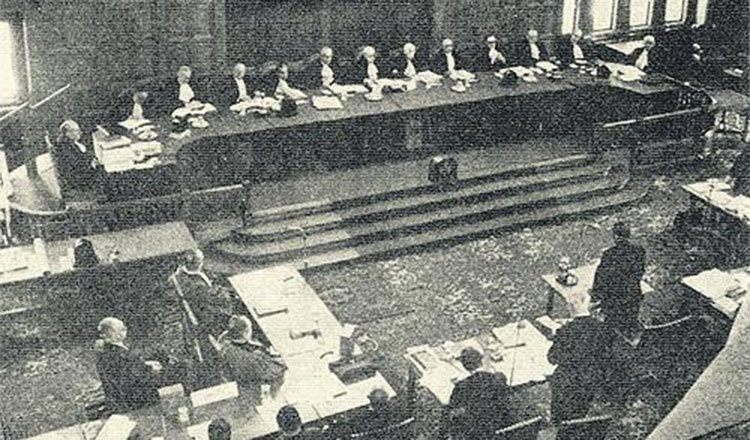
Addressing the General Assembly annual meeting on the ICJ report on Thursday, Ambassador Chansophea described the court as a vital institution for the peaceful settlement of international disputes, guided by its commitment to the rule of law.
He noted that the volume of cases brought before the court over the past two decades reflected the growing need for countries to use judicial mechanisms to resolve disputes peacefully.
“The peaceful settlement of disputes, including through judicial settlement, is enshrined in Article 33 of the UN Charter,” he said, stressing that judgments delivered in contentious cases are final and legally binding.
“Cambodia, therefore, calls for full and effective implementation of and compliance with the court’s decisions,” he added.
The envoy recalled the ICJ’s 1962 judgement and its 2013 interpretation in the case concerning the Temple of Preah Vihear, describing them as contributions to the court’s jurisprudence. He noted that the court’s observations in the case were cited in subsequent proceedings.
“The court serves not only as a guardian of international law, but also as a custodian of the values of the international community: peace, justice and humanity,” he said.
The following day, speaking at the 20th plenary meeting of the General Assembly Fourth Committee, which handles special political and decolonisation matters, Ambassador Chansophea reaffirmed Cambodia’s commitment to UN peacekeeping and outlined priorities for making future missions more effective.
He paid tribute to peacekeepers who died in the line of duty, including 14 Cambodian blue helmets who have died since Cambodia began participating in UN peacekeeping missions in 2006. Their sacrifices, he said, demonstrated the human cost of maintaining international peace as conflicts grow more complex.
He pointed to the UN liquidity crisis, which has forced the repatriation of roughly a quarter of its uniformed peacekeeping personnel.
“Peacekeeping has rarely been more needed and rarely more stretched,” he said, while welcoming the adoption of the 2026 report of the Special Committee on Peacekeeping Operations (C-34) and the Secretary-General review of future peace operations.
He said the two documents provide a foundation for adapting peacekeeping to contemporary challenges through missions that are politically focused and responsive to host countries.
Highlighting Cambodia’s experience, he described the country’s transformation from a former host of UN peacekeeping operations into an active contributor to international security. More than three decades ago, the United Nations Transitional Authority in Cambodia (UNTAC) helped secure peace. Cambodia marked the 20th anniversary of its participation in UN missions this year.
“A powerful illustration of our journey from a nation devastated by conflict and landmines into a committed contributor to global peace and security,” he said.
Since 2006, Cambodia has deployed 10,726 military personnel, including 1,052 women, to 10 countries under two UN missions. Currently, 475 Cambodian peacekeepers, including 95 women, serve in the Central African Republic, South Sudan, the Democratic Republic of the Congo, and Lebanon, undertaking engineering, demining, explosive ordnance disposal, military policing, and observation duties.
Outlining priorities for the future of peacekeeping, Ambassador Chansophea said sustainable peace must be nationally led, with UN missions supporting national institutions and empowering host governments. Drawing on Cambodia’s experience, he said stronger national institutions ensure that peace becomes self-sustaining.
He called for planned transitions from peacekeeping missions, warning that abrupt withdrawals destabilise fragile environments while prolonged deployments risk weakening national responsibility.
“A well-planned transition is not the end of engagement. It is the beginning of nationally owned peace,” he said.
He urged host countries and conflict parties to respect the privileges and immunities of UN peace operations and protect personnel. He called on member states to prosecute crimes against peacekeepers with support from the UN Secretariat, in line with Resolution 2823 (2026).
Cambodia expressed its readiness to share peacekeeping expertise through the National Centre for Peacekeeping Forces, Mines and Explosive Remnants of War Clearance, particularly in demining and engineering training.
Ambassador Chansophea highlighted the importance of triangular partnerships, South-South cooperation, and pre-deployment training. He also noted the contribution of women to peacekeeping, saying female personnel strengthen community engagement and mission credibility.
“Cambodia will continue to increase the deployment of women in all roles, including command positions,” he said, calling for adequate gender-responsive facilities and training across UN missions.
Peacekeeping is a tangible expression of multilateralism and the promise of the UN Charter, reaffirming Cambodia’s commitment to UN peace operations, he added.