Southcentral Kentucky’s shared history remembered in ever-cherished relic
1/9
Swipe or click to see more
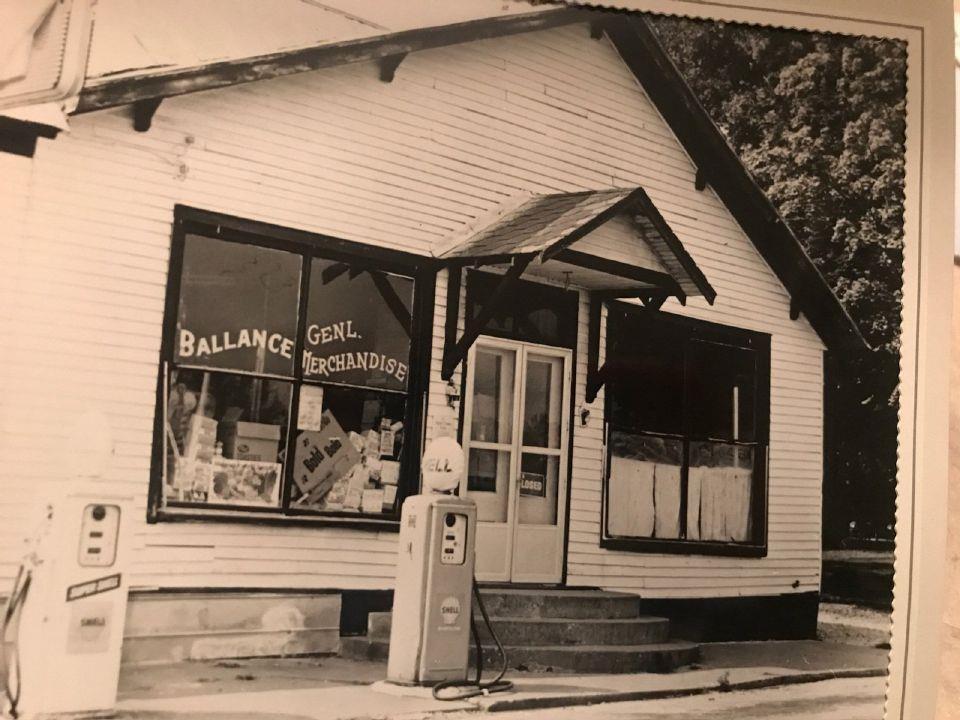
Ballance General Merchandise operates within the Corinth community of Logan County in the 1950s.
(BOB BALLANCE)
2/9
Swipe or click to see more
Roger and Joe Hughes sit in front of Boyce General Store for a picture in 1939 and 2012.
(BOYCE GENERAL STORE)
3/9
Swipe or click to see more
Boyce General Store in days past.
(BRIE GOLLIHER)
4/9
Swipe or click to see more
Lifelong Boyce resident Geraldine Hester stands with Boyce General Store co-proprietors Derek Ostrom and Janette Ostrom on April 18, 2026, in front the store.
(DAVID MAMARIL HOROWITZ)
5/9
Swipe or click to see more
Jarek Ostrom flips a patty for a patron at Boyce General Store on April 18, 2026.
(DAVID MAMARIL HOROWITZ)
6/9
Swipe or click to see more
Brie Golliher and husband Brad Golliher stand in front of Boyce General Store back when they owned and operated the historic store.
(BRIE GOLLIHER)
7/9
Swipe or click to see more
Boyce General Store, established 1869, sits at the gravel lot intersection off Highway 240 on April 18, 2026, in the southern outskirts of Warren County.
(DAVID MAMARIL HOROWITZ)
8/9
Swipe or click to see more
Ballance General Merchandise proprietor Henry Wilkins Ballance Sr. and his wife Bernice Simmons Ballance have their picture taken in 1886.
(BOB BALLANCE)
9/9
Swipe or click to see more
Ballance General Merchandise, once a hub of activity for Logan County’s Corinth community, sits vacant under a canopy of trees on Aug. 26, 2026.
(BOB BALLANCE)
Editor’s note: This is the first in a 4-part series about southcentral Kentucky’s country stores.
In the rolling farmland of Warren County’s southern outskirts, an analog marquee beckons travelers to a staple of country heritage almost gone from the region.
The freestanding, weathered building anchors rural Boyce, its wood-benched porch overlooking a gravel lot intersection off Highway 240. Shelves inside display long-retired farming implements, canned goods and wares of brands and times dwindling, throughout the years, from our collective memory.
Boyce General Store, established 1869, upholds a rare commitment to its community’s country history:
When, in daily life, neighbors mostly went where they could walk while the sun shone. When, for hundreds of small, unincorporated communities without city government, folk worked the farm or died. When, remote from town’s opportunities, the country store became a hub of necessities — for food and mail and wares and chatter in farmlife respite — for just about every community in southcentral Kentucky.
“I can sit here and picture everything,” says Boyce native 88-year-old Geraldine Hester, peering out the window:
Email newsletter signup
The storefront, so close to home that any belongings her family owned had come from the shelves. The community, so familiar that children walked home from school across the road, the 7-year-old Hester barefoot out front. The encounters, so routine that Hester met the man she would marry here — not uncommon, she says, at the hub all came to.
“We was all just family,” Hester recalls.
From the 1800s through the last century, similar sights and experiences were playing out an eight-hour walk south at Amos Grocery in Allen County, 21 hours north from there at Hedgepeth Farm Supply in Hart County, and throughout every county regionwide.
Southcentral Kentucky’s stories of such places remote from town — recalled by scores of historians, store owners and patrons past and present — broadly paint a shared, cohesive history of the country.
And, of the stores born from need. In the 19th century and the first half of the 20th, virtually all of the hundreds of small rural communities had one — a neighbor’s solution to scarce reliable transportation and bare road infrastructure.
“They were indispensable,” Barren County’s historian Sam Terry says.
But needs began dwindling gradually, as transportation and economic improvements bolstered access to town throughout the latter part of the 20th century, and the younger generations in particular left their rural communities. Cars and better infrastructure like paved roads and bridges had opened up access to jobs outside the farm, goods at a cheaper price, and school districts consolidated closer to town as one-room schools shuttered in the outskirts.
Farming had become mechanized and centralized, making it widely infeasible for families to sustain themselves on the small farms — which had been the region’s economic linchpin. Meanwhile, whereas many stores had served as vital post offices closer to 1900, Rural Free Delivery spread regionally in the first part of the 20th century, bringing mail to people’s doorsteps.
The closures picked up through the ’60s, and by the ’70s, numerous vacancies punctuated the region. Big box retailers and grocers began their advance on the region with a monopolistic purchasing power that surviving stores could not match. And, aging proprietors were passing away, often without anyone willing or able to continue the widely outdated business model as the increasingly diversified job market drew people to town.
By the ’80s, these stores were all but gone from most of southcentral Kentucky.
Today, a tiny handful persist. Holding a magnifying glass to local needs, each adapts in its own way to changes in geography and community.
Most have shifted more toward down-home cookin’ with ingredients from surrounding farms. In more rural counties like Allen and Hart, where the stores were prevalent longer, isolation from corporate competition still allows several to survive by selling tools, hardware and services required by farmers and other manual laborers.
What unites our communities, though, is a hold of memories cherished and mourned — of familiar faces, shared struggles and joys in a way of life — carried from one rustic, weathered building to the next.
Logan County
In the early 1800s, the limits of horse-and-ox travel, coupled with rudimentary dirt traces, hampered country communities’ access to the markets, newspapers and other amenities of established towns like Russellville.
The stores became more common in Logan County after the railroads of the 1860s turned into economic lifelines, according to county historian Mark Griffin. Communities like Olmstead and Red Oak — today known as Oakville — grew around the coal and water stops along the railway.
The Louisville & Nashville Railroad — as well as Owensboro & Nashville Railroad — ushered in customers and a wider range of merchandise, according to Griffin.
“It got everything that you needed,” recalls lifelong Logan Countian Bob Ballance, whose grandfather owned and operated Ballance General Merchandise on Franklin Road beginning in 1886.
Country stores were known for their variety, and in the ’40s, the Ballances sold everything from work garments to mule collars to shotgun shells. Beef sold in the store came from cattle his family slaughtered nearby. Customers bought or sold chicken, and creamers brought milk. Bob Ballance’s grandfather was often outside filling gas tanks from beneath the roofed pumping station — something which became a staple at country stores.
Driving a semi-trailer and tank wagon trucks, Ballance saw them every 4-5 miles as he sold gasoline to the stores across Logan and Simpson counties in the mid-’50s.
And then, they started petering out, he says. His uncle sold the family shop to move, and it closed in the ’60s along with many other of the county’s stores. They waned in the ’70s, and most disappeared by the ’80s, Griffin says.
He knows just one survivor: Keysburg Country Store & Family Restaurant, in Olmstead near the Tennessee state line.
Asked what was lost, Ballance recalls his grandfather’s pot-bellied stove and pool table, and the meat-slicer for meals eaten together.
“The community,” he says.
“It was the community area.”
“Everybody came … for one reason or another.”
— To be continued next Sunday.