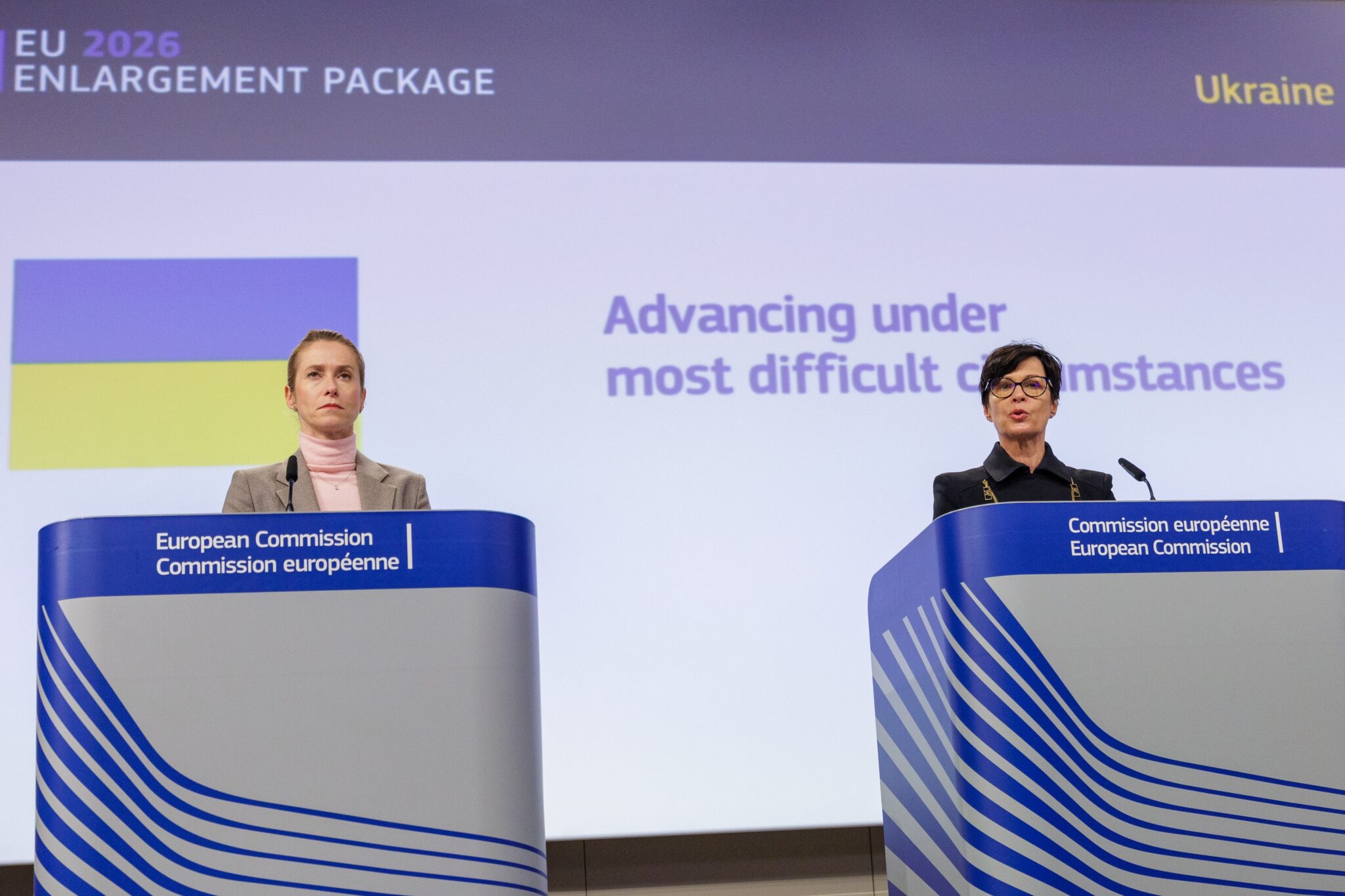
Kaja Kallas (L), EU Foreign Affairs chief and Marta Kos (R), Commissioner for Enlargement, attend a press conference on the Enlargement package in Brussels, November 4, 2026. Photo:EPA/Oliver Matthys
The European Commission’s annual Enlargement Package, its report on the progress of EU candidate countries, on Wednesday introduced accession roadmaps for Montenegro and Albania, while criticising a lack of progress towards EU integration in other Western Balkan countries.
“Membership is moving closer for countries that deliver. For the first time, we introduce roadmaps for accession negotiations with Montenegro, Albania, Moldova and Ukraine,” Kaja Kallas, EU High Representative for Foreign Affairs and Security Policy, said during the launch in Brussels.
“Montenegro is the closest to the finish line with a clear path to signing the accession treaty by next summer,” Kallas added.
Marta Kos, European Commissioner for Enlargement, highlighted that, “for the first time since 2011, when the EU closed accession negotiations with Croatia, we are in a position to close accession negotiations with another candidate country”, referring to Montenegro, adding: “The country has already closed 21 negotiating chapters; 14 to go.”
Albania’s Prime Minister, Edi Rama, praised the report, describing it as “another step forward toward the historic goal of uniting with Europe.
“This assessment does not diminish the significance or the urgency of the challenges in the country’s daily life – issues that have received, continue to receive, and will continue to receive the full attention of myself, the government, and the parliamentary majority. On the contrary, the high praise in today’s report motivates us to do even more and to perform even better,” he said.
Serbia was described as having a high level of alignment with EU laws but Kos warned that, “in Serbia, we have seen backsliding across the fundamentals. The new government will have the chance to reverse the course”, referencing recent elections that ousted the long-ruling Serbian Progressive Party.
The country had “made further steps backwards on fundamental rights, in particular in the freedom of expression, public administration, and academic freedom” she noted.
Bosnia and Herzegovina made no progress in key areas of EU integration, including the judiciary, the fight against corruption, media freedom and the economy, while its visa policy has regressed, the Commission said.
The report, covering September 2025 to September 2026, described Bosnia’s growing political instability, weak institutions and state capture, noting that most of the recommendations from last year remain unimplemented.
The Commission also urged Bosnia to align its visa policy with the EU, warning that visa-free arrangements with seven countries could increase irregular migration risks.
North Macedonia was also criticised for failure on EU-related reforms, singling out the lack of progress in fighting corruption, media freedom and judicial independence, while noting that constitutional changes required to advance accession negotiations remain untouched.
Bulgaria has blocked North Macedonia’s EU accession path over disputes concerning history, language and national identity. Although Sofia formally lifted its veto in 2022 following a French-brokered compromise, North Macedonia’s commitment to include Bulgarians among its constitutive peoples in its Constitution remains unfulfilled, leaving the country’s accession process effectively stalled.
In Kosovo, an almost two-year institutional blockade halted the implementation of EU-related reforms, and the country has made only limited progress in key areas, with political instability, a lack of judicial independence, and shortcomings in the fight against corruption.
Kos noted that “Kosovo has recently intensified the implementation of the reform agenda. The EU has welcomed the election of the new president and we hope that the renewed institutional stability will enable Kosovo to progress”. Because of the two-year political crisis, Kosovo risks losing more than 40 million euros in EU growth plan funds after missing the June 2026 implementation deadline.
The Commission’s 2026 Turkey Report painted a bleak picture. It said that “democratic backsliding continued, particularly in the areas of political pluralism, integrity of electoral process, the rule of law and local governance”, amid intensified judicial pressure on opposition politicians and parties.
The report highlighted the continued detention and prosecution of opposition politicians in Turkey, including Istanbul Mayor Ekrem Imamoglu, the annulment of the opposition Republican People’s Party’s 2023 congress, and government pressure on independent media and critics.
Turkey started EU accession negotiations in 2005, but its membership bid has been practically frozen amid international deadlocks and democratic backsliding.