Nearly 2,000 Chinese businesses have been established in Nicaragua during the first two years of the free trade agreement with China, according to the president of the Asociación Pro-Unificación Pacífica de China en Nicaragua. Shujin Huang made the statement to official media outlets after an event marking the 160th anniversary of the birth of Sun Yat-sen.
He said the association continues to promote additional investment from China, describing Nicaragua as a safe country with a competitive market. The free trade agreement between the two countries entered into force on January 1, 2024. The Banco Central de Nicaragua reported that net foreign direct investment from China reached 29.3 million dollars in 2025.
That figure represented 1.9 percent of the 1,502.5 million dollars in total net foreign direct investment recorded by the country that year. In 2024, any Chinese flows were not reported separately and would have been included in aggregate categories if present at all. Huang said the businesses operate mainly in commerce, with some also active in free-zone maquilas. The relatively low official investment total relative to the number of establishments indicates that most are small-scale operations.
The Asociación Pro-Unificación Pacífica de China en Nicaragua was founded in May 2024 and was officially registered as a legal organization under Ministerial Agreement 24-2024-OSFL, allowing it to operate in its own name under Nicaraguan law. Its founding event included participation by Chinese Ambassador Chen Xi and Nicaraguan officials including National Assembly President Gustavo Porras, Foreign Minister Denis Moncada and Presidential Adviser Laureano Ortega Murillo.
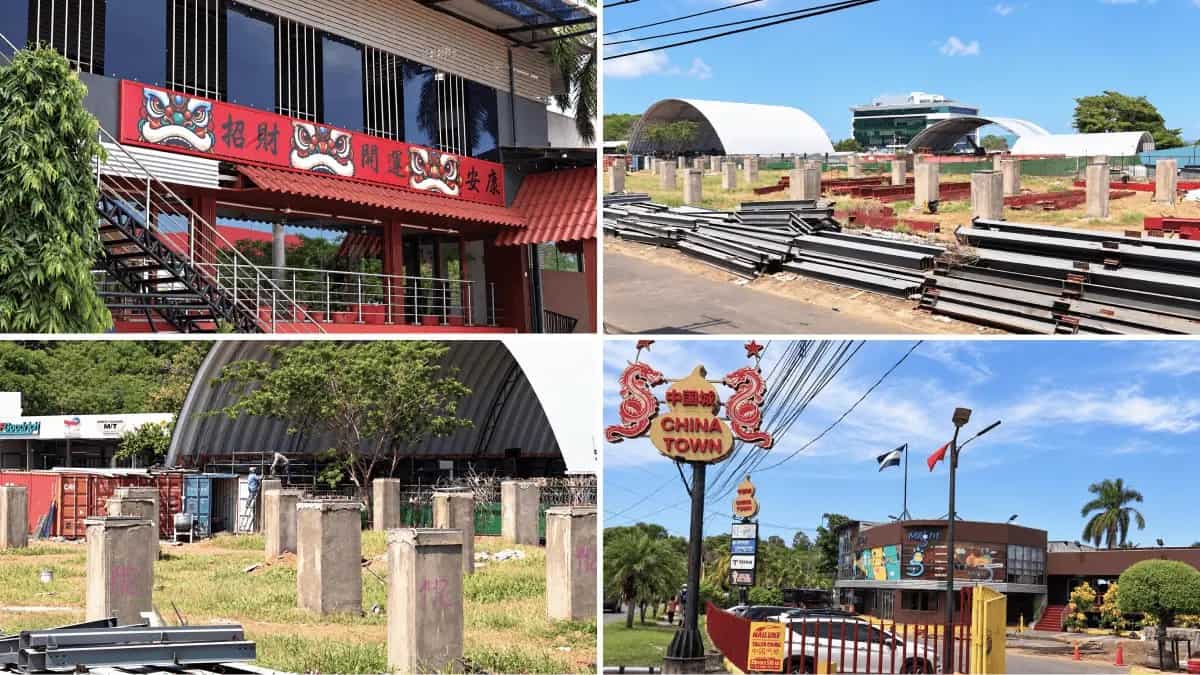
As part of the commercial expansion, construction of a Chinatown complex advances in Managua near the Rotonda Universitaria. The project, also known as Plaza China or Plaza 101, involves a two-story structure of approximately 8,000 square meters with an investment of about 3 million dollars. It is planned to house around 100 businesses operated by Chinese, other Asian and Nicaraguan owners.
The site currently holds roughly 30 businesses. Administrators have described the work as being in an intermediate phase, including installation of a stone arch more than six meters high carved in a dragon style and brought from China. The complex is intended to concentrate commercial activity, gastronomy and cultural offerings. Huang cited the existing Plaza China as an example of growing Chinese capital presence, noting that more than ten foreign-investment businesses already operate there.
Nicaragua and China restored diplomatic relations in December 2021 after Managua broke ties with Taiwan. The free trade agreement was signed on August 31, 2023. Official Nicaraguan statements have presented the pact and related initiatives as measures to expand trade and investment opportunities. The association’s stated goals include supporting Chinese investors and promoting the policy of one China.
As of now, the association continues to encourage further arrivals of Chinese capital. Construction on the Managua Chinatown project remains under way, with officials and association representatives describing it as a visible marker of the commercial presence that has developed since the trade agreement took effect. The Banco Central de Nicaragua has not published a full country-by-country breakdown beyond the 2025 net total that places China at 29.3 million dollars.