Many of those returning to their home areas, especially widows and women supporting their families, direct their criticism toward the Ministry of Social Affairs and Labour after waiting in vain for job opportunities Among them is Taghreed, who longs for a steady income that would cover her basic needs and allow her to rent a home if she is left alone in the camp.
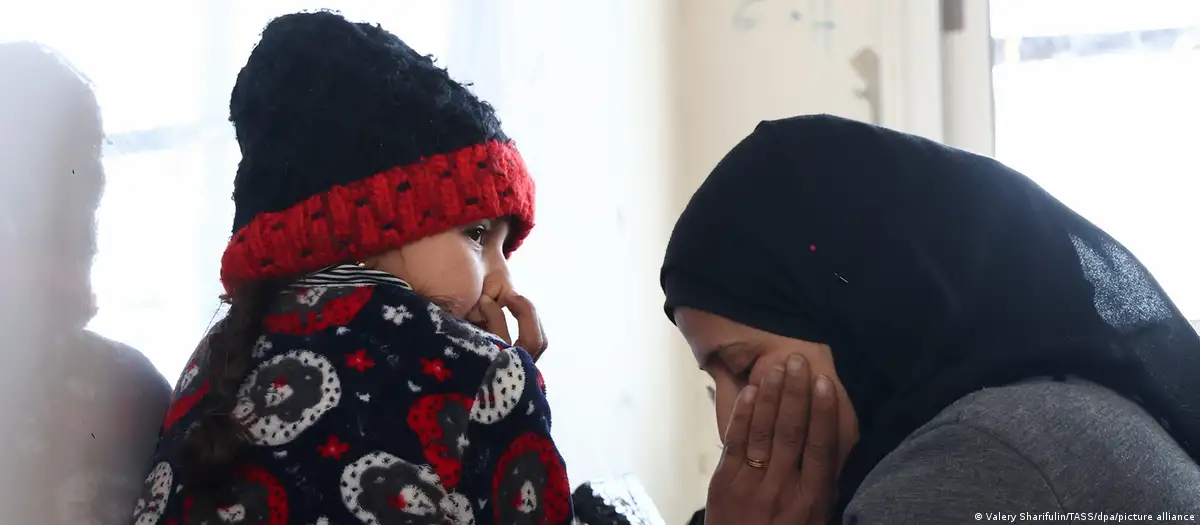
In her threadbare tent, Taghreed Othman is still trying to endure life in Barisha camp in rural Idlib. She watches her neighbours depart one after another and fears being left alone with her three young daughters in a place “cut off from everything.”
Displaced from Kafr Nabl in 2019, Taghreed has lived in the camp since 2021. “Death would be easier than this,” she says. Her tent stands between a cemetery and a cesspit. Last year, sewage flooded the area, forcing her to abandon her tent for ten days. She now awaits winter with dread, convinced that water will engulf her shelter “from above and below” as rain pours in and the wastewater pit overflows.
Since the fall of Bashar al‑Assad’s regime, many families have returned to their home areas. Of the thirty tents once inhabited in Taghreed’s camp, only four remain occupied. Those who stayed, she says, are the poorest, with neither income nor homes to return to. “Of course I want to go back to my village and live near my family,” she says bitterly. “But there is nothing I can do.”
Displacement has been one of Syria’s most complex challenges since the revolution began, with an estimated fourteen million people uprooted. Since December 2024, nearly two million internally displaced people and 1.7 million refugees have returned. Around 5.5 million people remain displaced inside the country, while reconstruction needs are estimated at 216 billion dollars and 15.6 million people still require humanitarian assistance, according to a statement by Paula Gaviria Betancur, the United Nations Special Rapporteur on the human rights of internally displaced persons.
Returns have taken place in two ways: at personal expense, or through voluntary return convoys organised under the “Syria Without Camps” initiative, scheduled to continue until the end of this coming September. The Syrian government launched the initiative following Presidential Decree No. 59, issued on 10 March, and allocated 7.5 million dollars in grants to areas receiving returnees to repair schools, water sources, health centres and other infrastructure.
The sum is modest compared with the scale of need. According to estimates from the Ministry of Emergency and Disaster Management, relayed by its Media and Communications Department, the initial funding required to implement the “Syria Without Camps” vision amounts to roughly two billion dollars for only 120 communities out of 3,344 localities. The government therefore hopes that the United Nations and international partners will increase support for early recovery and rehabilitation projects and help close the funding gap, the department told Daraj.
Some camp residents have little interest in the government’s plans or its estimates. They have nowhere to return to. Among them is Fouad Mohammed al‑Khatib, 45, who sold a plot of land he owned in Kafr Zita in rural Hama and built something resembling a home in al‑Andalus camp in Atmeh. He cannot imagine returning to his devastated village to live in the open and endure displacement all over again.
Fouad was displaced in 2014 while awaiting his first child after ten years of marriage. Today, he feels helpless as he prepares for the new arrival, following the closure of all free hospitals and health centres that once operated in the camp. He must take his wife to a private hospital whose fees he cannot afford. He says camp services, including water provision and rubbish collection, have deteriorated since liberation, while others, such as healthcare, have disappeared entirely.
“A Mattress and Blankets”
Those who fled their villages at the beginning of the revolution are returning with children born in displacement, and in some cases grandchildren. For those who once lived in the family home, there may no longer be room for them and their children, assuming the house still stands. Some have therefore moved their tents from the camps to the ruins of their homes, settling in villages and towns whose services and resources vary widely.
In Jarjanaz, Fayez Mahmoud al‑Shahoud, who returned from a camp in Azaz, is trying to improve his circumstances. He has rented a house for one hundred dollars a month to take up a government job paying no more than one hundred and eighty dollars. “I had no choice,” he says. “I was a public employee and was dismissed because of the revolution. They reinstated me in my municipal job, so I returned and rented a house, because my own home is completely destroyed.”
Fayez heard about the return convoys and registered four months ago. He transferred his children to the village school, but no one has contacted him since. The process amounted to “questionnaires and questions that led nowhere,” he says. He eventually hired a vehicle to move some of his belongings so his children could attend school, leaving the rest in the camp. “The rest of my things are still in Azaz, exposed to theft and rain, while I wait for transport.”
He describes life in the camp as dreadful. An open sewer ran close to their homes and overflowed in winter. Even so, he considers himself to have been better off there: he paid no rent and worked in a shop that provided a higher income than his current salary.
Fouad is still waiting for the convoy to leave his camp. Although it will offer him only limited help, he considers it better than nothing. Travelling with the convoy means saving the one hundred dollars needed to transport furniture, as well as passenger fares. The campaign also provides families with “mattresses, mats, blankets, a tarpaulin, a kitchen equipment kit, containers, a solar‑powered light and a piece of fitted carpet,” according to the emergency ministry’s Media and Communications Department.
Homes Seized
Assistance for people returning from camps in areas formerly under the Autonomous Administration appears somewhat more generous. Each family travelling with the convoys receives two thousand dollars in financial assistance, alongside some supplies, according to Jwan Isso, a lawyer specialising in displacement and head of relations at the Committee for the Displaced of Ras al‑Ayn/Serekaniye.
Displaced people returning to Ras al‑Ayn face much the same conditions as other returnees: destroyed homes and dilapidated infrastructure. Isso says the committee has organised six convoys so far, carrying more than 4,200 families from among the thirty‑five thousand people living in camps near Hasakah. He explains that those returning come from villages around Ras al‑Ayn rather than the city itself, where people arriving from other governorates have seized residents’ homes and shops.
“More than six hundred thousand homes, three thousand shops and hundreds of thousands of hectares of farmland have been seized, as Ras al‑Ayn is a fertile agricultural area,” Isso says.
Where Are the Ministry and the Donors?
Many of those returning to their home areas, particularly widows and women supporting their families, direct their criticism at the Ministry of Social Affairs and Labour after waiting in vain for job opportunities. Among them is Taghreed, who dreams of a steady income that would cover her basic needs and allow her to rent a home if she is left alone in the camp.
Watheq Hallaq, director of the ministry’s Social Policy Directorate, says the ministry currently has no programmes devoted specifically to widows. “However, this does not mean that they fall outside the scope of its services, which include psychological and social support through the ministry’s social centres, as well as connecting people in need with a network of humanitarian and development partners.”
“The ministry is currently developing national standard operating procedures for case management,” Hallaq adds. “At a later stage, these will provide a framework to ensure that services reach widows and women supporting their families systematically and consistently, rather than relying on sporadic individual interventions.”
Many widows are unaware of the services available or how to access them, Hallaq says, and addressing this is among the ministry’s priorities.
“The ministry recognises that humanitarian assistance alone cannot provide a stable and sustainable life after return, and that the failure of some families, including households headed by widows, to access assistance or employment opportunities reflects a real gap in the response. Addressing it requires joint action by government institutions, partners and those involved in the labour market.”
Regarding the ministry’s role in the “Syria Without Camps” initiative, Hallaq says its work centres on the social and protection aspects of return. This requires strengthening the capacity of local communities and national institutions to accommodate returning women and men, provide them with social services and protection, and address the vulnerabilities that could force families into displacement again.
This article was translated and edited by The Syrian Observer. The Syrian Observer has not verified the content of this story. Responsibility for the information and views set out in this article lies entirely with the author.