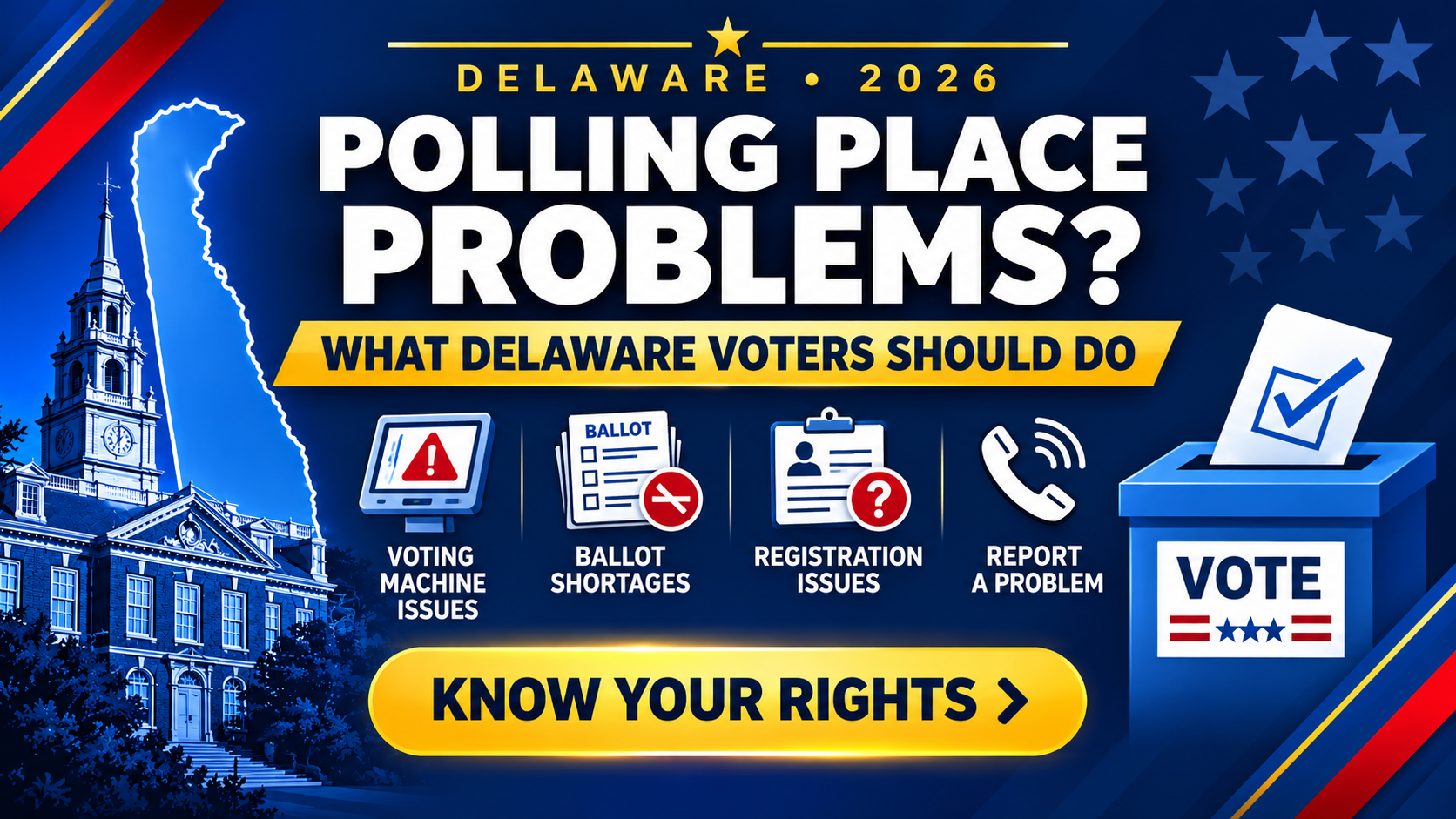
From malfunctioning voting machines and registration disputes to suspected fraud and intimidation, voters have several ways to document concerns and seek help from state, federal and political party officials
DOVER — When Delaware voters head to the polls Tuesday, Nov. 3, most will cast their ballots without difficulty. But what happens when something doesn’t seem right?
Voting machines that stop working. Registration records that don’t match. Voters turned away. Questions about whether ineligible individuals are voting. Allegations of intimidation or interference.
Concerns about these issues have surfaced in previous elections, raising questions about election security, voter access and accountability.
While an allegation does not establish wrongdoing, legitimate concerns deserve examination, not dismissal.
Election integrity requires ensuring that every eligible voter can cast a ballot while preventing illegal voting or misconduct from compromising the process.
Just as important, voters need to know how to report problems, who is responsible for investigating them and how to preserve evidence.
When voting machines fail
Malfunctioning voting machines can create long lines, delays and questions about whether voters will have an opportunity to cast their ballots.
Delaware has contingency procedures, including the use of paper ballots when voting machines are unavailable.
Ballot shortages and other disruptions present additional challenges that election officials are responsible for resolving.
A machine failure does not automatically mean fraud has occurred. However, repeated problems, unexplained delays or irregularities involving ballots deserve examination.
When voters are turned away
Registration disputes are another potential Election Day problem.
A voter may be told their name is missing from registration records, their information does not match or they are at the wrong polling location.
Delaware has procedures for handling registration discrepancies, identification questions and provisional ballots.
A documented example occurred during Delaware’s 2024 primary election, when the Department of Elections acknowledged a clerical error affecting 764 voter registration records.
The error involved party affiliations recorded incorrectly during automatic voter registration. State officials said they corrected the problem and that no voters were prevented from voting because of the error.
The incident demonstrated that administrative mistakes can occur — and why identifying, correcting and explaining them matters.
What about illegal voting?
Concerns about election integrity also include allegations that unregistered individuals are voting, someone is impersonating another voter or a person is attempting to vote more than once.
Delaware law prohibits fraudulent voting, including impersonation and knowingly casting multiple ballots.
But suspicion alone does not establish a violation.
Someone being unfamiliar at a polling location does not mean that person is ineligible. Registration disputes also do not necessarily indicate fraud.
Credible allegations require investigation and evidence before conclusions can be reached.
Intimidation and interference are serious offenses
Threats, harassment, coercion and attempts to interfere with voting can violate Delaware law.
The Delaware Department of Justice has identified voter intimidation, interference with election officers, impersonating law enforcement and improper questioning of voters among activities that may constitute election offenses.
Delaware also restricts certain campaign activities within 50 feet of polling place entrances.
These protections apply to voters of every political affiliation.
What is Delaware doing?
Attorney General Kathy Jennings, Gov. Matt Meyer and State Election Commissioner Anthony Albence outlined the state’s Election Day preparations in an Oct. 30 announcement.
The preparations include trained election officers, statewide investigators, attorneys available to assist election officials and coordination with law enforcement.
The Department of Justice’s Division of Civil Rights and Public Trust will help investigate allegations of voter intimidation and criminal interference.
The Department of Elections and Department of Justice also plan to jointly staff a voter hotline at 302-739-4277.
But preparation alone is not enough. Public confidence depends on how effectively problems are addressed and whether officials explain what happened.
What should voters do if something goes wrong?
Voters who encounter problems at their polling place should notify an election officer and seek assistance.
State guidance identifies several circumstances in which additional procedures may apply:
-
Voting machines unavailable: Paper ballots may be used.
-
Missing registration records: Provisional ballot procedures may be available.
-
Registration discrepancies: Election officers can review applicable records and procedures.
-
Voters in line at 8 p.m.: Those already in line are entitled to vote.
-
Suspected fraud or intimidation: Concerns can be reported to election authorities. Immediate threats should be reported to 911.
The statewide voter hotline is 302-739-4277.
Why documenting an incident matters
An important step in addressing suspected election irregularities is creating an accurate written account.
A telephone call can alert authorities to an immediate problem, while a written report provides a record that investigators can review afterward.
An incident report should identify the polling location, date and approximate time of the incident, individuals involved, potential witnesses and a factual description of what occurred.
Supporting information may include lawfully obtained photographs, documents or communications. Voters should observe restrictions on recording inside polling places and avoid interfering with voting or compromising ballot secrecy.
Reports should distinguish between something personally witnessed and information received from someone else.
People submitting complaints should retain copies, supporting materials, email correspondence and any acknowledgment from election officials.
Delaware provides an online Complaints & Issues form.
For formal administrative complaints covered by the federal Help America Vote Act, Delaware has additional requirements. These complaints must be submitted in writing, signed, sworn and notarized. An ordinary email or online issue report does not automatically satisfy those requirements.
Where can voters report concerns?
The Delaware Department of Elections oversees polling locations, voting equipment, registration records and election administration.
Its county offices can also receive concerns about election procedures.
The Delaware Department of Justice investigates potential violations of state law, while federal authorities may investigate violations of federal voting rights laws.
The U.S. Department of Justice Civil Rights Division maintains a reporting system at civilrights.justice.gov/report and a toll-free number, 800-253-3931.
Reports involving threats or violence should be directed to emergency services when immediate assistance is needed.
Both political parties offer additional contacts
Delaware’s two major political parties also provide ways for voters and election observers to contact their organizations about election concerns.
The Delaware Republican Party can be reached through DEGOP.gop and its published headquarters number, 302-668-1954. A separate number, 302-397-8074, has been supplied as a Republican election-integrity contact, although Delaware LIVE has not independently confirmed its current hotline designation.
The Delaware Democratic Party can be reached at 302-328-9036 and through DelDems.org. Its website identifies that number as its state headquarters contact.
At the national level, the Republican National Committee operates Protect the Vote, an election-integrity initiative involving election observers, volunteers and legal efforts.
A similarly named website, protectthevote.org, redirects to a nonpartisan Election Protection organization and is not affiliated with the RNC.
Political party reporting channels provide additional points of contact but do not replace complaints submitted directly to government election authorities.
Delaware LIVE wants to hear from voters
Voters who believe they have witnessed a problem or irregularity at their polling place can also contact Delaware LIVE at [email protected].
Readers are encouraged to include the polling location, approximate time, a factual description of what occurred and any supporting information.
Delaware LIVE may follow up on credible reports as part of its Election Day coverage, seeking independent confirmation and responses from appropriate election officials.
Contacting the newsroom does not replace reporting concerns to election authorities or law enforcement.
Accountability matters
A fair election protects eligible voters from being denied their ballots while ensuring that only legally qualified individuals vote.
It also protects election workers from harassment and requires credible allegations of misconduct to receive appropriate scrutiny.
Not every equipment failure is fraud. Not every registration discrepancy is an attempt at illegal voting. But legitimate concerns should not be ignored simply because officials believe their preparations are adequate.
Written documentation, timely reporting and transparent investigations all contribute to public confidence.
Delaware voters deserve an election system that is fair, responsive and accountable.
The ultimate measure of election integrity is not whether officials promise a secure election, but how effectively they address problems when they occur.
TO GO BOX: Election Day problems and reporting contacts
Delaware LIVE collaborates with a network of professional journalists to cover a diverse range of stories across various fields. Staff Writers include experienced journalists and young professionals. If you have questions, please feel free to contact [email protected] or our publisher, George D. Rotsch, at [email protected]