EVERETT — Dozens of speakers shared differing opinions on the potential consolidation of Everett Transit and Community Transit at two public hearings on Wednesday and Thursday, as the city and transit agency consider whether to approve the merger next week.
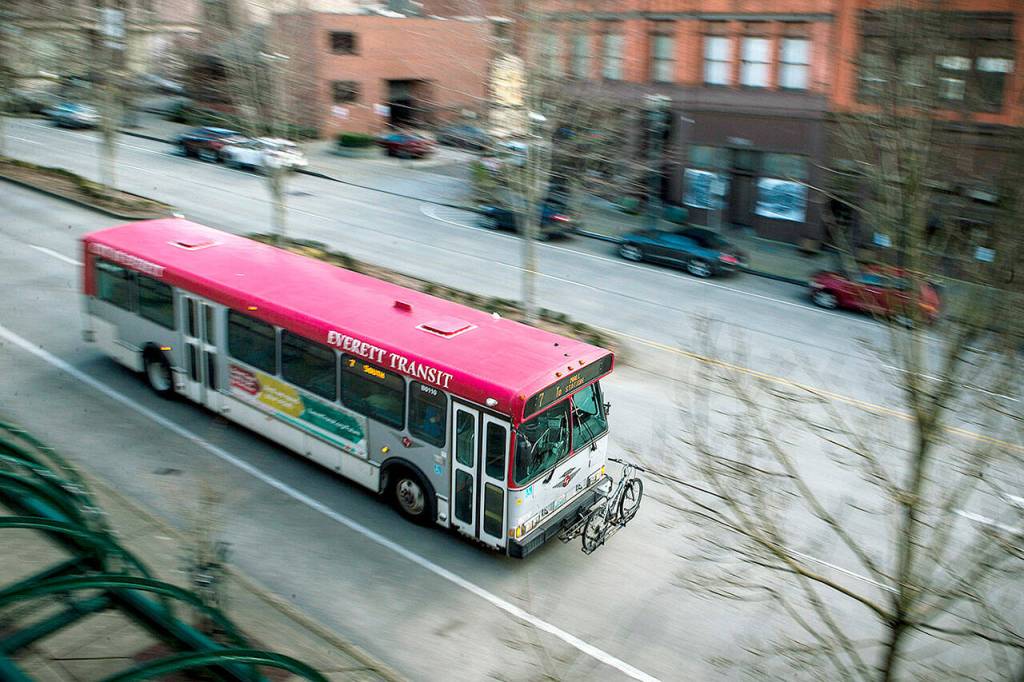
The consolidation measure would see Everett Transit cease to operate and Community Transit, which operates across Snohomish County, take over operations within Everett’s borders. It would significantly increase bus service within Everett over the next four years, officials have said, while also increasing the transit sales tax in the city from 0.6% to 1.2%.
Opinions in the community are still split over the proposed consolidation, with some arguing that the merger, which would boost transit service by 50% within the city of Everett as soon as 2031, is worth the increase in sales tax. It would also allow for easier connections for trips going into and out of Everett’s borders and could fill gaps in areas that are lacking in frequent transit service, proponents have said.
Opponents of the merger have argued that consolidation, and the tax increase that would come with it, is unnecessary as Everett Transit already provides good bus service. Some have also raised concerns about what will happen to employees who transfer from Everett Transit to Community Transit, and if they will be able to retain their seniority, an important point for bus drivers as they spend years building up their seniority and it can determine which routes and vacation days employees can choose.
The merger would also change paratransit eligibility for older riders. Currently, Everett Transit allows those 65 or older to use its paratransit service even if they don’t qualify under Americans with Disabilities Act requirements, which state that paratransit services must be provided to people who can’t use fixed-route buses due to a disability. If the merger goes into effect, existing paratransit riders over 65 would continue to be able to use the service, but those who turn 65 after the merger goes into effect would not automatically qualify for the service.
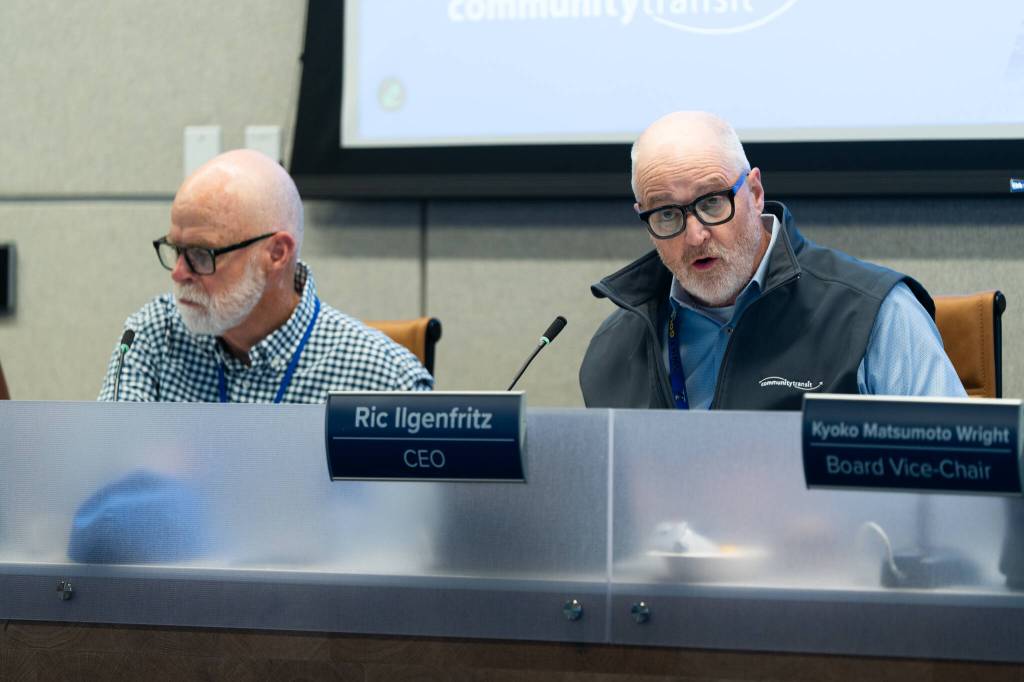
The decision ultimately lies with the Everett City Council and Community Transit’s board of directors, who are set to vote on whether to approve an interlocal agreement at two meetings next Wednesday and Thursday.
‘The moment we should seize’
Proponents who spoke in favor of the merger said that it would be a way to fill gaps in the city’s public transportation system and provide more frequent service at a time when the population of the city is expected to grow significantly over the next 20 years.
“We need to ensure that the next 64,000 residents don’t gridlock our streets and parking lots with more cars, and that new apartment buildings can be built for more people to live in rather than for their cars to be stored in,” said Brock Howell, the executive director of the Snohomish County Transportation Coalition.
A number of community members from the Casino Road neighborhood spoke in favor of the merger, citing a desire for safer buses and more direct routes to other parts of the city and county. Sylvia Mendoza, who lives in south Everett, said that her daughter’s commute to the Arlington area takes around two and a half hours each way because of the multiple transfers needed to complete the route.
“That is why the merger of Everett Transit and Community Transit is the moment we should seize to integrate more direct routes,” Mendoza said in Spanish.
Erik Ashlie-Vinke, a government and community relations director at Sound Transit, said that the agency fully supports the merger and that it presents a “unique opportunity to create a more connected, efficient and rider-focused transportation network.”
“It would help our agency better understand future service needs, station access requirements, and how local and regional transit services can work together most effectively,” Ashlie-Vinke said.
Ray Stephanson, Everett’s longest-serving mayor and the current CEO of Economic Alliance Snohomish County, spoke in favor of the proposal, saying that improved public transit in the city and surrounding region could help attract new companies and investment in Everett.
“Having to transfer from one system to another to get to work on time, or get to class on time, was a challenge,” Stephanson said. “And I believe that this consolidation could help solve this problem in a very successful way.”
Bob Leonard, an executive director at the city of Everett, said Wednesday that consolidating the two agencies would help leverage Sound Transit’s $11.6 billion light rail extension that is set to reach the city within the next 11 years. He said putting a consolidated network would allow Community Transit to more effectively prepare for light rail’s arrival and would make Sound Transit’s federal grant applications more competitive.
“Light rail does not begin and end at a station platform. Riders need reliable connections from their neighborhoods to jobs, schools, healthcare facilities, Everett Station and future Link stations,” Leonard said. “The success of light rail in Everett will depend on the strength of the local and regional transit network supporting it.”
At Thursday’s Community Transit hearing, all speakers were in favor of the merger, citing the increase in bus service and reduction in transfers that would come with consolidation. Patrick White, a transit advocate from Seattle, said he supported consolidation but called on Community Transit to consider bringing its paratransit service, DART, in-house instead of contracting with a third party to provide the service. He also said the agency should look for ways to improve bus service more quickly if consolidation is approved.
“That’s a long time for Everett residents to be paying for more service without getting it,” White said Thursday. “Even just a little bit in fall of 2027 would do. One more evening trip here, a little bit of frequency there … These are easy wins that we can get quickly to show people that the merger was worth it.”
‘We’re small and responsive’
Opponents of the measure argued that the sales tax increase would add an additional burden to Everett residents at a time when costs are rising, and that the proposed interlocal agreement did not include enough explicit protections for the employees that would transfer from Everett Transit to Community Transit.
“For you to vote on something with so many moving parts and so many unknowns at this time would be irresponsible at best, or willfully ignorant at worst,” Emma Calvert told the city council Wednesday.
Members of the Amalgamated Transit Union 883, the union representing Everett Transit’s drivers and mechanics, have been outspoken against the measure, staging a protest in front of city hall in September. Steve Oss, the president of the local union, said that Everett Transit is able to be flexible and meet the city’s needs because of its small size.
“We aren’t small and incompetent, we’re small and responsive,” Oss said. “We are a local agency. Other places are jealous that we have our own transit agency … We should be proud of that, we should keep our own and use it.”
Some said that the city has already faced recent tax increases — which include a hike in utility taxes, the voter-approved emergency medical services levy and a looming possibility of a public safety sales tax to balance the 2027 budget — and that another sales tax would put additional stress on Everett residents.
“Necessary taxes are one thing, but this is unnecessary,” said Daryle Sullivan, an Everett Transit driver. “Transit service in Everett is great as it is.”
Shanine Chapman worried if Community Transit would continue to provide free shuttle services to Everett events, and raised concerns over the changes to paratransit eligibility that would come with consolidation.
“Are we telling future seniors, ‘So sad, too bad, pay more for less?’” Chapman said.
At Wednesday’s meeting, a number of residents also asked the council to send the measure to the public and allow residents to vote. Transit consolidation used to require a public vote but a 2025 state law changed that, allowing governing bodies of cities and public transportation benefit areas, like Community Transit, to approve a merger via an interlocal agreement.
“We are talking about making a permanent change to the city’s infrastructure and yet we’re not letting the citizens vote on this permanent change to the city’s infrastructure,” said Keith Jacobson, an Everett Transit driver.
Jennifer Gregerson, an administrative official at the city, said that staff recommends the governing bodies vote on the negotiated interlocal agreement rather than sending it to the voters as “it gives the city certain guarantees and benefits” in the agreement, known as an ILA.
City attorney Ramsey Ramerman also argued that the United States’ system of government is set up to delegate “highly complex decisions like this” to elected representatives, he told the council Wednesday.
“This is not the type of thing that works well on a vote process,” Ramerman said. “You’ve seen the ILA, it’s a very complicated agreement, and that’s why we put it to our elected representatives because you guys have the time and skill and expertise to dig in. Certain things just don’t work well on a populous basis, and that’s why we have this form of government.”
Tom Gibbons, a retired Everett Transit scheduler and dispatcher, told the council that “morale is low at Everett Transit among the employees” as they remain uncertain about how their earned seniority could be impacted by a potential merger. He called on the council to delay the vote until there was more certainty in the interlocal agreement regarding employee seniority.
“If that is done then the drivers will know that their seniority will be protected through the process,” Gibbons said. “… I would urge you to hear what we’re saying and take this to heart to protect the seniority rights of the employees of Everett Transit.”
Kandy Bartlett, Everett’s director of labor and administrative services, told the council Wednesday that members of ATU 883 will retain their existing seniority until they bargain with the union representing Community Transit employees, ATU 1576. The two unions will then have to come to an agreement on how seniority will be implemented, Bartlett said. If they can’t come to an agreement, they could end up in an arbitration process, she added.
Both of the union’s existing contracts expire at the end of 2027, but the contracts will continue to be enforced until a new contract is ratified, Leonard said.
The Everett City Council is expected to vote on whether to approve the consolidation agreement at 6:30 p.m. on Nov. 4. Community Transit’s board of directors is expected to vote at 3 p.m. Nov. 5.
Will Geschke: 425-339-3443; william.geschke@heraldnet.com; X: @willgeschke.