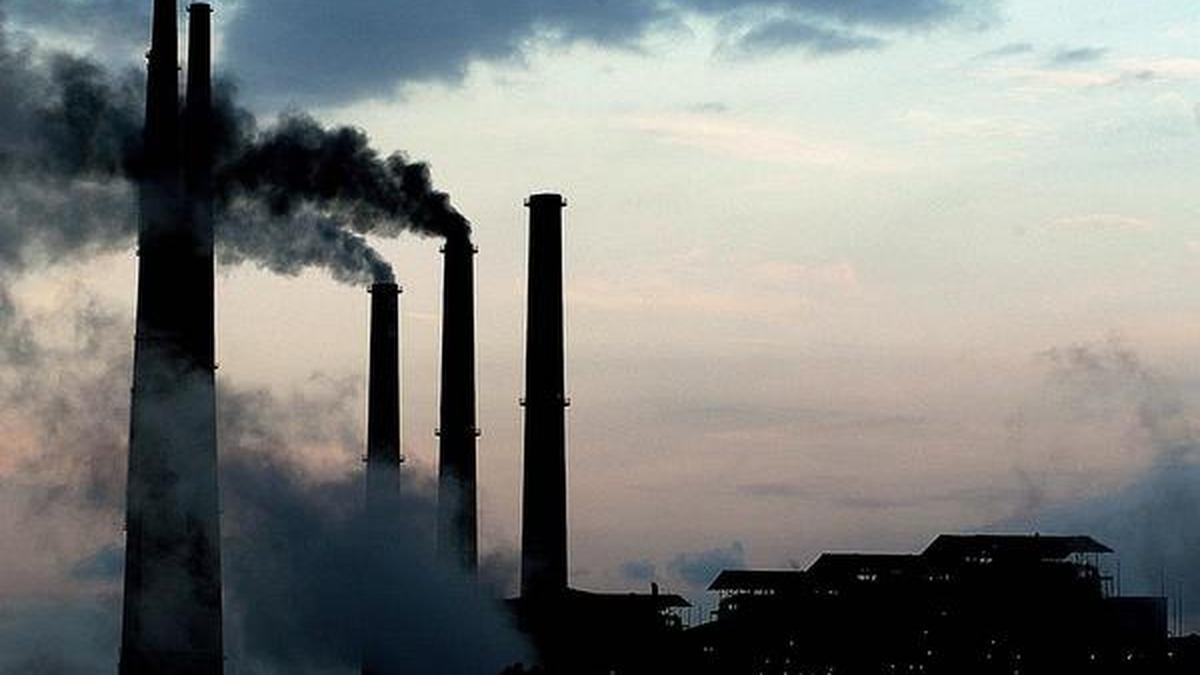
Image for the purpose of representation only.
| Photo Credit: File
The Central Pollution Control Board (CPCB) has directed pollution control authorities in Delhi-NCR to shut industrial units that have failed to place orders for installing or upgrading air pollution control devices (APCDs). Though not a new measure, it signals a tightening of enforcement of emission standards ahead of the winter pollution season.
In an October 30 letter, the CPCB has asked the Delhi Pollution Control Committee (DPCC) and the State Pollution Control Boards of Haryana, Uttar Pradesh, and Rajasthan to immediately issue show-cause notices to non-compliant units covered under the Commission for Air Quality Management’s (CAQM) revised emission norms. Units that fail to produce evidence of having placed orders for the equipment within five days are to face closure orders and remain shut until they demonstrate compliance with a credible installation timeline, the letter notes.
The direction comes ahead of restrictions scheduled to take effect in Delhi from November 1 under the government’s winter pollution management framework, which includes curbs on vehicles, construction activities and other pollution sources. After peaking in the “poor” category around 222–232 mid-week (October 28–29), continuous rainfall dropped Delhi’s average AQI to 60 on Friday (October 30, 2026) and around 95 on Saturday morning (October 31, 2026), according to the Indian Institute of Tropical Meteorology-maintained network.
The CAQM prescribed a particulate matter (PM) emission limit of 50 mg/Nm³ for 17 categories of highly polluting industries, as well as specified ‘medium’ and large ‘red-category’ industries, food-processing units, textile industries operating boilers and metal industries with furnaces. The revised standard became applicable from October 1.
The CPCB’s latest direction follows reports that several industrial units have not placed orders for new APCDs or for retrofitting existing equipment, and have also failed to obtain adequacy assessment reports or exemption certificates.
APCDs are filtration and emission-control systems fitted to industrial exhaust stacks to capture particulate matter before gases are released into the atmosphere. They include bag filters, which trap dust using fabric membranes; electrostatic precipitators, which use high-voltage electricity to collect charged particles; cyclone separators, which use centrifugal force to remove coarse particles; and scrubbers, which use liquids to capture dust and certain gases.
The CPCB’s previous attempts at imposing deadlines have only had limited effect. Only around 200 of 2,321 identified industrial units had complied with the installation or retrofitting requirement by July 31, according to reports. Industries had cited delays in equipment procurement, higher costs and shortages of agencies capable of assessing existing systems.
Until the latest tightening, several units operated under an earlier PM emission limit of 80 mg/Nm³, with 50 mg/Nm³ serving as an ‘advisory target’.
Published – October 31, 2026 03:37 pm IST