Overview:
An unused classroom at Angaur Elementary School is becoming a museum to preserve the island’s cultural artifacts, document its history and educate future generations.
By: L.N. Reklai
ANGAUR, Palau (Oct. 24, 2026) – “People, when they find artifacts such as World War II remnants or cultural artifacts, they usually take them, but now, with the museum, these items are brought to us,” said Angaur High School Principal Tiffany Kasiano.
An unused classroom at Angaur Elementary School is being transformed into a museum where residents can bring historical artifacts, students can learn about their island’s past, and visitors can discover Angaur’s distinctive cultural heritage.
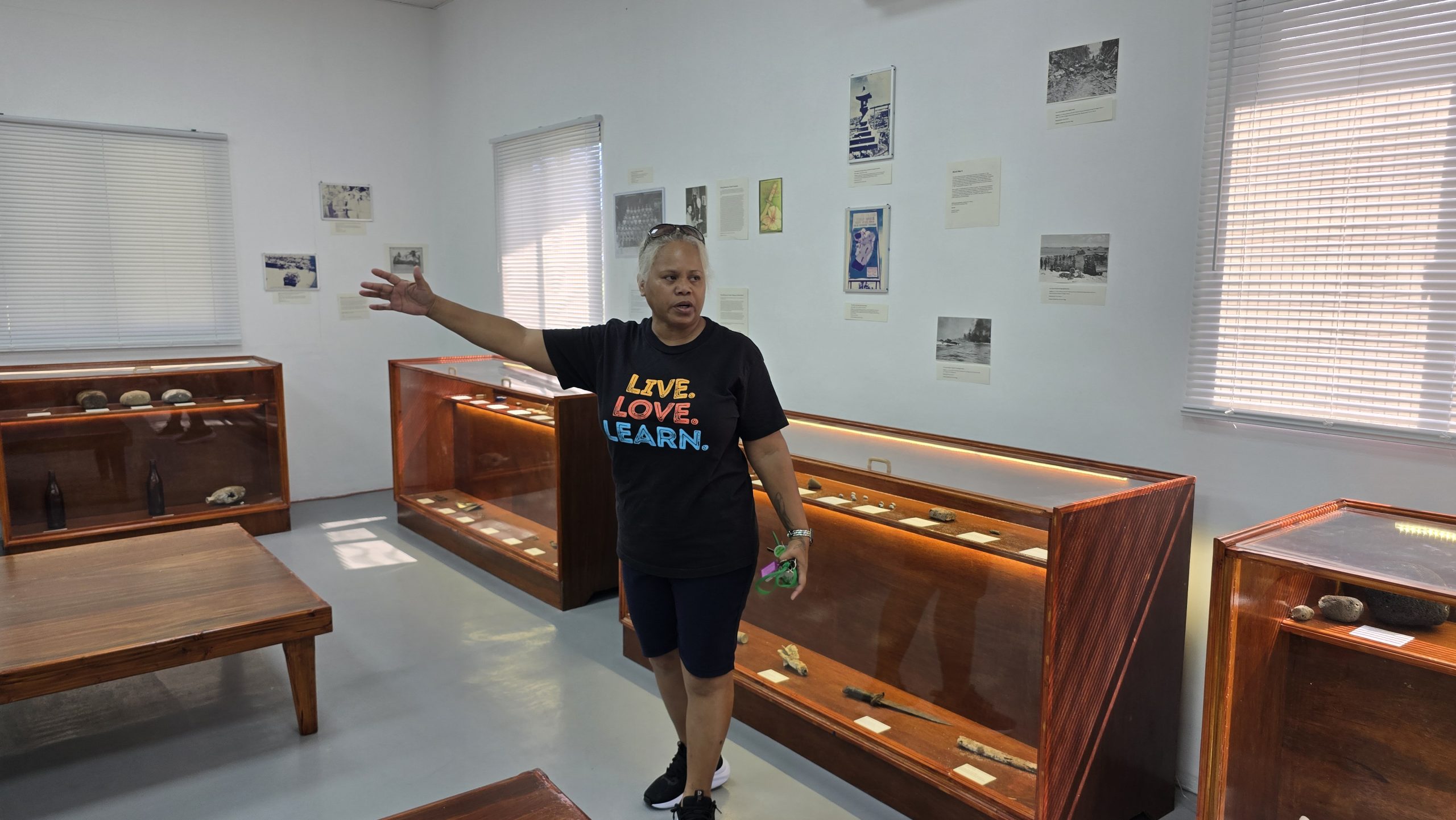
The small museum already displays cases of World War II-era items, including an old short sword, glass bottles and ammunition parts. Other cases contain stone adzes dating to Angaur’s prehistoric period.
Angaur artifacts from WWII at the new Angaur Museum housed in the Angaur Elementary School. October 24, 2026. Island Times
Kasiano envisions expanding the collection and organizing the space to tell the story of Angaur, from its traditional and cultural history to its prehistoric beginnings, phosphate mining and role in World War II.
The project was made possible through Japan’s Grassroots Grant Program as part of the broader renovation and improvement of Angaur Elementary School.
The room formerly served as the school library. When the Ministry of Education moved the library into classrooms, the space became available for another purpose.
“When the Ministry of Education decided to bring the library into the classrooms, this became available and with support of Japan’s Grassroots Grant Program, we were able to renovate and change it into Angaur’s museum,” Kasiano said.
The planned museum will be divided into three sections. One will focus on Angaur’s traditional and cultural history, another on its prehistory, and the third on its modern history, including phosphate mining and World War II.
Kasiano said the school is working with an archaeologist and Palau High School students to help arrange the exhibits and organize the artifacts.
The team is also collecting and labeling items donated or brought in by residents, including artifacts found by people who were collecting bone remains and items recovered during construction under the TACMOR project.
For Kasiano, the museum is intended to do more than preserve objects from the past. It will serve as an educational resource for Angaur students while giving residents a place to safeguard and share pieces of their island’s history.
She also hopes to open the museum to tourists and other visitors to Angaur, allowing them to learn about the state’s history and cultural traditions.
Although Angaur is part of Palau, it has distinct cultural practices that differ from those of other parts of the country. According to Palauan legends, Angaur was the beginning of Palau and is also where Palauan souls go after death.
The island was also mined for phosphate by three different colonial powers and was heavily attacked during World War II, along with nearby Peleliu.
Through the classroom-turned-museum, Kasiano hopes to bring these layers of history together in one place, preserving Angaur’s past for the next generation while sharing it with those who come to learn about the island.