- Residents of Pamarawan, a low-lying fishing village at North Manila Bay, no longer experience flooding after the construction of a nature-based coastal defense and flood control project.
- Instead of concrete, the project opted to use locally available materials, such as bamboo poles, oyster shells and coconut husks, to protect Pamarawan from tidal waves and storm surges.
- Bamboo cribs also help accumulate sediment, which is expected to gradually raise the seabed to a height sufficient to plant mangroves, while discarded oyster shells in cocomesh bags aid in restoring oyster reefs, further strengthening the shoreline against future flooding.
- The pilot initiative, the first nature-based coastal protection project in the Philippines, is touted as a potential model to address similar flooding problems elsewhere in the country.
See All Key Ideas
PAMARAWAN, Philippines — For years, residents of Pamarawan barangay, or village, in the City of Malolos, had to live with floodwater inundating their streets as the southwest monsoon, known locally as hagabat, brought strong waves into the fishing village.
It got even worse during typhoons. “When there was a typhoon, the waves would go over the breakwater by almost a meter, a direct hit on the houses beside the dike,” said Roldan Dayao, secretary of Pamarawan, a low-lying fishing village at North Manila Bay that is only accessible by boat.
The village already has a concrete breakwater that stands 3 to 4 meters (9-13 feet) high, Dayao said. But it does little to prevent the recurring flood.
The situation changed after the construction of a nature-based coastal defense and flood control project. It used locally available materials, such as bamboo poles, oyster shells and coconut husks, to protect Pamarawan from tidal waves and storm surges.
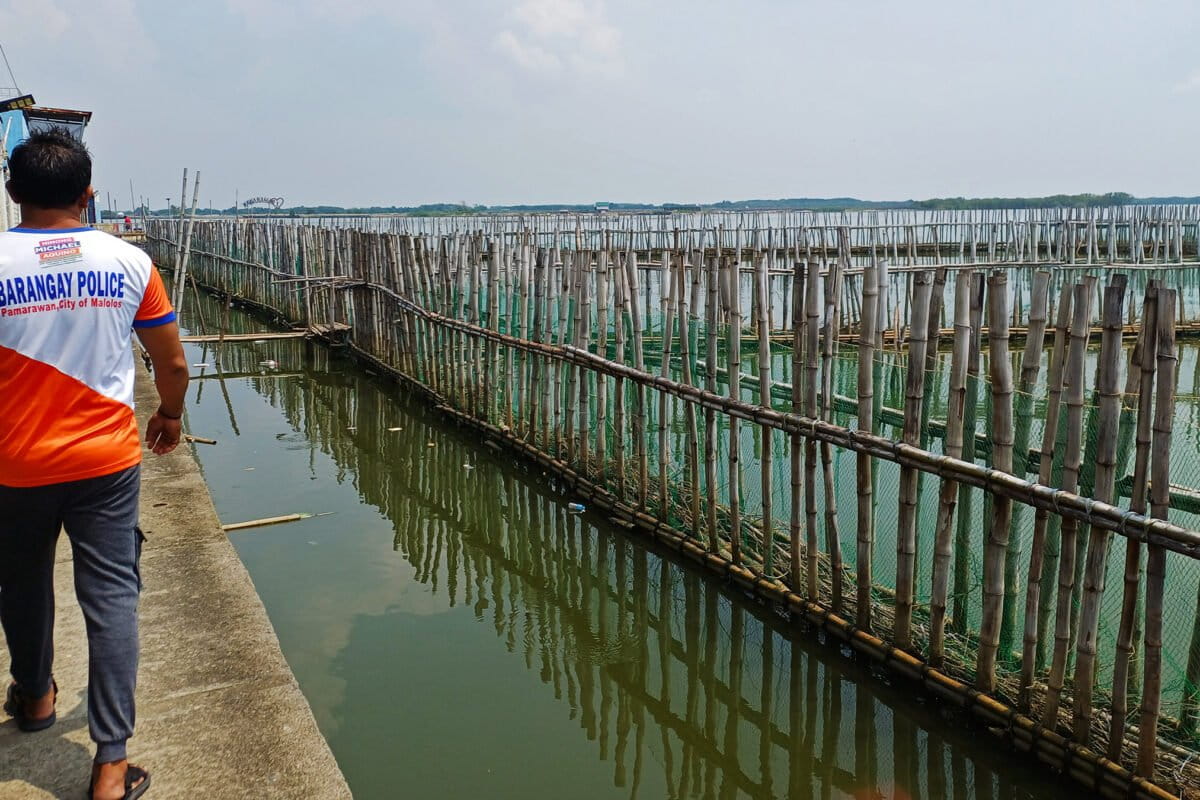
Interlocking, interconnected bamboo cribs now cover 14 hectares (35 acres) off the coast. The bamboo structures, alongside discarded oyster shells placed inside cocomesh, or coconut husk nets, serve as breakwaters that reduce incoming wave energy.
Small boats inside a bamboo enclosure, part of a nature-based coastal defense and flood control project, in Pamarawan barangay, in Malolos City, Bulacan province, the Philippines, on Sept. 28, 2026. Image by Oliver Samson for Mongabay.
The cribs also trap drifting mud and sand. Over time, the accumulated sediment is expected to gradually raise the seabed to a height sufficient to plant mangroves. Meanwhile, the oyster bags will help restore oyster reefs, further strengthening the shoreline against future flooding.
Malolos Mayor Christian Natividad greenlit the proposed project developed by Dutch engineering firm Haskoning in 2023. The pilot initiative, the Philippines’ first nature-based coastal protection project, kicked off in 2024 and is slated for completion later this year.
In a TV interview in August 2026, Natividad said that the 130 million Philippine peso ($2 million) project began because of severe flooding that recurs annually not only in the provincial capital, Malolos, but also in other towns in Bulacan province.
“And for the longest time, coastal protection is really heavily reliant on gray infrastructures, hard infrastructures,” he said. “We see that it’s not enough.”
According to Haskoning, the project was inspired by nature-based sediment-trapping concepts for mangrove restoration in Indonesia and “adapted to the specific coastal and typhoon conditions of North Manila Bay.”
The Pamarawan project “was developed in response to a clear societal challenge: increasing coastal flood risk driven by storm surges, high tides, sea-level rise and land subsidence in Barangay Pamarawan,” Trevor Morrish-Hale, president and chairperson of Haskoning Philippines, told Mongabay.
Discarded oyster shells in coconut husk nets are part of the nature-based coastal defense and flood-control project in Pamarawan barangay on Sept. 27, 2026. Image courtesy of Malolos City Information Office.
“Rather than relying solely on hard infrastructure, the approach combines engineering with natural processes through measures such as sediment-trapping units, enhanced and living breakwaters, mangrove restoration opportunities and green embankments,” he said via email.
“Green embankments, sediment-trapping structures and enhanced breakwaters are considered together, rather than as isolated interventions,” he added.
No more flooding
Floods have been a perennial problem in Malolos and other low-lying coastal areas in North Manila Bay, especially during the southwest monsoon months, which run from late May or early June to October. Rising sea levels linked to climate change and land subsidence caused by excessive groundwater extraction have worsened the chronic flooding.
According to Pamarawan officials, residents have already felt a difference since the project began. “It has been almost two years now that we have not been flooded,” Dayao said, crediting it to the nature-based solutions project.
Barangay Councilor Ferdinand Cruz concurred, saying that this year, Pamarawan escaped the flooding that hit neighboring communities hard.
That included the massive flood that impacted several towns for weeks in August. The flooding killed 15 people and forced the provincial government to put Bulacan under “a state of calamity.”
“It rained almost every day, and there was habagat, but we did not experience flooding,” Cruz said. “Nearby areas with higher elevation than ours were submerged, with some houses flooded halfway and others almost up to the roof.”
Workers install coconut husk mesh in Pamarawan on Sept. 29, 2026. Image courtesy of Malolos City Information Office.
Workers place oyster shells in coconut husk nets in Pamarawan on Sept. 27, 2026. Image courtesy of Malolos City Information Office.
Pamarawan resident Arsenio Ramos Jimenez Jr. expressed his optimism. “There is a good chance that the barangay will be better protected from strong waves when the project is completed, particularly when storm surges coincide with high tide,” he said.
“In the long run, once mangroves are planted inside the nature-based flood control project, they could provide significant protection by serving as a natural barrier against waves. They could also provide habitat for marine life.”
Pamarawan lost its mangroves as part of a wider pattern in Bulacan, which lost 52.9% of its mangrove forests after being converted for fishponds and land reclamation between 1990 and 2002.
Dayao recalled what it was like when the village still had thick mangroves. “They could block the big waves,” he said. “But when our mangroves disappeared, the water began entering our barangay.”
The nature-based project seeks to reverse this, allowing mangroves to be cultivated again.
Thanks to the bamboo cribs, accumulated sediment has already reached roughly 0.3 meters (1 ft.) in some areas, Cruz said. It is expected that within two years, the seabed will be high enough to plant mangroves.
Dayao sees mangroves as a potential long-term defense. “You don’t need to build a huge wall to stop big waves,” he said. “The mangroves themselves can block them.”
A bird’s-eye view of Pamarawan’s nature-based coastal defense and flood-control project on Sept. 29, 2026. Image courtesy of the Philippines’ Department of Public Works and Highways.
Balancing livelihoods with restoration
There is another added benefit. Residents have observed that no more waste from Manila Bay is floating toward their shoreline and that the bamboo structures are attracting marine life, such as shrimps, crabs and oysters, which fishers are allowed to collect.
Haskoning said that 80% to 90% of construction labor was hired from Pamarawan to provide the community “vital income opportunities.”
However, not all of the barangay’s 3,000 residents initially supported the construction, especially those who lost their livelihoods due to the project.
More than 50 residents lost income because their fish corrals, called baklad in Tagalog, which catch fish and shrimps, and oyster farms were located in the area occupied by the project, said Jerome Faustino, a local fisher who also serves as a barangay police officer.
Dayao acknowledged that compensation was given only to some baklad operators.
However, both local officials said fishers, especially those who lost their livelihoods to the project, had been hired to work on the construction.
“Fishermen affected by the project were given the priority for employment,” Cruz said.
Small motorized fishing and passenger boats are moored along the shore of Pamarawan barangay. Image by Oliver Samson for Mongabay.
The nature-based coastal defense and flood-control project in Pamarawan barangay. Image by Oliver Samson for Mongabay.
Beyond Pamarawan
For decades, the Philippines has invested billions of pesos in “gray infrastructure,” concrete structures such as seawalls, dikes and canals. However, many projects have been marred by poor construction and designs ill-suited to worsening floods and plagued by corruption.
More recently, such projects in Bulacan are at the center of a graft scandal. Since last year, government auditors have uncovered suspected fraud in flood control projects in the province, including “ghost” structures — projects that were never built despite full payment.
The nature-based project in Pamarawan reportedly cost less than conventional engineering solutions and is currently touted as a potential model to address similar flooding problems elsewhere.
In a meeting with local government officials in September, Department of Public Works and Highways Secretary Vince Dizon praised the pilot scheme and said it could be replicated in other flood-prone areas in North Manila Bay, from Hagonoy municipality in Bulacan to the neighboring towns of Macabebe, Masantol and Sasmuan in Pampanga province.
Similar nature-based solution initiatives are also underway in places such as Borongan and Ormoc in the Eastern Visayas region, as well as Camarines Sur.
From right, Malolos Mayor Christian Natividad and Philippine Department of Public Works and Highways Secretary Vince Dizon visit the nature-based project in Pamarawan barangay on Sept. 29, 2026. Image courtesy of Malolos City Government.
In July, the Department of Environment and Natural Resources formally adopted the International Union for Conservation of Nature’s (IUCN) Global Standard for Nature-based Solutions (NbS), which puts ecosystem restoration as a cornerstone of the country’s climate and disaster resilience efforts.
The step suggests a broader shift in the Philippines to adopt nature-based solutions in flood protection rather than relying exclusively on conventional concrete infrastructure.
“Although the Pamarawan project was developed before the formal adoption of the IUCN Global Standard for Nature-based Solutions, many of the same principles were already embedded in its design,” said Morrish-Hale, who also serves as director of Haskoning’s Water & Maritime Advisory Group.
While Pamarawan can serve as an example, he warned against simply replicating the Pamarawan design elsewhere.
“Every coastline has different hydrodynamic, ecological, geotechnical and socio-economic conditions, so nature-based solutions need to be tailored to the site,” Morrish-Hale said.
“Pamarawan should therefore be seen less as a blueprint and more as a practical demonstration of the principles and processes needed to develop effective nature-based coastal resilience projects.”
Banner image: Barangay police officer Jerome Faustino walks along a nature-based coastal defense and flood-control project in Pamarawan barangay, in Malolos City, in the Philippine province of Bulacan, on Sept. 28, 2026. Image by Oliver Samson for Mongabay.
Artificial mangrove roots offer a stopgap for Thailand’s eroding coastline