EVERETT — Boeing reported revenue increases as it works to fill its record backlog during Tuesday’s third-quarter earnings presentation.
Boeing CEO Kelly Ortberg kicked off the earnings call by highlighting some of the aerospace company’s recent accomplishments, including the certification of the 737 MAX 7 and 10, securing a multi-billion-dollar contract to produce its sixth-generation fighter jet for the U.S. Navy and delivering 161 commercial aircraft through the third quarter, the most since 2018.
“We know there’s more work to do, and I’ve said before, our progress is not always going to be perfectly linear,” Ortberg said during the presentation. “But we continue to improve, and I’m confident we’re on the right track.”
Boeing sees overall revenue increase while commercial airplanes dip
Ortberg said the company has narrowed its range and expects to generate $2 billion of free cash flow in 2026, and add an additional billion the following year , including the additional capital expenditures needed to support the F/A-XX development for the Navy.
In Ortberg’s prediction, 2028 and 2029 show even greater improvements, with free cash flow expected to jump to $6 billion and $10 billion respectively, as Boeing starts “to burn off some of the headwinds and accelerate,” from 2028, he said.
Those targets rely on the assumption that 777X will be certified by mid 2027, Jay Malave, Boeing’s executive vice president and chief financial officer, added later in the earnings call.
The $10 billion is underpinned by higher anticipated 737 and 787 deliveries with improving cash margins, positive cash contribution from 777X and growth among other Boeing divisions such as global services, Malave said.
Compared to the same quarter last year, Boeing’s revenue, reported to be $24.2 billion, increased by 4%. The growth was partially offset by a “less favorable commercial delivery mix” this quarter, Malave said.
Operating margins saw a 1.5% increase compared to last year, according to the presentation.
“We’ve come a long way, but we’re entering a new phase, and the bar is higher now, as it should be,” Ortberg said.
Despite overall improvements in the company’s report, Boeing’s Commercial Airplanes division had reported a 3% decrease in revenue compared to last year. Meanwhile, operating margins improved from last year but still came in at -6.5%.
“That improvement was partially offset by a reduction in booking rates associated with production rate adjustments and higher estimated supply chain costs,” Malave said.
Meanwhile, Boeing’s Defense, Space & Security and Global Services divisions showed increases this quarter, with revenue increasing 15% and 4% respectively.
Despite the signs of growth, as of Wednesday morning, Boeing’s stock fell just under 11% in the last day.
Work to stabilize 737 MAX line continues
In September, Ortberg said the 737 MAX line is taking “a little bit longer” to stabilize than anticipated during an industry conference.
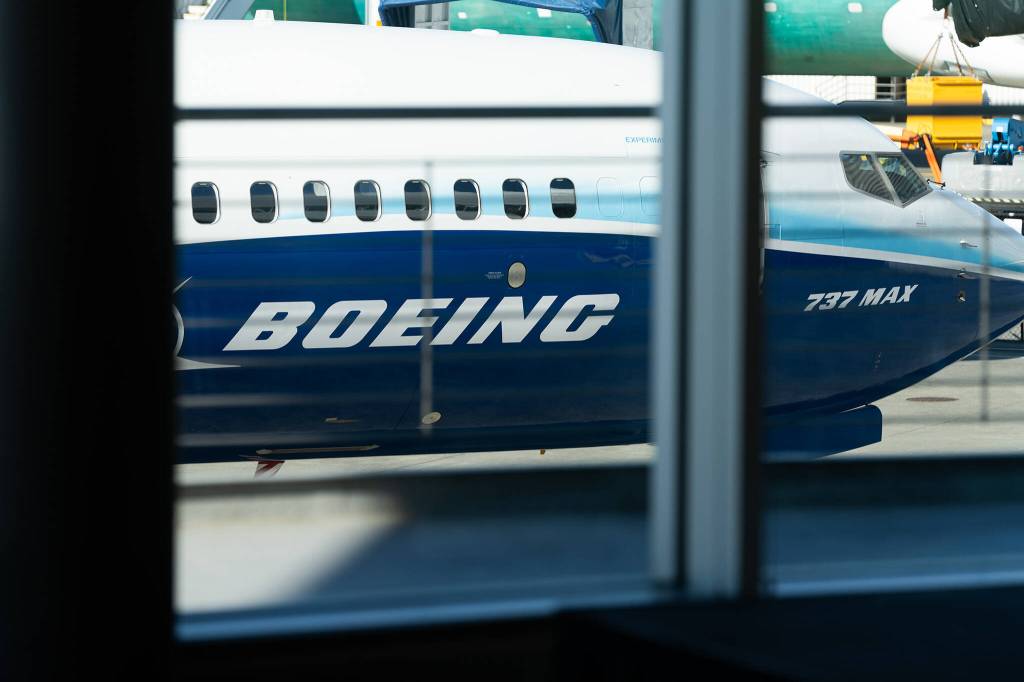
The 737 MAX production rate sits at 47 planes a month after the aerospace company passed the Federal Aviation Administration’s capstone review. But Boeing hopes to eventually produce 52 planes per month, a goal Everett’s North Line is expected to help accomplish.
At the time, Ortberg attributed the company’s constraints to its wing production and said Boeing had not seen the flow improvement it expected.
The Everett production line produces the 737 MAX 8, 9 and 10, aside from the wings, which are produced at the Renton site and transported to Everett for final assembly.
To hit its 52 planes per month goal, Ortberg said Tuesday the company needs to get the North Line certified and producing, along with stabilizing production of wings and fuselages, which are made in Kansas. He added later that focus on the fuselages will come after they “get through wings.”
“I’m expecting it’ll take us into next year to get fully stable at this rate,” he said. “Our output of wings is improving, but we need to demonstrate sustained performance at this level and ensure we have a high confidence plan to step up to rate 52 when the system is ready.”
While production is still slowed at the North Line, Ortberg said the Everett line saw its first 737 MAX 10 roll out Monday.
Turning focus to 777X
With the 737 MAX 7 and 10 certified, Boeing can turn its focus to the 777-9, Ortberg said.
“We continue to make progress on flight testing and still need approval to begin the balance of the flight test program,” he said.
Ortberg added that Boeing continues to expect the plane’s first delivery in 2027.
As Boeing gets closer to the 777X certification, Malave said the company has firmed up its production and delivery plan.
“We are currently producing airplanes at a rate of approximately one per month, and expect to stay at that level for most of 2027,” he said.
Record delivery backlog
For Boeing’s commercial planes, the division is experiencing a record backlog of $612 billion, including more than 6,300 planes, according to the presentation.
“This includes orders during the quarter from Turkish Airlines, Ethiopian Airlines and Lufthansa,” Malave added.
As for the 737 MAX, Boeing has delivered 124 of its most popular planes this quarter.
“As we close out the year, the delay in stability at 47 per month is expected to translate to the lower delivery output and come in shy of the 500 delivery target,” Malave said.
As for what’s next for the aerospace giant, Ortberg said once Boeing finishes its 777X program, “you will see a shift of resources and spending from those development programs to new programs.”
Jenna Millikan: 425-339-3035; jenna.millikan@heraldnet.com; X: @JennaMillikan