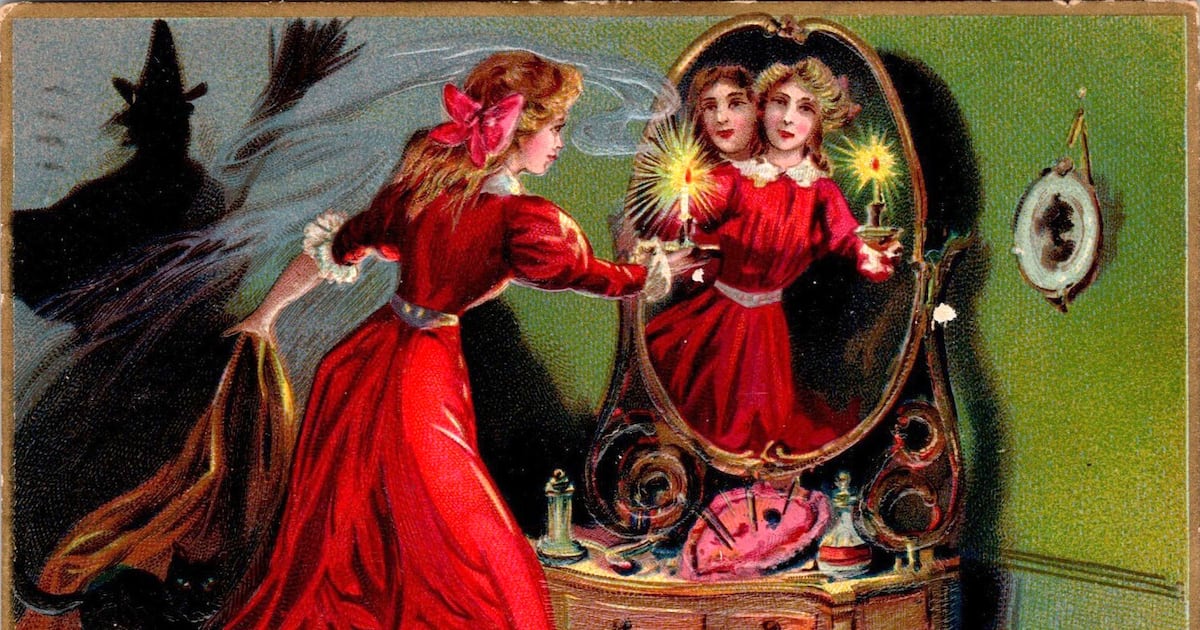
A Halloween postcard depicting a parlor game involving a woman and a man appearing over her shoulder in a mirror. (Photo provided by David Reamer)
Part of a continuing weekly series on Alaska history by local historian David Reamer. Have a question about Anchorage or Alaska history or an idea for a future article? Go to the form at the bottom of this story.
On Oct. 11, 1915, a Fairbanks newspaper called the Alaska Citizen ran a story on Halloween customs. This was so long ago that trick-or-treating was not mentioned, as it was not yet an established tradition. Instead of free candy, eerie parlor games were offered, meant to scare and delight in equal measure, laughter in the lengthening dark of an encroaching winter. Participants smiled at the absurdities of fortune-telling apples and roses, but in their hearts, they wondered if there was something to it. In the recesses of their minds, where fears and dreams mingle, they considered which would be better: an innocent game or a portal beyond the rules of the world as they understood them.
The most popular game was, naturally, also the most frightening. From the same story, “More trying to the nerves is the next test, but it is reasonably certain to produce results. The girl or man who would read the future must take a candle and go alone into the darkest, loneliest room of the house. He or she must look into the mirror. By the flickering light of the candle the future wife or husband is almost certain to be seen peering into the mirror over the shoulder of the seeker after hidden knowledge.”
A Halloween postcard depicting a parlor game involving a woman who looks into a mirror with the hopes of seeing her future husband in the reflection. (Photo provided by David Reamer)
The game could only be played at night, preferably at midnight, the better to prey on the superstitious. And the specifics of the “darkest, loneliest room” changed with circumstance. In a multi-story home, the process demanded a march up the stairs and away from the crowd, the steps creaking loudly in the anxious quiet of the quest. In homes with basements, the seeker descended into cellars.
Hundreds of such postcards were printed each Halloween season. “On Hallowe’en, by pumpkin’s light, this witch will help you choose aright.” Or, “Don’t be afraid on Hallowe’en, if you take a lighted candle and a mirror clean, at the stroke of twelve, look and there’s seen, the face of your lover that I ween.” Perhaps everyone was not quite ready for romance. As one such postcard declared, “On Hallowe’en, oh mercy me, the awfullest things that one can see, ghosts and goblins, and witches too, and other things to frighten you.”
A Halloween postcard depicting a parlor game involving a blindfolded woman and a mirror. (Photo provided by David Reamer)
In many variations, the seeker was forced to walk backward, which aided the tension. From a 1916 story in the Alaska Daily Empire out of Juneau, “Little girls duck for apples till they are wet from head to foot, walk down the cellar stairs backward, hold a candle before a mirror to see their future husbands.”
The opportunities for shenanigans are obvious. Friends stealthily followed behind mirror-toting players, or hid in the darkened destinations. At the right moment, they leaped from the shadows, screams stabbing the night before terror collapsed into giggles. Or, there was the potential for romantic assignations. A hopeful young man, yearning to make his feelings known, could plan to reveal himself in a mirror. As another postcard suggested, “of course this affair must be prearranged to be successful for the Witches are busy and can’t tend to everybody.”
In this way, Halloween was once widely considered more of a holiday for girls. While there are old traditions of boys and mischief on All Hallow’s Eve, what doesn’t have traditions of boys and mischief? In the 1914 short story “A Halloween Party” by Esther Vandeveer, a mother organizes a Halloween party with apples, mirrors, and other household items used to predict husbands. And her own husband asks, “Halloween is for girls, I presume.” His fate had possibly been ordained by a mirrored image some years prior, but that is women’s knowledge. It’s better that he doesn’t know how life really works.
A Halloween postcard depicting a parlor game involving a woman who looks into a mirror with the hopes of seeing her future husband in the reflection. But in this picture, her brother is kissing the cook. (Photo provided by David Reamer)
The Skagway newspaper, the Daily Alaskan, reprinted that short story. Back then, romantic Halloween tales were an annual staple in papers around the country, very much including Alaska. For Halloween was for lovers, or future lovers at least. The more ghoulish trappings — the ghosts and goblins and witches — just made the heart pump faster still, the blush a little brighter.
In 1908, the Daily Alaskan ran “Landing a Burglar.” Author Martha Cobb Sanford wrote of a single girl lost in sadness during a wedding, lonely and envious of the bride. “Wedding nights, sighed Elsie, were much like Halloweens — one dipped into the future and saw sweet visions, but only visions, after all!” After all, what could be worse than a silly game that promised love than having no love at all. In some ways, it was better to believe in spiritual, spooky fate.
Three years later, the Daily Alaskan ran “The Infallible Charm: A Halloween Story” by Clarissa Mackie. “Step by step around the house, under the grape arbor that spanned the back premises, under the rose trellised pergola on the south, and the mirror remained a black void. Eve knew she would die of terror if a face should appear in the mirror, but she felt that death would be preferable to a solitary existence without love or romance.”
A Halloween postcard depicting a parlor game involving a woman who sees a man appearing in a mirror. (Photo provided by David Reamer)
From “Her Halloween” by F. A. Mitchel, “Ethel knew all the young men in her neighborhood, and it seemed probable that if she married she would be chosen by one of them, for no one else ever came to that region. She did not expect to look into a mirror and see reflected there over her shoulder the face of a stranger. She only hoped to know which of three young men of her acquaintance would ask her to marry him. She had no reason to suppose that any of them would ask her, but in case any one did, she wished to know which it was to be.”
The Daily Alaskan ran “Her Halloween” in 1912. If you thought old-timey pioneers read rip roarin’ adventures and hunting tales, well, that’s true. But they also read Halloween romances, the sweethearts and lonely souls that they were.
For there was another variation to the mirror parlor game. If no one appeared in the mirror, that was fine for games in the dark with friends and all the expected jokes at your expense. However, what if something else appeared in the reflection, a skeleton or other personification of death? Well, that meant the seeker would die without marriage. This unfortunately binary view of life for women, as fit for marriage or coffin, may have played into the parlor game’s decline. Likewise, it is telling that its American popularity seems to have peaked shortly before the 19th Amendment to the Constitution, which granted women the right to vote.
A Halloween postcard depicting a parlor game involving a woman who sees a man appearing behind her in a mirror. (Photo provided by David Reamer)
The mirror game as played in the 19th century into the early 20th, was itself the product of cultural evolution. Mirrors were long associated with superhuman perceptions, including in the Snow White mythos and “Through the Looking-Glass,” the “Alice in Wonderland” sequel by Lewis Carroll. Indeed, mirror divination, also known as catoptromancy, dates back to at least ancient Egypt and appeared in cultures around the world.
Mary Coleridge (1861-1907) toyed with and twisted the mirror parlor-game concept in her poem “The Other Side of a Mirror.” When she gazed into it, she saw no future partner or spectral vision. She did not see other worlds or futures or pasts. Instead, she “found reflected there, The vision of a woman, wild, With more than womanly despair.” Finally, she realizes this woman is herself; the true revelation is understanding herself. It concludes, “I am she!”
By the mid-20th century, the matchmaking mirror parlor game survived mostly as a memory, an example of what old people used to get up to, nothing that would interest the cooler, younger generations. But the core conceit, of conjuring images via a mirror, continued in gruesome, twisted fashion. In long decades, even centuries ago, it was “calling the witch in the mirror.” By the 1960s, other names were whispered shakily in dark bathrooms. Perhaps you’ve heard of Black Madame or Mary Worth. Maybe you have stared at your reflection and uttered, “Bloody Mary, Bloody Mary, Bloody Ma- …” Or there is the Candyman.
Halloween could still be for lovers, or you can play in more horrific sandboxes. So, when Halloween comes:
At midnight into the mirror you must stare
Not at yourself but over your shoulder there
Will you see the face of love so fair
Or the skeletal grim death offering glare.
• • •
Key sources:
Ellis, Bill. Lucifer Ascending: The Occult in Folklore and Popular Culture. Lexington, KY: University of Kentucky Press, 2004.
“Goblins and Witch Night Drawing Near.” [Juneau] Alaska Daily Empire. October 28, 1916, 2.
“Hallowe’en and Its Unique Customs.” [Fairbanks] Alaska Citizen. October 11, 1915, 6.
Mackie, Clarissa. “The Infallible Charm: A Halloween Story.” [Skagway] Daily Alaskan. November 6, 1911, 3.
Sanford, Martha Cobb. “Landing a Burglar.” [Skagway] Daily Alaskan. November 20, 1908, 3.
Vandeveer, Esther. “A Halloween Party.” [Skagway] Daily Alaskan. December 2, 1914, 3.