Jakarta, IO – The Health Ministry (Kemenkes) is bolstering early detection of visual impairment through its “Free Health Checkup” (CKG) program. Out of the 34 million people who have undergone eye examinations through the program, 1.6 million were found to have indications of visual impairment.
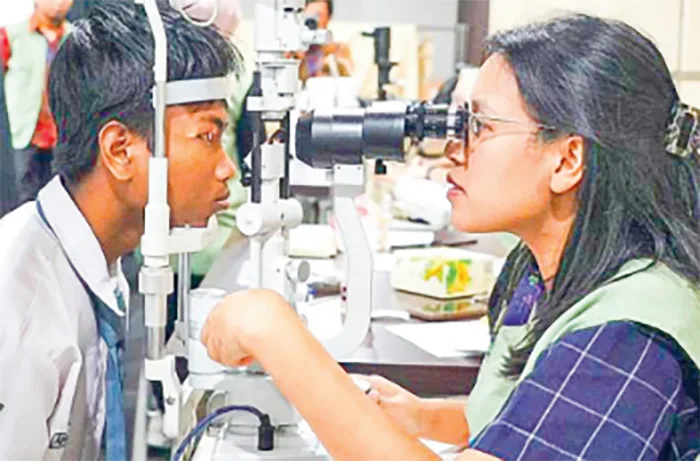
These efforts were reinforced through the launch of the Comprehensive Community Eye Care (CCEC) program, in commemoration of World Sight Day 2026 on Thursday (15/10/2026). The event was attended by junior and senior high school students, representatives of professional organizations and health development partners. In addition to the program launch, activities included educational sessions and eye screenings for students.
Over the next three years, the initiative aims to conduct similar examinations on more than 60,000 students and workers, across five provinces and 19 regencies and cities. Deputy Health Minister Prof. Dante Saksono Harbuwono stated that eye examinations should be an integral part of a health checkup, from an early age. Globally, an estimated 1.1 billion people live with untreated visual impairment, 90 percent of which is preventable or treatable.
“Do not wait until your eyes feel heavy, blurry, or painful. Take care of the first organ that works for us every single day,µ he said.
To strengthen prevention and treatment efforts, .emenkes is executing four strategic steps: expanding eye screenings through the C.G program, broadening access to cataract surgeries, addressing the uneven distribution of ophthalmologists and promoting eye health education in schools and workplaces. The Ministry is also coordinating with the national health insurer BPJS .esehatan and the Indonesian Ophthalmologists Association (Perdami) to address disparities in the regional allocation of cataract surgery services.
Adopt 20-20-20 Rule
Prof. Dante added that the public should adopt simple habits to maintain eye health, especially when using digital devices. One recommended measure is the 20- 20-20 rule—resting the eyes for 20 seconds every 20 minutes of screen time by looking at an object 20 feet (about six meters) away.
Meanwhile, the Ministry’s Non-Communicable Diseases Director dr. Siti Nadia Tarmizi, MEpid, noted that establishing Vision Centers is a key initiative, one intended to bring eye care services closer to the public. This model connects community health centers (Puskesmas), regional health departments, professional organizations, health workers and development partners to streamline access to eye exams and treatment.
According to dr. Nadia, eye care services have historically been concentrated in hospitals, requiring residents to travel long distances for checkups and treatment. Through the Vision Center model, eye screening services, professional healthcare support and the provision of eyeglasses are expected to extend down to the Puskesmas level.
From a partnership perspective, Amanda Huang, chief of programs and partnership at The Fred Hollows Foundation, explained that the CCEC program builds on ongoing collaboration with the Indonesian government, to expand community-based eye health services. The program is designed to facilitate earlier access to visual impairment screenings and interventions, including through schools and primary care facilities.
Over the next three years, the CCEC initiative aims to train more than 2,000 healthcare professionals and teachers, support 16,500 cataract surgeries, and distribute over 100,000 pairs of prescription glasses. The program will also establish 13 new Vision Centers and strengthen 21 existing ones. Amanda stressed that the initiative is expected to reach individuals earlier and bring high-quality eye care directly to their local communities.
Read More: Culinary Culture Playground with Over 50 Creations at Hutan Kota GBK
The benefits of eye screening were felt firsthand by Fayra Salsabila, a student at state junior high school SMPN 145 Jakarta, and one who participated in the event’s screenings. The examination revealed astigmatism with a cylinder of 2.00 in one eye and 1.50 in the other. She received a free pair of glasses along with advice on habits to avoid, in order to protect her sight.
“I got free glasses from this screening. Next, I just need to go back to choose my preferred frame style at the optical shop,µ Fayra said.
The 2026 World Sight Day commemoration carried the national theme ´Eye ScreeningsBy strengthening screening protocols, widening healthcare access, and raising public awareness, Kemenkes encourages regular eye examinations, so that visual impairments can be detected as early as possible. (est)