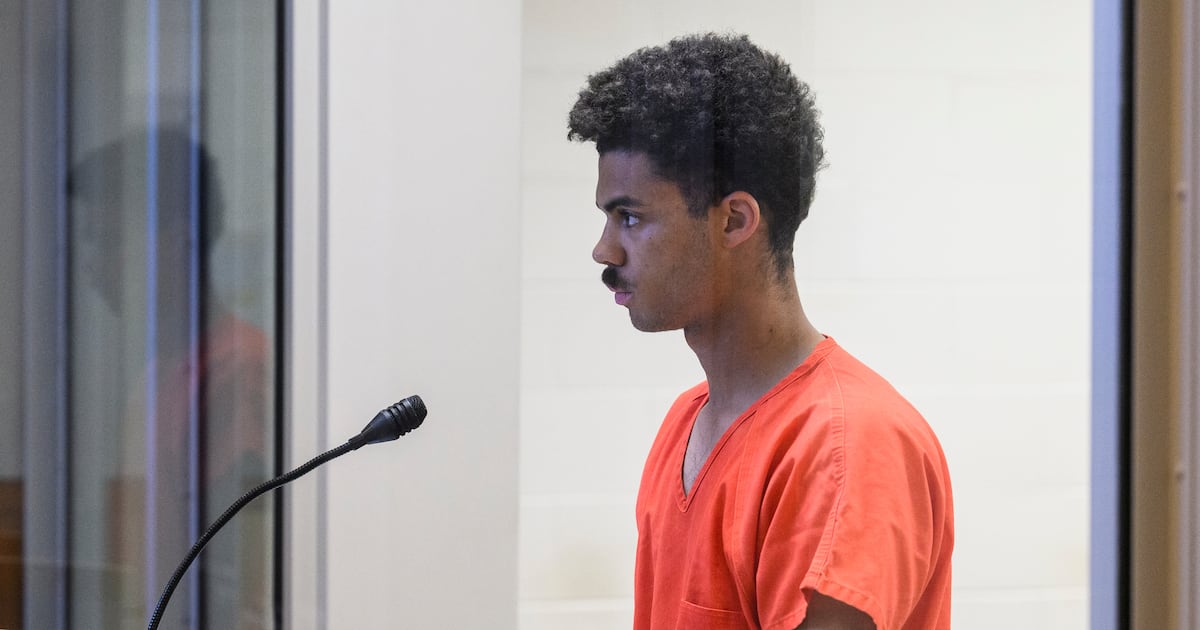
Zarrius Hildabrand is arraigned for murder at the Anchorage Jail courtroom on August 11, 2023. Hildabrand is accused of killing his wife, Saria Barney Hildabrand. (Marc Lester / ADN)
An Anchorage judge sentenced a former U.S. Army soldier Friday to nearly 60 years in prison in the 2023 killing of his wife.
In June, an Anchorage jury convicted Zarrius Hildabrand of second-degree murder and two counts of evidence tampering in the death of his wife, 21-year-old Saria Barney Hildabrand. He was acquitted on a more serious charge of first-degree murder after the two-week trial.
After the couple celebrated Hildabrand’s 21st birthday with friends the night of the killing, prosecutors say Hildabrand shot his wife in the head when she confronted him with evidence that he was cheating on her. Hildabrand then hid her body in a drainpipe near their apartment before reporting her missing more than a day later, according to prosecutors.
Anchorage Superior Court Judge Peter Ramgren handed down an 84-year sentence, with 25 years suspended, after several of Barney’s family members spoke about how her death has devastated them. Barney’s family has described her using only her maiden name after the death.
This undated photo provided by Meredith Barney shows her daughter, Saria Barney Hildabrand. Her husband, U.S. Army soldier Zarrius Ray Hildabrand, faces murder and evidence tampering charges stemming from her death in August 2023. (Courtesy Meredith Barney via AP)
The sentence means Hildabrand will spend 59 years in prison, though Ramgren said he will be eligible to seek discretionary parole after serving about 40 years. Hildabrand will also serve 10 years of probation following his release.
“This was an inexplicable killing, completely unwarranted and without provocation,” Ramgren said. “He killed his wife and then methodically engaged in a dayslong attempt to cover up his conduct and to avoid its consequences, with no thought for anyone but himself.”
Hildabrand was stationed at Joint Base Elmendorf-Richardson and served with the 11th Airborne Division. His attorney, Lacey Jane Brewster, said he received an other than honorable discharge after his arrest.
Family members said Barney, who served as combat medic in the Alaska National Guard and also worked at a Midtown restaurant, joined the guard to pay for college and a future career in the medical field.
Hildabrand, who sat mostly expressionless and stared toward the judge while wearing a yellow Anchorage Correctional Complex jail jumpsuit, hasn’t said why he shot Barney and has claimed that he was too drunk to recall what led to her death.
“This man showed no remorse or even emotion about what he did to her. He played a game with me and my family,” said Barney’s mother, Meredith Barney. “Every human makes mistakes, even big ones that hurt people. However, not everyone defiles a corpse and throws it down the storm drain. He did that. He did that to my little girl.”
In an Oct. 15 sentencing memorandum, Brewster said if Hildabrand killed his wife, it was “more likely” that the death was the result “of a drunken mishandling of a firearm.”
Brewster pushed for a sentence of about 22.5 years in prison because of a lack of previous criminal convictions or history of violence, a clean military record before his arrest and good behavior while jailed, signaling that Hildabrand was unlikely to reoffend when released.
Hildabrand didn’t comment during Friday’s hearing, only saying “No, your honor,” when Ramgren asked if he’d like to speak.
While issuing his sentence, Ramgren said he hoped Hildabrand “would have something to say” during the hearing and “at least extend some sort of apology to the family.”
“His failure to take responsibility reflects poorly on his prospects for rehabilitation,” the judge said of Hildabrand.
Prosecutors asked the judge to disregard a typical sentence range of between 20 and 30 years for similar second-degree murders and send Hildabrand to prison for 74 years, according to their Oct. 13 sentencing memorandum.
After he killed Barney, Hildabrand used her phone to message friends and call in to work sick and took other steps to hide the crime, such as buying cleaning supplies, a cover to hide a blood-stained mattress and a large garbage can to dispose Barney’s body in, prosecutors said.
Hildabrand called police about 30 hours after killing Barney to report her missing, which resulted in an extensive search effort that included police and dozens of military members, said prosecutor Kaila Hurley.
When Barney’s mother and other family members arrived from out of state to look for her, Hildabrand helped them search the woods near the couple’s apartment and steered the family away from the area where he disposed Barney’s body, she said.
“He made sure to inflict the most amount of harm he could at every point,” Hurley said of Hildabrand.
Family members said Barney was an important part of a large extended family who brought everyone closer together and stepped up to help raise her younger siblings when Barney’s mother was working to finish her undergraduate and graduate degrees.
Barney, they said, was resilient, hardworking and kind, and shared a passion for basketball with her father.
“Losing her has left an enormous hole in her family. She was young, but she was a pillar to so many,” said Royce Barney, her uncle. “She spent her short life taking care of other people and working hard for something better. She deserved the chance to live it.”