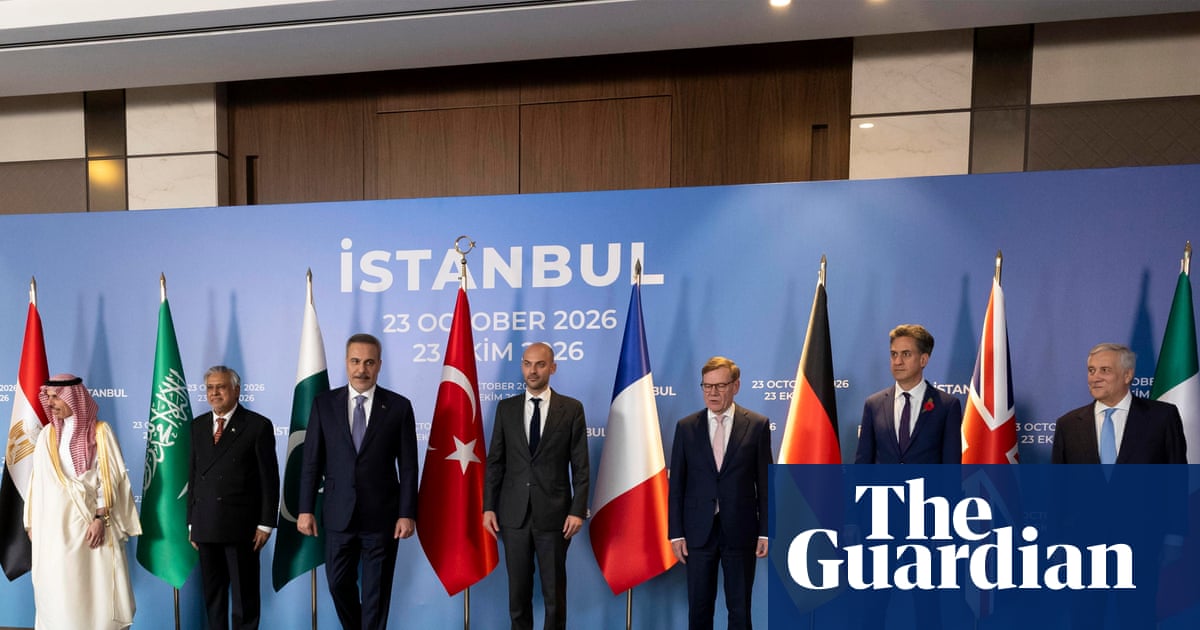
Foreign ministers at a summit of eight European and Middle Eastern countries have urged the US and Israel not to renews their attacks on Iran, warning a fresh outbreak of fighting would spread conflict and push oil prices even higher.
The development of a new multinational “anti-war bloc” represents a challenge to the increasingly open plans by the US and Israel to relaunch strikes on Iran while talks on Tehran’s nuclear programme remain deadlocked.
The Turkish foreign minister, Hakan Fidan, joint convener of the summit in Istanbul, said: “Military intervention in Iran is not any kind of solution. We agreed that a new military attack would spread the war and the conflict in the region. All the countries around the table do not want the war to spread even more, once again.”
Ministers also demanded an end to the Houthi assaults on Saudi Arabia, and an immediate opening of the strait of Hormuz currently blockaded by Iranian ships and drones.
Jean-Noël Barrot, the French foreign minister, said another war between Iran and the US would be bad for both sides, and only worsen rising oil prices, which have hit their highest level since May. Ed Miliband, the UK foreign secretary, also urged both sides to embrace diplomacy.
The Istanbul meeting, an unprecedented gathering of regional and European leaders initiated by Turkey and Germany, represented a rare chance for European ministers to have any input into the crises afflicting the Middle East, including in Yemen, Palestine and Iran. They have largely been left as bystanders, apart from sending air force protection to Saudi Arabia as it tries to fend off Houthi drone and missile assaults on its airports and energy installations.
The Middle Eastern states were represented by Fidan, Egypt’s Badr Abdelatty, Pakistan’s Ishaq Dar and Saudi Arabia’s Faisal bin Farhan. Pakistan, Turkey and Saudi Arabia formed the Mecca defensive security pact in August, a grouping Egypt may join.
The European side was represented by Barrot, Miliband, Germany’s Johann Wadephul and Italy’s Antonio Tajani. The agenda covered the Palestinian issue, including settlement expansion, settler violence and the two-state solution, as well as security in the strait of Hormuz, Yemen and efforts to end the Russia-Ukraine war and prevent spillover into the Black Sea.
Wadephul said: “We are united by the impact these deadlocked conflicts are having on the economy and security of our countries and by the will to seek new ways to bring about solutions.”
He made no criticism of the US but accused “the Houthis and Iran of blackmailing world trade and continuing to stranglehold global supplies of energy and fertiliser”.
“We are feeling the effects of the attacks on shipping routes and whether at the petrol pump or the supermarket,” he said. “Elsewhere there is threat of famine.”
Tajani said the aim of the meeting was to work for “de-escalation to guarantee freedom of navigation”.
“I do not believe the problem can be solved from a purely military standpoint,” he added. “If we want to reopen Hormuz, which is vital for our economies, we must promote dialogue and make Iran understand that this attitude cannot continue.”