Want to bookmark your favourite articles and stories to read or reference later? Start your Independent Membership today.
Join today
Already a member?
Log in
Thousands of students have staged protests across Indonesia over the government’s response to the haze that has spread across Southeast Asia, demanding that president Prabowo Subianto declare a national disaster.
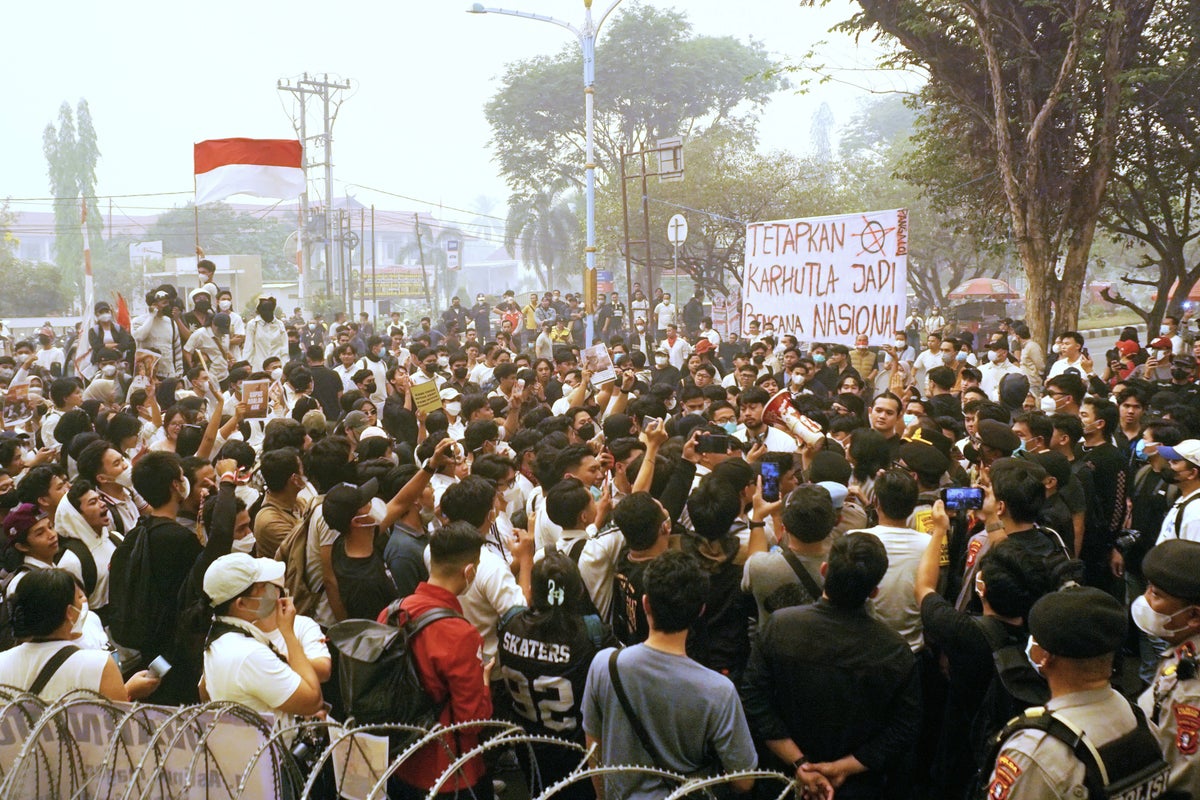
More than 500 protesters gathered on Friday outside the Central Kalimantan governor’s office in Palangkaraya, the provincial capital on Borneo island, where many of the fires are burning.
Many wore thick masks against the smoke, which has tinged the city orange, and some held signs reading “haze emergency”.
Protests earlier in the week spread to more than half a dozen cities, including Jakarta, Bandung, Yogyakarta, Pekanbaru and Makassar on Tuesday, when students marked the second anniversary of Mr Prabowo’s government.
Vincent Thomas, a student at Universitas Padjadjaran who joined the protest in Bandung, said the demand went beyond Borneo.
“We want the government to openly declare a national disaster emergency,” he told The Associated Press.
“Not just regarding Kalimantan, but regarding forest fires across the entire country, in every part of Indonesia.”
“In Indonesia, we’re so angry. We want the officials responsible to be held accountable.”
Demonstrators gather amidst heavy haze during a protest demanding action over forest and land fires outside the Central Kalimantan Governor’s office in Palangkaraya (AFP/Getty)
Protesters demanded a declaration of emergency which would unlock funds and help thousands of people with medical expenses. However, Mr Prabowo has so far resisted it.
The haze has made large numbers of people ill. More than 333,470 residents have had acute respiratory illnesses across the seven affected provinces since mid-August, according to Indonesia’s health ministry, up from nearly 280,000 a week earlier.
Fires have affected more than 1.9 million hectares in the first nine months of the year, an area just under the size of Wales. Most are started by farmers and plantation workers clearing land by slash and burn, which is common in Indonesia’s dry season, and this year’s are the worst in more than a decade.
Forests were dry because less rain fell than usual in the wet season, and experts blame record heat and an El Nino that may be the strongest in living memory.
“The current haze crisis is a real symptom, a real example of how climate change affects our day-to-day lives,” said Syahdiva Moezbar of the Centre for Research on Energy and Clean Air in Jakarta.
The protests have also drawn in wider anger at the government. Students at the Tuesday demonstrations criticised what they called ineptitude and corruption, and in many cases the haze protests have merged with ongoing demonstrations over Indonesia’s struggling economy.
One banner in Jakarta read “If we burn, you burn with us!”, and another read “Haze & Prabowo’s Regime = National Disaster”.
University students sit on a road during an anti-government protest a few days after the second anniversary of President Prabowo Subianto’s inauguration in Surabaya (AFP/Getty)
The government says it is fighting the fires. More than 60,000 firefighters, including volunteers, have been deployed across the country, and 49 aircraft are available for water bombing and cloud seeding to make rain, although haze has grounded many of them at times, said Berton Panjaitan, spokesman for the national disaster agency.
Indonesia has also tried new methods. It dispersed 2.4 tonnes of dry ice from aircraft over South Sumatra province on 15 and 16 October to try to clear the smoke, and the head of the disaster agency, Kristomei Sianturi, told reporters in Palembang on Sunday that the trials had been “fairly effective”. The agency is considering expanding them to more regions.
Jakarta has changed its position on foreign help. An Indonesian official said at the start of last week that the country could handle the fires itself, but by the end of the week the government said it would accept assistance from neighbours.
The smoke has crossed borders. Singapore and the Malaysian capital Kuala Lumpur were ranked among the world’s most polluted cities this month by the monitoring platform IQAir, and the pollution has closed schools in East Timor and been detected in the Philippines.
Singapore has issued legal notices to seven companies in Indonesia that it blames for the fires, and its environment minister, Grace Fu, has warned that air quality there could worsen.