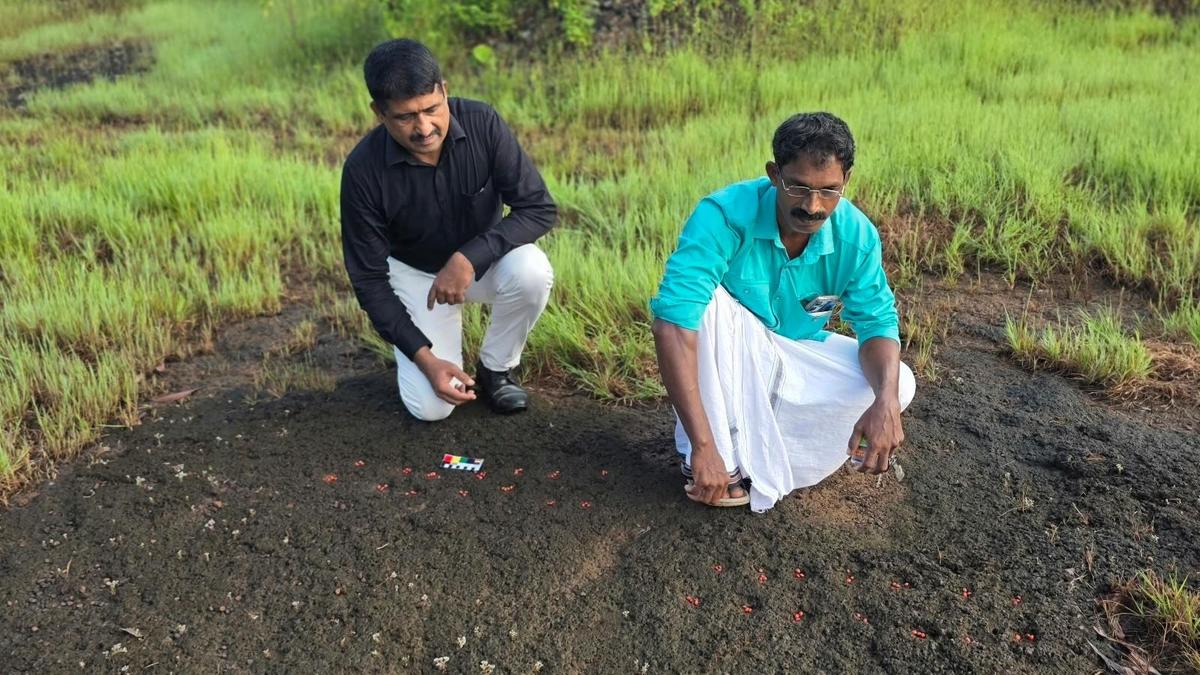
Historian Nandakumar Koroth (right) and archaeology enthusiast Satheesan Kaliyana near the rock carvings at Madikkai in Kasaragod district, believed to offer clues to the gaming traditions of prehistoric communities.
| Photo Credit: arranged
Rock-carved game boards resembling the traditional 14-pit Manjadippala or Kadippala boards used in Kerala have been discovered at Madikkai Umichi, Banam, and Cheemeni Ariyittapara in Kasaragod district, providing possible evidence that people in the region engaged in recreational activities thousands of years ago.
Six distinct game boards have been identified so far; four at Banam; one at Umichi in Madikkai; and one Ariyittapara at Cheemeni. All of them are located near the natural water reservoirs, locally known as Pallam, in Kasaragod district.
A ‘game board’ resembling the 14-pit Manjadippala carved on a rock in Kasaragod.
| Photo Credit:
arranged
The discovery suggests that the inhabitants of the region had opportunities for recreation and possessed an understanding of counting and numerical relationships, observed Nandakumar Koroth, head of the Department of History at the Nehru Arts and Science College, Kanhangad. The finding emerged after archeology enthusiast Satheesan Kaliyana drew attention to unusual pits carved into rocks in the area.
“The rock carvings indicate that people who lived in these areas may have played games during their leisure time. The resemblance between these ancient structures and the traditional Manjadikkali boards used by people till about 40 years ago is particularly significant,” said Dr. Koroth.
Need for conservation
He said they could have been made using stone tools such as celts or iron tools. But further archaeological investigation and scientific dating are required to establish their precise age. The State Archaeology department or the Archaeological Survey Of India should intervene to document and protect the rock-carved boards, the researchers said adding that conservation is urgent because several carvings have already been buried or are located in areas affected by construction and proposed development projects.
Senior archaeologist and former archaeology professor Ajith Kumar, however, cautioned against assigning a specific antiquity to the carvings without further evidence. While the structures could be identified as game boards resembling Pallankuzhi, their discovery near other archaeological remains did not establish that they belonged to the same period.
He said Pallankuzhi is a traditional game played on a board containing two parallel rows of pits usually seven in each row. Some boards have larger pits that serve particular functions in the game. Seeds, including tamarind seeds, are traditionally used as counters. Dr. Ajith said game boards of this kind are not confined to Kasaragod or Kerala.
Similar examples have been reported at several archaeological sites in south India, including Tamil Nadu and parts of Karnataka. Similar structures have been documented on dark volcanic basalt rock at Deccan College in Pune, its nearby temple premises and the Aurangabad cave complex. Archaeologist have also identified comparable Mancala boards in Africa with some believed to date back approximately 8,000 years.
A ‘spiritual’ angle
He noted that some researchers had proposed that certain carved features found alongside human figures at rock-art sites might have been associated with belief about spirits. One interpretation suggests that games or other activities may have been intended to entertain spirits and prevent them from returning to places where they could cause trouble. However, he stressed that such explanations remained speculative and were not supported by conclusive scientific evidence linking the game boards to spiritual practices.
Dr. Ajith said although the boards could reflect a long-standing tradition of playing such games, their resemblance to a game that survives into modern times makes dating particularly difficult. The fact that similar games were played in later periods means that the carvings cannot automatically be assigned to the Neolithic or Megalithic periods. Further, natural processes within laterite might produce formations that could be mistaken for human-made ones.
The question of when the boards were actually carved therefore remained open, he added.
Published – October 23, 2026 07:00 am IST