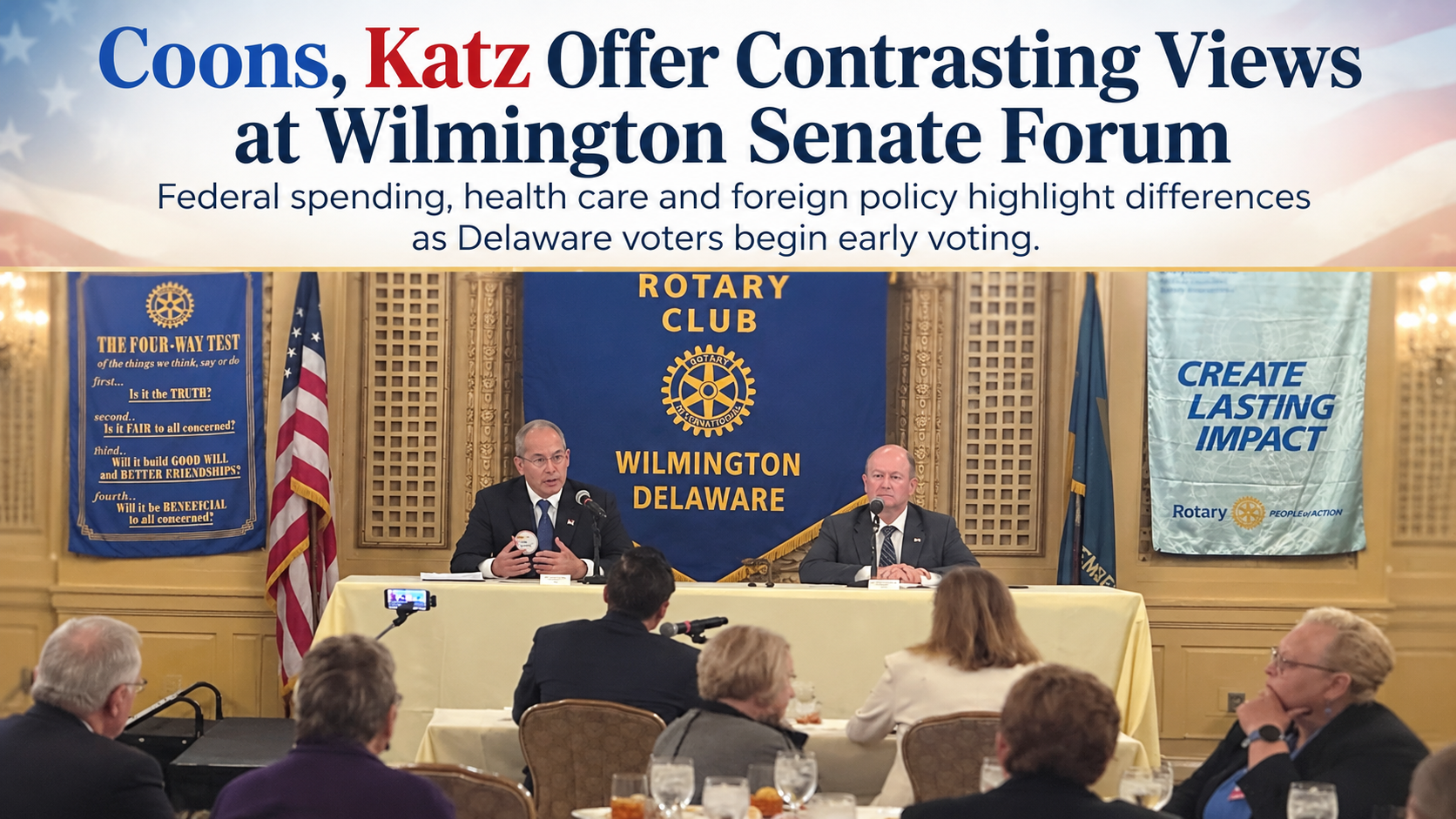
Photo taken by Delaware LIVE. Graphics added by on 10/22 using AI.
Federal spending, health care costs and foreign policy highlight differences as Delaware voters begin casting ballots.
By George D. Rotsch, Delaware LIVE News
WILMINGTON, Del. — Democratic U.S. Sen. Chris Coons and Republican challenger Dr. Mike Katz presented different approaches to controlling federal spending, reducing health care costs and addressing America’s foreign policy challenges Thursday during a U.S. Senate candidate forum at the Hotel du Pont.
The hourlong discussion, hosted by the Rotary Club of Wilmington and moderated by Jake Owens of Spotlight Delaware, gave voters an opportunity to compare the candidates as early voting began for the Nov. 3 general election.
Coons emphasized his 16 years in the Senate, bipartisan legislative experience and willingness to challenge President Donald Trump’s policies. He said his campaign is focused on three priorities, in this order: opportunity, security and justice. Coons described opportunity as helping Americans build better lives, security as protecting families and their futures, and justice as addressing political divisions and abuses of power.
Katz, a physician, former state senator and business executive, argued that after 16 years of Coons representing Delaware in Washington, it is time for a change. He characterized the election as a performance review of the incumbent and a job interview for the challenger, calling for new leadership focused on financial responsibility, government efficiency and solutions to longstanding problems.
While both candidates promised to work across party lines, their differences were evident in how they would address some of the nation’s most pressing challenges.
Photo: The Gold Ballroom at the Hotel duPont, the stie of the Candidate Forum on Thursday October 22,2026.
Federal spending and debt
With the national debt approaching $40 trillion, both candidates acknowledged that federal spending and borrowing have become serious problems.
Coons said Republicans and Democrats share responsibility for growing deficits. He advocated increasing taxes on wealthy Americans and highly profitable corporations while providing relief to working families.
Katz argued that Washington cannot continue increasing taxes without addressing the underlying cost of government.
He called for restructuring federal operations, eliminating waste, establishing balanced budgets and developing a plan to reduce the national debt.
Moderator Owens challenged both candidates to identify specific budget decisions they would make, including which constituencies they would be willing to disappoint.
Neither presented a comprehensive deficit-reduction plan identifying specific spending cuts and revenue increases.
Social Security and health care
The candidates also offered different approaches to preserving Social Security and controlling health care costs.
Coons supported raising the income cap subject to Social Security payroll taxes and working through a bipartisan process to consider additional changes necessary to strengthen the program.
Katz said Social Security represents a commitment to Americans who have contributed throughout their working lives. He advocated reviewing how the program operates before considering changes to benefits or retirement requirements.
On health care, Coons defended the Affordable Care Act as a means of expanding access to insurance and preventive treatment.
He argued that improving access to primary care could reduce expensive emergency treatment and improve long-term outcomes.
Katz, drawing on four decades in medicine and health care management, said the system requires more fundamental reform.
He argued that government subsidies and insurance changes primarily determine who pays rising medical bills without adequately addressing why care costs so much.
Katz acknowledged beneficial provisions of the Affordable Care Act, including protections for people with pre-existing conditions, but described the overall law as a failed approach to controlling health care costs.
Neither candidate provided a detailed legislative plan showing how his proposals would reduce costs for Delaware patients and employers.
Tariffs, energy and family expenses
The cost of living was another area of disagreement.
Coons criticized the Trump administration’s broad tariffs, arguing they increase prices for consumers and businesses, particularly those importing construction materials or exporting products to Canada.
He pointed to Delaware industries, including chemicals, agriculture and port operations, as examples of businesses affected by international trade policies.
Katz described tariffs as a legitimate economic tool when used selectively to protect American workers and businesses from unfair foreign competition.
He said tariffs should have clearly defined objectives, measurable results and congressional oversight.
Both recognized the importance of maintaining American competitiveness, but Coons placed greater emphasis on removing trade barriers while Katz focused on targeting unfair trade practices.
Iran war divides candidates
Foreign policy produced some of the forum’s clearest differences.
Coons strongly criticized the administration’s war with Iran, arguing that inadequate planning and insufficient consultation with Congress and American allies contributed to higher gasoline prices and instability in the Middle East.
He called for ending the conflict and restoring shipping through the Strait of Hormuz.
Katz said preventing Iran from obtaining nuclear weapons remains essential to American and international security.
He criticized decades of foreign policy decisions, including the 2015 nuclear agreement supported by Coons, which Katz argued failed to resolve Iran’s long-term nuclear threat.
Both expressed concern about presidential military actions without sufficient congressional involvement, although they emphasized different responsibilities and policy failures.
On Ukraine, Coons strongly defended continued support for the country against Russia’s invasion. Katz criticized failures of American and international leadership but did not outline a detailed alternative strategy for ending the conflict.
Katz questions political process
One of the forum’s more pointed moments came when Katz departed from a question about Ukraine to raise concerns about the conduct of Delaware’s Senate campaign.
He alleged that campaign communications had been hacked, staff members had been threatened and supporters had experienced intimidation.
Katz also criticized the absence of a traditional public debate and what he described as insufficient scrutiny of the incumbent.
The allegations were not substantiated during the forum, and no evidence was presented establishing who might have been responsible.
The campaign has previously criticized Coons for declining other proposed debates, including a student-organized event at the University of Delaware. Thursday’s forum brought both candidates together, although the format did not allow direct exchanges or audience questions.
Bipartisanship and congressional accountability
Despite their disagreements, both candidates supported maintaining the Senate filibuster, which generally requires 60 votes to advance major legislation.
Katz said the rule protects minority-party interests and discourages either party from imposing sweeping changes without broader support.
Coons also defended the filibuster while expressing openness to certain reforms, particularly involving voting rights.
Asked when they would oppose their own parties, Katz pledged to evaluate legislation based on Delaware’s interests rather than party loyalty.
Coons cited examples of bipartisan legislation he had worked on with Republican colleagues, arguing that his record demonstrates an ability to deliver results even when party leaders disagree.
The discussion also touched on artificial intelligence, immigration and U.S. military assistance to Israel.
Both candidates supported responsible AI development, although Katz emphasized innovation and competitiveness while Coons stressed safeguards and the potential impacts of data centers on communities.
On immigration, Katz emphasized stronger border enforcement and legal immigration reform. Coons called for border security combined with greater accountability for federal immigration enforcement and legal pathways for qualifying immigrants.
Different approaches, shared challenges
Throughout the forum, Katz returned to his central argument that longstanding federal problems require changes in management, priorities and accountability.
Coons pointed to his relationships in Congress and legislative experience as reasons he could continue delivering results for Delaware.
Both identified rising costs, federal debt and political division as major concerns. Their disagreement centered largely on whether those problems are better addressed through changes to existing federal policies or more extensive restructuring of government programs.
The forum also left questions about specific spending reductions, long-term Social Security financing and measurable health care savings.
With early voting underway, Delaware voters now have a clearer comparison of the candidates’ priorities — and the decisions each would face in Washington.
TO GO: Delaware U.S. Senate election
- Candidates: U.S. Sen. Chris Coons (D) and Dr. Mike Katz (R)
- Forum: Thursday, Oct. 22, Hotel du Pont, Wilmington
- Host: Rotary Club of Wilmington
- Moderator: Jake Owens, Spotlight Delaware
- Early voting: Oct. 22-Nov. 1, on designated voting days
- Election Day: Tuesday, Nov. 3, 2026
- Voting information: Delaware Department of Elections
Delaware LIVE collaborates with a network of professional journalists to cover a diverse range of stories across various fields. Staff Writers include experienced journalists and young professionals. If you have questions, please feel free to contact [email protected] or our publisher, George D. Rotsch, at [email protected]