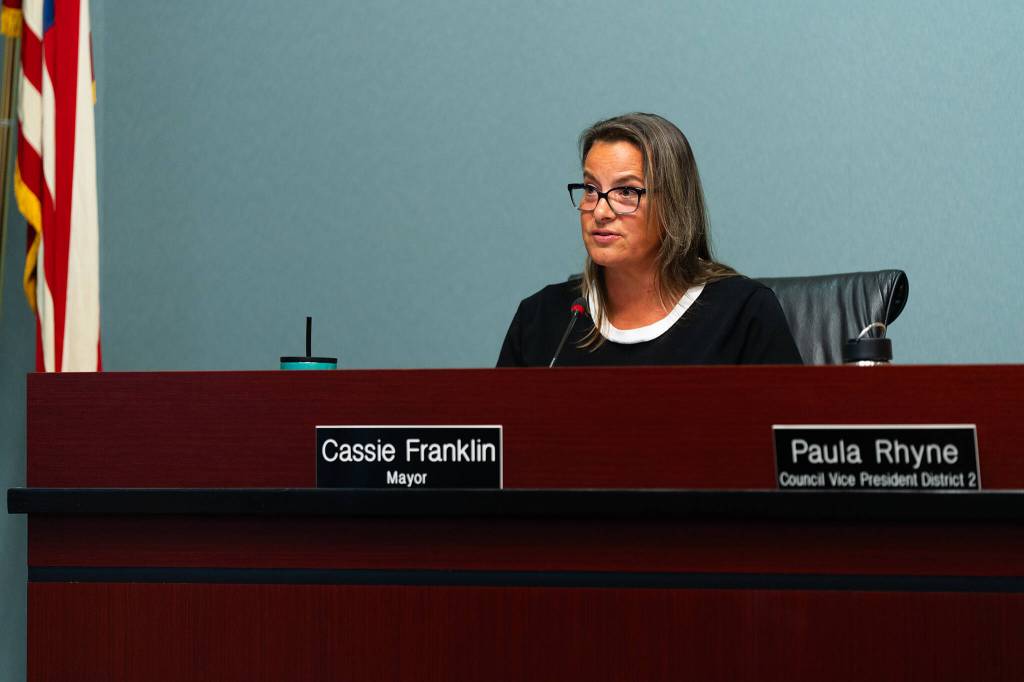
EVERETT — Everett Mayor Cassie Franklin unveiled her proposed 2027 budget on Wednesday, asking the City Council to approve a 0.1% sales tax increase to close a funding gap while maintaining existing city services.
In her budget address, Franklin said that the new revenue from the sales tax, as well as other tax increases that the council has approved earlier this year, would mean that the city could close a looming $13.1 million deficit and retain the same number of employees. Zero positions would be cut under the proposal, a city spokesperson confirmed Wednesday.
Franklin said that the $204 million general fund proposal includes new staff positions for the city’s municipal court system as well as its emergency management department. It would also increase the amount of funding available for the city’s human needs grants, which go toward local nonprofits to help provide access to food and housing.
The sales tax increase would raise about $4.9 million per year, spokesperson Simone Tarver wrote in an email Thursday.
In 2025, the state Legislature gave cities and counties the ability to implement a 0.1% public safety sales tax increase, requiring that the revenues go toward “activities that substantially assist the criminal justice system.” Nearby municipalities like Lynnwood, Edmonds and Snohomish County have recently put that sales tax into place as a way to fund police services and public defenders.
According to Franklin, the sales tax would also maintain long-term funding for Everett’s community alternative response team, known as the CARE Program, which sends social workers to respond to some 911 calls involving behavioral health challenges.
“I know bringing forward a tax increase is tough, but it’s the right decision for public safety in Everett,” Franklin said.
The City Council had already voted earlier this year to increase revenues through a utility tax hike, raising an existing tax rate from 6% to 12%. That increase is expected to bring in about $7.5 million in 2027, officials previously said.
The tax increase affects all customers of the city’s water system, which serves about three quarters of the population of Snohomish County. The decision to increase the tax outside of city borders drew rebukes from nearby municipalities and utility districts.
Franklin said that the city has continuously made cuts to the city budget in recent years, but a structural deficit — in which expenditures continue to outpace revenues — remains. Everett, along with other cities, has previously cited a 1% cap on annual property tax revenue increases as a primary factor causing its financial difficulties.
Everett went to voters in 2024 for a property tax levy lid lift to help close a looming deficit, but it was rejected. The city laid off 31 employees, cut street repair services, reduced library hours and cut Everett’s park rangers program in order to balance the 2025 budget. Those reductions have remained in place since. The city balanced the 2026 budget by using nearly $5 million of COVID relief dollars to help prevent significant cuts.
“The underlying issue remains: The revenues available to fund essential local government services cannot keep pace with the cost of providing them,” Franklin said. “For Everett, further cuts would mean eliminating services, having fewer resources for public safety, less maintenance in our parks and further reductions across all city departments.”
Everett also recently reworked its business and occupation tax code, raising an additional $3.5 million per year in revenue through higher taxes on manufacturing, services and wholesale companies. But the measure also made thousands of additional businesses exempt from the tax, and lowered taxes on retail shops and restaurants. City officials said about 6,500 of Everett’s 9,000 businesses are exempt from the tax, and about 2,000 companies saw a tax reduction from the changes.
That funding from the increased B&O taxes will not go into the general fund, however. It will mostly be spent on the city’s proposed downtown stadium project, known as the Outdoor Event Center, with some additional funding set to go toward business support programs and new grants to commercial districts.
In 2024, a fiscal advisory committee had recommended against raising taxes to pay for the stadium project. Franklin argued in her address that solving the city’s budget challenges “requires much more than cutting costs” and that the stadium could attract people, businesses and private investment to the city.
“We must aggressively grow our economy, and cities don’t grow by standing still,” she said. “Part of our job as a city is to periodically make bold public investments.”
As part of her address on Wednesday, Franklin also said that she planned to issue a new mayoral directive — a formal document issued by the mayor that instructs staff to take specific actions — asking city staff to “take a closer look,” Franklin said, at how Everett can prepare for growth in the south Everett area and find opportunities for investment.
City officials are already working on a subarea plan, a land use planning document that focuses on a specific part of the city, for the Casino Road area in south Everett.
Franklin has issued 14 directives during her three terms in office. She last issued a directive in February, which outlined city policies in response to increased immigration enforcement across Snohomish County.
“We want to be intentional about how south Everett grows and evolves,” Franklin said. “That means making thoughtful decisions that support a good quality of life today and prepare us for tomorrow.”
More people may be folding into Everett’s boundaries soon, according to Franklin. Since April, city officials have been working on a potential annexation of areas south of Everett, including the Mariner neighborhood, but Franklin revealed Wednesday that process could be complete as soon as six months from now. The city’s population could grow by more than 40,000 residents at that point, she said.
Franklin said additional funding that comes from state incentives to annex urban growth areas could allow Everett to “expand city services responsibly to serve those new Everett residents” and could “support additional strategic investments,” she said.
As part of her address, Franklin touted the city’s recent moves to streamline the housing construction process, including changing zoning to allow for more housing units, offering pre-approved accessory dwelling units, and simplifying the process of dividing property into multiple parcels. Franklin said she plans to announce “the next phase in our permitting modernization” next week.
Budget deliberations will continue through the month of November. The full budget book is not yet available but will be published in late October, according to a city website. The council is expected to vote on the budget at a Dec. 2 meeting.
Will Geschke: 425-339-3443; william.geschke@heraldnet.com; X: @willgeschke.