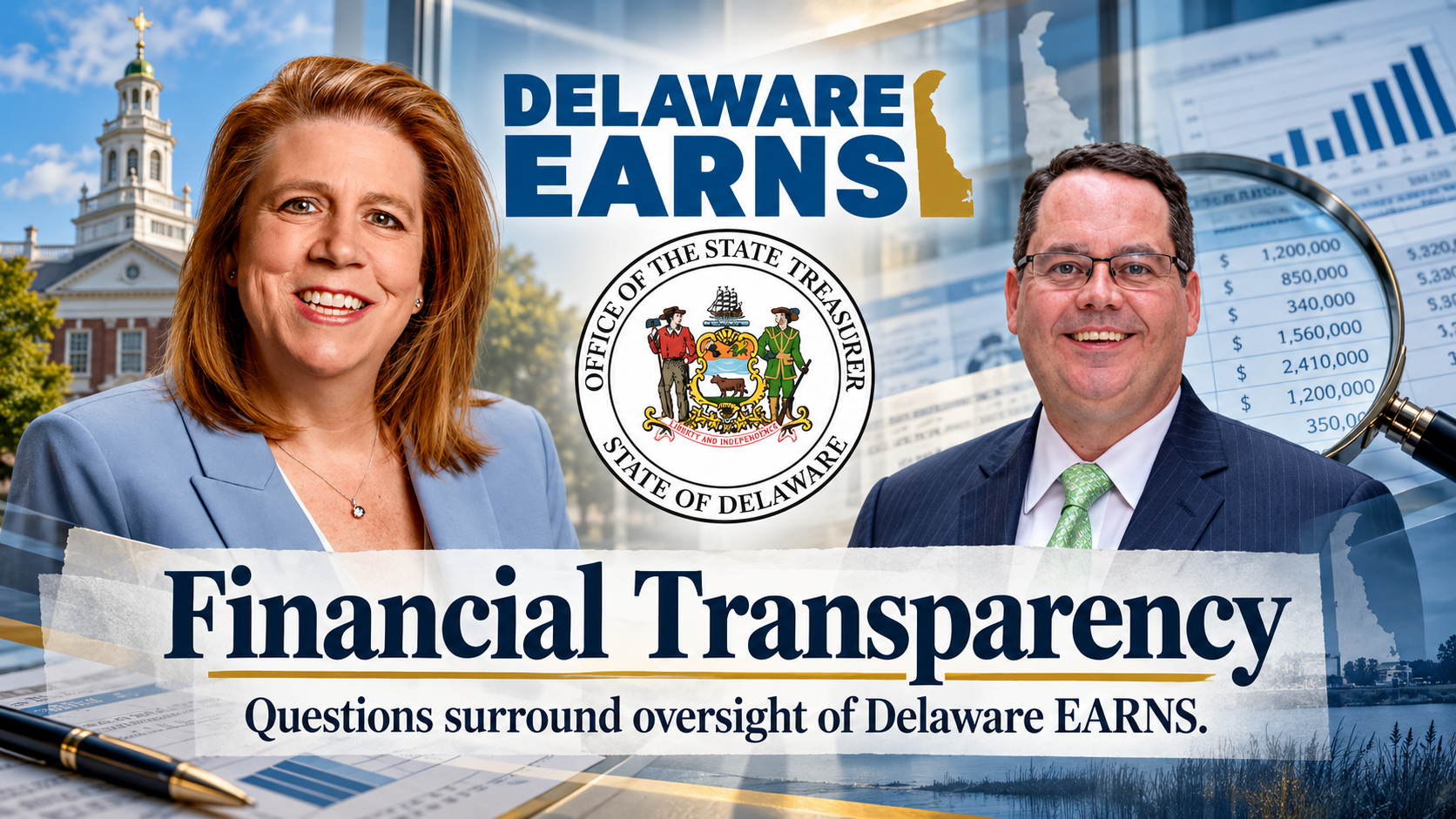
State lawmaker helped establish program later directed by her husband, highlighting the importance of public disclosure, accountability and financial transparency
By George D. Rotsch, Delaware LIVE
DOVER, Del. — A Delaware lawmaker’s role in helping establish a state-sponsored retirement savings program that later employed her husband raises questions about transparency in government hiring, financial oversight and the safeguards intended to maintain public confidence in state decisions.
State Rep. Krista Griffith, D-, was among the co-sponsors of House Bill 205, the legislation that created Delaware EARNS, a retirement savings program designed to help private-sector workers who lack access to employer-sponsored retirement plans.
The legislation, primarily sponsored by Rep. Larry Lambert, D-Claymont, passed with bipartisan support and was signed into law by Gov. John Carney in August 2022.
The law authorized the creation of the program, including a paid leadership position responsible for overseeing its implementation.
Griffith’s husband, Ted Griffith, subsequently became the first director of Delaware EARNS, a position within the Office of the State Treasurer.
There is no evidence presented in the research reviewed by Delaware LIVE that Rep. Griffith improperly influenced her husband’s hiring or that either violated state ethics requirements.
However, the relationship presents a legitimate public-interest question: What hiring, disclosure and oversight procedures were followed, and how can Delawareans independently verify that decisions involving public employment and taxpayer funding were handled appropriately?
A program intended to help Delaware workers
Delaware EARNS was established to address a significant gap in retirement savings opportunities.
State officials estimated that nearly 150,000 Delaware workers lacked access to retirement plans through their employers when the program was authorized.
EARNS allows eligible workers to contribute to individual retirement accounts through payroll deductions, even when their employers do not offer a traditional retirement plan.
Employers facilitate participation, while workers control their own contributions and may opt out.
State Treasurer Colleen Davis championed the legislation as a way to expand retirement security while reducing the administrative burden on small businesses.
The program has reported measurable progress. In April 2026, the Treasurer’s Office announced that EARNS participants had accumulated $10 million in retirement assets.
Those savings belong to participating workers and should not be confused with taxpayer appropriations used to establish and administer the program.
A qualified director, but questions about the process
Ted Griffith came to Delaware EARNS with significant experience in financial services.
According to his official Treasury biography, he is a certified financial planner who spent 16 years at Vanguard, including work as a financial adviser overseeing approximately $100 million in client assets.
He also held responsibilities in marketing and financial communications.
Those credentials are relevant to evaluating his qualifications for leading a retirement savings program.
The separate question is how Delaware selected him for the position.
Publicly available information reviewed for this story identifies Griffith as program director but does not establish the complete recruitment and selection process, including how widely the position was advertised, how many applicants were considered or who made the final hiring decision.
Those details would help determine whether the hiring followed a competitive, documented process consistent with state requirements.
Transparency would also help protect the reputation of a qualified public employee by allowing the process to be judged on facts rather than assumptions about family relationships.
Taxpayer funding adds another accountability issue
The original fiscal analysis for Delaware EARNS projected approximately $1.1 million in government implementation expenses over three fiscal years.
Those estimated costs included funding for a full-time program director as well as other administrative expenses.
Actual spending and appropriations must be distinguished from those initial projections.
The question of public funding is particularly relevant because Rep. Griffith subsequently served on the General Assembly’s Joint Finance Committee, which plays a central role in developing Delaware’s annual operating budget.
A review of legislative and budget records could establish whether Griffith participated in decisions that specifically affected EARNS staffing, compensation or administrative funding after her husband became director.
Such participation would not automatically establish an ethics violation. Legislative budget votes frequently involve departments employing relatives of lawmakers.
The more relevant questions are whether any decisions directly affected a household financial interest, whether state ethics requirements applied and whether appropriate disclosures or other safeguards were observed.
These are questions that can be resolved through legislative records, personnel documentation and applicable ethics guidance.
Outside consultants and financial oversight
The transparency questions extend beyond the hiring of the program director.
During implementation, the Treasurer’s Office selected AKF Consulting Group to help develop and administer EARNS.
According to Treasury records cited in the research report, AKF was the only qualified consultant to submit a proposal in response to the state’s request for proposals.
An evaluation committee reviewed the submission and unanimously recommended the firm.
A procurement process that attracts only one qualified bidder is not necessarily improper. However, it makes documentation of the selection process, contract costs and performance particularly important.
AKF subsequently assisted Delaware in evaluating opportunities to cooperate with other state-sponsored retirement programs.
In December 2023, Delaware joined the Partnership for a Dignified Retirement, an interstate arrangement involving Colorado and Maine.
State officials said the partnership would reduce startup costs, accelerate implementation and provide economies of scale.
The arrangement uses Vestwell, working with BNY Mellon, to provide retirement program administration and related services.
The public-interest questions are whether those projected savings have materialized, what fees Delaware and participating workers are paying, and how the state evaluates the performance of its vendors.
These questions concern the management of public programs and retirement services rather than any demonstrated wrongdoing by the program’s employees or contractors.
Who is responsible for oversight?
Delaware EARNS was initially overseen by a seven-member board responsible for implementation, vendor relationships, investment oversight and administration.
On Jan. 1, 2026, those responsibilities transferred to the Delaware Plans Management Board, which oversees other state-sponsored savings and investment programs.
The board’s publicly posted meeting materials include EARNS business reports, creating opportunities for public review of the program’s activities.
Still, important questions remain about how easily taxpayers can obtain information concerning hiring decisions, administrative expenses, consulting contracts, vendor performance and potential conflicts of interest.
The distinction matters.
Public disclosure requirements are intended not simply to identify wrongdoing after it occurs but also to help prevent conflicts, promote accountability and give residents confidence that government decisions serve the public interest.
Transparency should not require allegations of misconduct
Family relationships involving elected officials and government employees are not inherently improper.
Delaware’s relatively small political and professional community makes such relationships particularly relevant to public confidence.
The challenge for government is to ensure that hiring, contracting and funding decisions are made through established procedures, with appropriate safeguards when personal or family interests may be involved.
In the case of Delaware EARNS, records documenting the director’s selection, applicable ethics guidance and subsequent legislative funding decisions could help resolve questions without relying on speculation.
The same standards should apply regardless of political party, elected office or the perceived merits of a particular government program.
Delaware EARNS was created to provide retirement opportunities for workers who lacked them. Its reported growth offers evidence that the program is serving that purpose.
Public confidence in those accomplishments would be strengthened by clear documentation showing how the program was staffed, funded and managed.
The broader issue is not whether a legislator’s spouse should be disqualified from public employment.
It is whether Delaware’s government provides enough transparency for citizens to know that employment decisions, taxpayer expenditures and public contracts are handled fairly, independently and in the public interest.
TO GO: Delaware EARNS and government transparency
- What is Delaware EARNS? A state-facilitated retirement savings program for workers whose employers do not offer qualifying retirement plans.
- Who created it? House Bill 205, primarily sponsored by Rep. Larry Lambert with bipartisan support, became law in August 2022. Rep. Krista Griffith was a co-sponsor.
- What raises questions? Griffith’s husband, Ted Griffith, subsequently became the program’s first director. His hiring process and any relevant legislative funding decisions warrant examination.
- Has wrongdoing been established? No. The research reviewed does not establish improper hiring, unlawful conduct or an ethics violation.
- What deserves greater transparency? Hiring procedures, compensation, state funding, potential conflicts of interest, vendor contracts and program performance.
- Where can residents learn more? Visit the Delaware Plans Management Board or review House Bill 205
Delaware LIVE collaborates with a network of professional journalists to cover a diverse range of stories across various fields. Staff Writers include experienced journalists and young professionals. If you have questions, please feel free to contact [email protected] or our publisher, George D. Rotsch, at [email protected]