Synopsis: Strategic proposals aim to ease tensions, foster trust, and pave the way for permanent sea boundary negotiations over overlapping claims in the Gulf of Thailand.
Cambodia’s four proposals on constructive public communication, avoiding threats or the use of force, restoring diplomatic representation and implementing existing agreements have been accepted for inclusion in a confidence-building package under the United Nations Convention on the Law of the Sea (UNCLOS) conciliation process with Thailand.
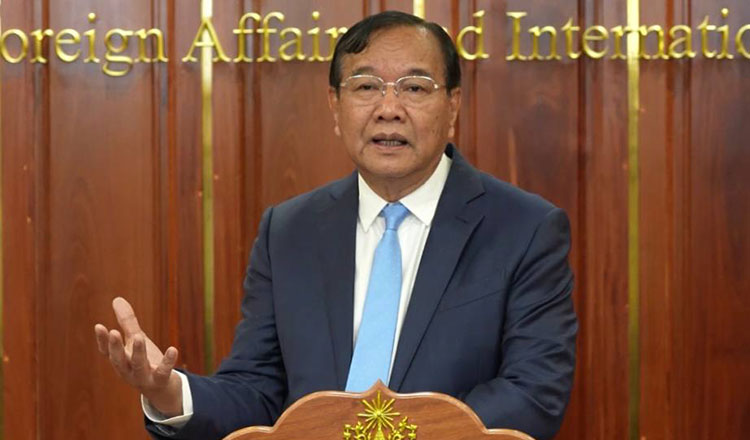
Foreign Affairs and International Cooperation Minister Prak Sokhonn announced the outcome in a special interview broadcast by state-run TVK on Tuesday, following the second meeting of the UNCLOS Conciliation Commission in The Hague, Netherlands.
The Permanent Court of Arbitration (PCA), which serves as the Commission’s registry, announced on Monday that both nations finalised confidence-building measures during the Commission’s second session, held from October 14 to 18. The measures were set out in an accompanying document dated October 17.
The document outlines six areas of cooperation aimed at strengthening trust, maintaining a constructive environment for negotiations and advancing efforts towards an agreement on the maritime boundary.
The first area commits both countries to engage constructively in the conciliation process and work towards agreeing on a permanent maritime boundary, in accordance with Articles 15, 74 and 83 of UNCLOS, with a view to concluding a bilateral maritime boundary treaty.
The second focuses on positive public communication. Both parties agreed to avoid statements intended to pressure the other side or limit negotiation options, while guarding against misinformation and disinformation that could undermine the process.
The document recognises both countries’ right to make statements to protect their legitimate rights and correct factual misinformation. However, both parties agreed to exercise restraint in public communications that could fuel negative public sentiment or heighten tensions between their peoples.
The third area concerns preventing further escalation of the dispute. Both countries committed to preserving the status quo in the maritime areas under consideration and refraining from actions that could materially alter the situation or escalate tensions.
The fourth area addresses bilateral engagement and diplomatic representation. The Commission noted that previously agreed understandings and measures had not yet been fully implemented and encouraged both parties to take steps to create an environment conducive to constructive negotiations.
In this context, the Commission encouraged both countries to enhance diplomatic representation by appointing a senior-level representative to the other party’s capital. It also encouraged them to participate constructively and openly in technical discussions on maritime boundary delimitation through a working group under the Commission’s auspices.
Sokhonn said Cambodia’s proposal to restore diplomatic representation to an appropriate level was intended to maintain direct communication between the two governments, particularly their prime ministers and foreign ministers, helping resolve disputes through diplomacy rather than military means.
Diplomatic relations between the two countries have been downgraded to the level of second secretary. Cambodia has proposed the return of deputy heads of mission to their respective diplomatic missions. Sokhonn said restoring diplomatic representation was important for maintaining dialogue, preventing misunderstandings and fostering mutual respect between the two countries.
The fifth area concerns bilateral communication channels, including those between the two countries’ naval commanders. Both parties agreed to use existing channels to ensure prompt notification and management of maritime incidents, helping prevent misunderstandings and tensions that could negatively affect conciliation proceedings.
The sixth area concerns implementation. The Commission acknowledged that measures would be implemented over the coming months, depending on progress in the proceedings. Both countries agreed to report on implementation and inform the Commission of serious difficulties. Either party may raise such matters confidentially with the Commission, which will consider them and recommend appropriate steps.
In addition to the four proposals, Sokhonn said the importance of fully implementing existing agreements, particularly the ceasefire and the Joint Statement of December 27, 2025. He said tensions along the land border could affect the maritime conciliation process, making compliance with existing agreements essential despite the Commission’s maritime mandate.
The Commission’s document said that both countries should take measures to strengthen trust and confidence and preserve a positive environment for negotiations. The agreed framework reflects their commitment to dialogue, international law and the peaceful settlement of disputes.
Responding to previous Thai accusations that Cambodia was portraying itself as a victim, Sokhonn said: “Cambodia does not need to play the victim, because we are already the victim.” The remarks were featured in a Khmer Times report titled “Cambodia Does Not Need to Play the Victim, Says Prak Sokhonn”, which included a video of the Sokhonn’s comments.
At the first round of talks in Singapore in September, Thai Foreign Minister Sihasak Phuangketkeow accused Cambodia of portraying itself as a victim in the maritime resources dispute and seeking to discredit Thailand through what he described as false narratives, distorted facts and unfounded allegations, including at international forums.
“It does this by playing the role of a victim with a sense of self-righteousness aimed at claiming the moral high ground,” Sihasak said.
Sokhonn on Tuesday emphasised the legal, political and moral significance of the confidence-building measures, noting that discussions took place at the Peace Palace in The Hague, which houses the headquarters of the International Court of Justice and the PCA.
He compared commitments made in an international legal setting to taking an oath in a pagoda before Buddhist monks, stressing the importance of honouring commitments and respecting international law and diplomatic principles.
The UNCLOS conciliation process is intended to help Cambodia and Thailand resolve their maritime boundary dispute through dialogue and peaceful means for the 27,000-square-kilometre Overlapping Claims Area in the Gulf of Thailand.
According to Sokhonn, the Commission’s third meeting is scheduled to take place in Kuala Lumpur, from November 23 to 27, followed by a fourth meeting in The Hague in late January.