Synopsis: The platform aims to centralise data, enhance screening of victims and strengthen reporting accuracy as authorities defend their anti-trafficking efforts following the Kingdom’s Tier 3 ranking in a US assessment.
The anti-human trafficking authority is planning to digitalise its data collection and categorisation systems to eliminate bias in victim identification and boost support services.
The plan was discussed in a high-level meeting led by Ministry of Interior Secretary of State and National Committee for Counter Trafficking (NCCT) Permanent Vice-Chairwoman Chou Bun Eng.
Bun Eng told Khmer Times yesterday that the purpose of the meeting was to hold technical-level discussions and seek consensus on the management of data concerning perpetrators and victims of human trafficking.
The data, she added, will be widely used by ministries and institutions under the framework of the NCCT, ensuring data consistency for the preparation of high-quality, reliable reports and the development of a national strategic plan to combat human trafficking that is targeted, effective and results-orientated.
“What we want to do is to computerise the process and integrate it into a digital system. The purpose is to eliminate bias,” Bun Eng said.
“This means that all data collected will come from every relevant institution, including the General Secretariat, the National Committee, and institutions at both national and provincial levels. All the information will be entered into the system.”
According to Bun Eng, information related to human trafficking comes from the 22 ministries, institutions and units represented on the committee, as well as sub-national authorities.
“However, the information is currently scattered across different sources. That is why we want everything integrated into a single system, allowing us to identify duplicate entries and clarify any discrepancies,” she said.
“We already have systems in place, but we are still considering how best to proceed.”
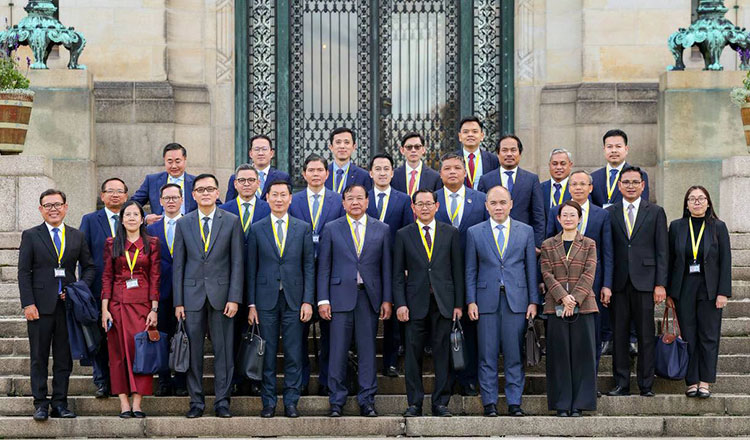
National Committee for Counter Trafficking Permanent Vice-Chairwoman Chou Bun Eng chairs a meeting in Phnom Penh. Interior Ministry
The Ministry of Interior already operates a reporting system for criminal offences, while a separate system is needed for human trafficking.
“We also need a dedicated system for the NCCT, which will incorporate information from relevant ministries and institutions responsible for prevention, combating trafficking, assisting victims and other related areas, including tourism,” she said.
“For now, we want to test the system by focusing on two main areas. First, the number of criminal offences reported and the number of operations conducted to suppress those offences. Second, the number of suspects and victims identified through the work of judicial police officers.”
The concept is still in the planning stage and will need some time before it is launched.
On Tuesday, Bun Eng led another meeting on reviewing the recent country report by the United States Department of State, which kept the Kingdom in Tier 3, the lowest ranking, and concluded that it has made little progress in fighting the modern form of human trafficking, which is strongly linked to online scam operations.
“We are reviewing all stakeholders’ recommendations. Where we find something inappropriate or inaccurate, we examine it and prepare our response, while also identifying areas where improvements are necessary,” Bun Eng said.
“Our review focuses on three main points. First, the efforts we have undertaken. Second, the challenges and outstanding issues. Third, our future direction.”
Authorities have noted Thailand’s Tier 2 ranking in the US report, which raised questions about the criteria for assessment.
“What we want to demonstrate is that the assessment did not adequately correspond with the actual results achieved,” Bun Eng said.
“We acknowledge that shortcomings and challenges exist. We do not deny them. However, the assessment must also take into account the efforts being made.”
She added that human trafficking is not a crime that the Kingdom can address alone, as it is connected to online scams and other forms of trafficking. These issues overlap and affect one another, ultimately contributing to the country’s declining ranking in the assessment of efforts to combat human trafficking.
“Therefore, we have instructed each ministry and institution to work towards providing more precise and concrete data to support our future efforts,” she said.
“Once an assessment has been issued, we cannot expect the assessors to return and revise their conclusions simply because we submit a response. Therefore, our focus must be on what we can do moving forward.”
Bun Eng noted that the authorities have already developed and implemented their action plans, with the ultimate objective of eliminating online scam operations, which are linked to human trafficking.
“If an investigation establishes that someone has violated the law, we will bring charges against that person,” she said.
“However, there are cases involving individuals whose roles have not yet been clearly established, partly because we do not have sufficient time to complete the assessment and identification process.”
When such situations arise, authorities respond with measures including repatriation.
“In such circumstances, we work to facilitate their return to their countries of origin, where their respective governments can take appropriate action under their own laws,” she said.
Whether those individuals deserve punishment or should be treated differently is for their home countries to determine, according to Bun Eng.
“As far as Cambodia is concerned, we deal with actual offences that have been identified and established within our territory. We have continuously brought cases before the courts, involving both Cambodian and foreign nationals. We make no distinction based on nationality,” she said.
“Some people assume that everyone who emerges from these operations must automatically be considered a victim. But is that necessarily the case? Our decisions are based on the identification and screening process.”
In the first half of 2026, authorities cracked down on 112 human trafficking and sexual exploitation cases, marking a 13% increase year-on-year. Law enforcement arrested 169 suspects and rescued 581 victims.
The cases involved forced labour, online romance/crypto scam centres, illegal employment, and unauthorised border crossings.
During the same period, 306 people went to trial while the courts issued verdicts in 165 cases, resulting in prison sentences for 232 individuals and suspended terms for 14 people.
In another development, it was confirmed yesterday that authorities have deported a total of 721 foreign nationals, including 95 women, of 20 nationalities from the Kingdom over a 10-day period from October 11 to Tuesday.
The operation was carried out under the directives of Interior Minister Sar Sokha and General Department of Immigration Director-General Lieutenant General Sok Veasna, who tasked the Department of Investigation and Procedures with continuing deportation proceedings.
The 20 nationalities were Indonesian, Chinese, Bangladeshi, Filipino, Nigerian, Pakistani, Cameroonian, Japanese, Ghanaian, Taiwanese, Malaysian, South Korean, Ugandan, Indian, Myanmar, French, Liberian, Swiss, Uzbek and American.
Among the total, 90 Chinese nationals, including three women, who were involved in online scams were deported on special flights.
Another 355 Indonesian nationals, including 54 women, who were involved in online scams were deported through Techo International Airport.
The remaining foreign nationals were deported after authorities found that they had committed various offences, including illegal border crossings, document forgery, residing without passports, extortion and kidnapping for ransom, using fake visas and fraudulent QR codes, drug trafficking and use, illegal employment and other crimes.