Jakarta, IO – The Meteorological, Climatological and Geophysical Agency (BMKG), together with relevant institutions including the Indonesian Military (TNI), the National Disaster Mitigation Agency (BNPB), the Forestry Ministry, the Defense Ministry and the National Research and Innovation Agency (BRIN), is using dry ice seeding through Weather Modification Operations (OMC) to help disperse dense haze caused by forest and land fires in Sumatra and Kalimantan. The technique targets atmospheric inversion layers that trap smoke near the surface, particularly when there are few clouds suitable for rain seeding.
BMKG Head Teuku Faisal Fathani explained that dry ice seeding was a tactical measure to address atmospheric conditions that hinder smoke dispersal. Under certain conditions, dense smoke from forest and land fires can become trapped in atmospheric layers near the surface, reaching altitudes of 6,000 to 7,000 feet or even higher.
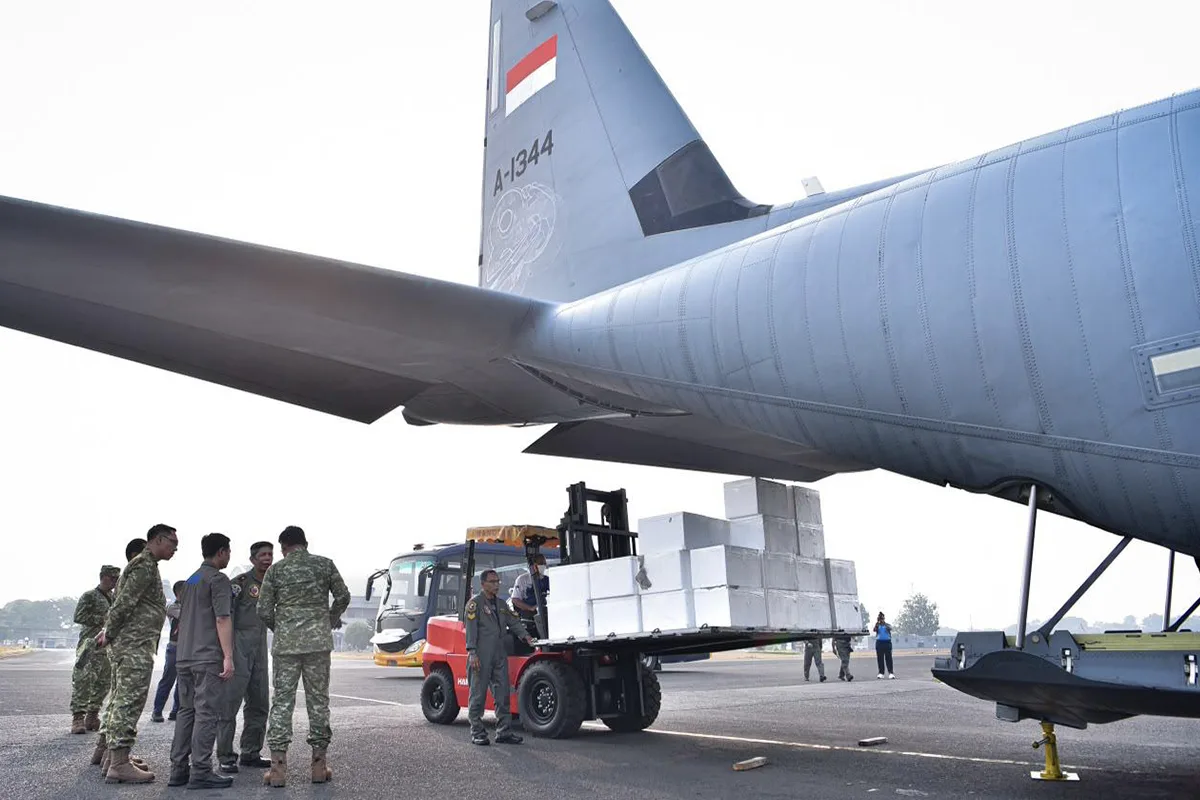
Meanwhile, Weather Modification Deputy Tri Handoko Seto explained that an inversion layer acts like a lid, preventing vertical air movement. To address this, OMC teams accurately disperse dry ice from aircraft above the inversion layer. As the dry ice sublimates, it causes rapid cooling and a sudden drop in temperature, helping restore convective airflow.
“This allows smoke to rise vertically and disperse into the atmosphere. The process also increases the likelihood of cloud formation, which can then be targeted for seeding during OMC,” Seto said on Tuesday (20/10/2026).
He stressed that using dry ice in these operations serves a different purpose from cloud seeding to induce rainfall. BMKG specifically targets inversion layers that trap smoke and intervenes in isothermal layers to alter atmospheric stability at higher altitudes. This provides a tactical alternative when skies are relatively dry and there are few clouds suitable for seeding.
Measuring Success
BMKG evaluates the effectiveness of dry ice interventions using several measurable parameters, particularly improvements in visibility and reductions in airborne PM2.5 pollutant concentrations. These indicators help show changes in atmospheric conditions and air quality in affected areas, including locations critical to essential infrastructure such as airports.
(Source: Special)
Seto said monitoring data collected over several days of operations indicated improvements in conditions in several affected areas. One example was Palembang, where visibility gradually improved following the intervention. However, BMKG still needs ongoing monitoring and data analysis to assess the operation’s effects over time.
Read More: 2 Years Of Prabowo’s Presidency: Rp3,923.2T In Investment Creates 5.48 Million Jobs, Over Half Outside Java
Improved visibility is important for ensuring the smooth execution of aerial operations to combat forest and land fires. When conditions permit and safety requirements are met, aircraft can carry out firefighting missions and patrols more effectively. However, the intervention’s effectiveness continues to depend on atmospheric conditions and the development of fires on the ground.
OMC using dry ice seeding is part of a broader effort to tackle forest and land fires, rather than a standalone solution to the fires or resulting haze. It must be carried out alongside ground firefighting, patrols, law enforcement and the involvement of communities and nongovernmental organizations (NGOs) in preventing and extinguishing fires.
“OMC is not the only measure to tackle forest and land fires. Ground firefighting, patrols, law enforcement and voluntary efforts by communities and NGOs also play important roles. Everyone shares the same goal: to bring the fires under control as quickly as possible. Therefore, all efforts must be coordinated, mutually supportive and sustained,” he stressed.
BMKG Head Faisal said coordination among institutions was essential to addressing the evolving forest and land fire situation in Sumatra and Kalimantan. BMKG will continue to optimize atmospheric analysis-based support through OMC alongside firefighting and prevention efforts on the ground, with the aim of ensuring an integrated response and reducing the impact of haze on communities and transportation activities. (est)