Synopsis: From fighting in opposing armies to escaping near-certain execution, Oum Lor recounts his remarkable story, hoping younger generations will learn from the Kingdom’s painful past.
At 77, Oum Lor has lived through some of the Kingdom’s darkest chapters, having served in two opposing armies, survived accusations of espionage and escaped execution. Now a farmer in Kandal province, he hopes his experiences will help younger generations understand the suffering endured by those caught in decades of conflict.
For Lor, war was never a distant event recorded in history books. It was a reality that took him away from his parents, placed a weapon in his hands and forced him to fight for opposing sides in a conflict that would eventually devastate the Kingdom.
Today, Lor leads a quiet life as a farmer in Angkrong village, Rolaing Ken commune, Kandal Stung district, Kandal province. Alongside his wife, Seng Chreb, 55, he has raised seven children, including five daughters, who now work in factories and farming.
Although he has no disability, injuries to his head and legs remain physical reminders of his years as a soldier. His memories, however, carry a heavier burden.
Lor’s extraordinary journey began in 1970, when the Kingdom was descending into civil war. He recalled being forcibly recruited into Lon Nol’s army at Stung Chral, leaving behind his parents and village.
What followed was his first encounter with the brutality of armed conflict.
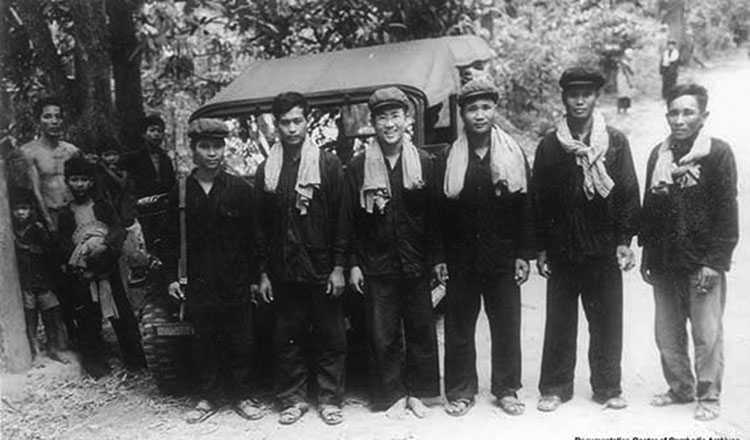
Khmer Rouge soldiers gather at the Olympic Stadium during the Democratic Kampuchea period. DC-Cam
For seven days and seven nights, he fought against Khmer Rouge forces before being captured as a prisoner of war. He eventually managed to escape and return to his unit. He was subsequently deployed to Wat Neak Voan in Phnom Penh.
But his loyalty to the Lon Nol army did not last.
By 1971, disillusioned with the political situation and the uncertainty of military life, Lor decided to abandon the army and join the Khmer Liberation forces, known as Khmer Rumdoah.
He recalled believing that the competing regimes were little different from one another, with ordinary people bearing the consequences of oppression and exploitation.
His decision placed him on the opposite side of the battlefield, fighting against the very forces he had previously served.
As a Khmer Liberation soldier, Lor participated in numerous military operations, including the Battle of Oudong, which he remembers as one of his most significant combat experiences.
However, changing sides did not bring him the security he had hoped for. Just five months into his new military service, he was suspended after being accused of working as a Central Intelligence Agency operative and spying for Lon Nol’s forces.
He was sent to the forests of Pursat province, where he remained for approximately a year while his case was investigated.
Eventually, he was cleared of suspicion and recalled to service.
For Lor, it was another lesson in how quickly a soldier’s circumstances could change, even within the ranks of the forces he had chosen to join.
From battlefield to labour camp
When the Khmer Rouge seized power in April 1975, Lor remained within its military structure. However, with active combat having ended, he no longer carried a weapon.
Instead, Angkar, the organisation through which the Khmer Rouge exercised its authority, assigned him to work in the Special Zone Unit.
In 1976, he was dispatched to Pursat province once again, this time to serve as a chief of a Hundred Cell, known in Khmer as Prathean Kang Roy, overseeing a group of children engaged in agricultural work.
His responsibilities later changed when Khmer Rouge authorities discovered that he possessed basic literacy. Lor was reassigned to military duties, managing the distribution of oil from a fuel depot to various military divisions.
It was a different role from the battlefield assignments of his younger years, but Lor remained within a system in which orders from above dictated nearly every aspect of daily life.
As Vietnamese troops advanced into the Kingdom, the situation deteriorated rapidly. Fear spread among the population, and Lor soon found himself fleeing once again, this time not towards another battlefield but in search of survival.
A bowl of porridge that bought time
Among Lor’s most vivid memories is an encounter during his escape towards the Kingdom’s North-west Zone, when he believed that he and those travelling with him were about to be executed.
As Vietnamese forces advanced, Lor and his group abandoned their military uniforms and scarves, hoping to conceal their identities and avoid being targeted.
They eventually arrived at a cooperative, where local residents warned them that they were fortunate to have reached the area when they did. According to the residents, Khmer Rouge cadres had only recently finished rounding up people for execution.
An even more frightening encounter followed the warning.
A man on horseback suddenly fired his gun and ordered Lor’s group to run towards a place he described as khang kram, meaning “down below”.
Lor immediately suspected that the instruction concealed a deadly intention.
“Where does ‘down below’ mean, if not into the earth?” he recalled thinking.
Rather than obeying the order, Lor and his subordinates, some of whom were travelling with their families, decided to find a way out.
He came up with a simple excuse: they needed time to eat porridge with their families before continuing.
The request bought them precious moments.
When an opportunity presented itself, they fled to another cooperative, hoping to disappear before the cadres realised what had happened.
But their escape was far from over.
Three Khmer Rouge cadres on horseback soon arrived, searching for the missing group. Fortunately for Lor, the men did not recognise him.
Thinking quickly, he pretended to be a bystander and pointed them in another direction.
“I only see these carrying poles; they all ran down that road,” he recalled telling the cadres.
The men believed him and rode off in the direction he had indicated.
It was a brief encounter, but one that Lor remembers as crucial to his survival.
Having escaped the search, he and his companions continued their journey until they reached Bakan district in Pursat province, where they remained until 1981.
Only then did Lor finally return to his birthplace, bringing an end to years of military service, displacement and uncertainty.
A survivor’s message to the next generation
Decades after moving through military camps, forests and battlefields, Lor now farms with his wife while his children pursue peaceful livelihoods. Having served in Lon Nol’s army and the Khmer Rouge military structure, he hopes younger generations understand the hardships and dangers of Cambodia’s turbulent past.
For those who endured those years, however, the memories of killings, forced labour and insufficient food remain painfully real.
“I want the younger generation to remember all these stories as a lesson,” Lor said.
He hopes that sharing his experiences will help youth understand not only the brutality of the past but the suffering endured by ordinary people whose lives were consumed by war.
Documentation Center of Cambodia director and military historian Youk Chhang said many men and women had fought in multiple wars, yet their sacrifices had received little commemoration.
He called for the construction of a monument to honour these soldiers.
- Tags: Cambodia, Khmer Rouge