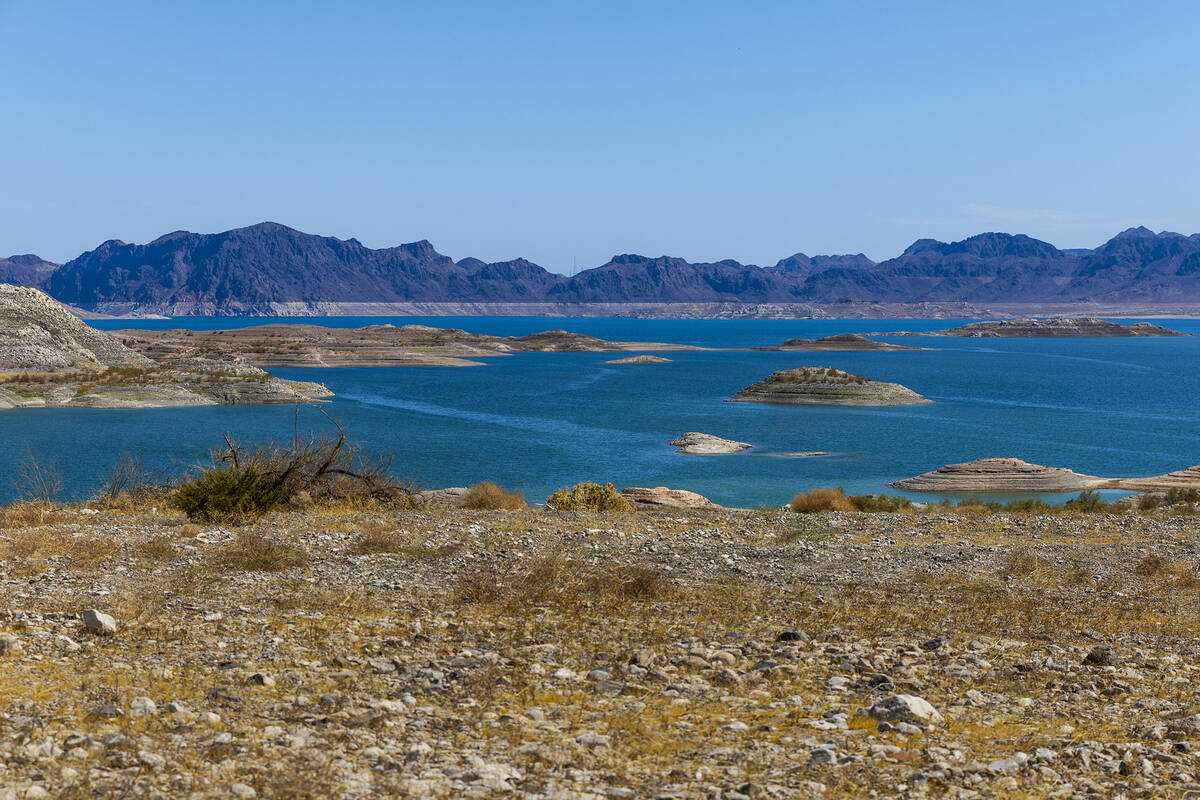
Throughout her decades-long political career, Rep. Dina Titus has seen rhetoric about water shift from a conversation of abundance to one of scarcity. Lake Mead, once an overflowing reservoir, has become a symbol of overuse and imbalance.
Simultaneously, Southern Nevada has gained an international reputation for conservation, to the chagrin of some of her constituents bearing the brunt of those conservation measures.
“I hear from constituents who say, ‘Well, they’re just taking my water to give it to somebody else. They’re not just really saving water. They’re just moving water around. You have to take out my grass to steal my trees, which is running off my birds, all so you can build a new development,’” Titus said. “How do you answer to that?”
At a roundtable discussion on Monday led by Titus at the Las Vegas Valley Water District, a diverse group of Southern Nevadan experts laid out their vision for solutions to the valley’s persistent water woes. While doom-and-gloom headlines may be at an all-time high and Lake Mead is setting all-time lows, they said tools exist to remedy the crisis, albeit expensive ones.
The answer to Titus’ question about growth is a complicated one, replied Colby Pellegrino, deputy general manager of resources at the Southern Nevada Water Authority.
“The first thing I’m going to say is, did you move here prior to 2002?” Pellegrino said.
That was the year that Southern Nevada got serious about conservation, implementing what she described as common-sense measures that allowed water use to plummet while adding hundreds of thousands of residents.
Every year, the water authority creates projections that evaluate the region’s water security over the next five decades, taking into account a liberal estimate for growth. Using water efficiently allows Southern Nevada to grow, Pellegrino said.
Pellegrino added that data shows much of the valley’s tree mortality is because of rising temperatures, not grass removal — a water authority argument that has stirred some debate among the valley’s arborists as homeowners sue over mass, mandatory turf conversions prompted by a 2021 state law.
Titus’ conversation comes days after Arizona decided to intervene as an interested party in Nevada’s lawsuit with the Trump administration over its plan to manage the Colorado River. The federal government, in the face of record-low flows and no relief in sight, has asserted its legal authority to slash Nevada’s water allocation by up to 71 percent over the next 10 years.
Titus, D-Las Vegas, is running for her eighth term in Congress and faces a Republican challenger in Nevada Sen. Carrie Buck.
So what can be done?
Titus was one of the 12 Western lawmakers who have urged Congress to act quickly to mirror what was a $4 billion investment in drought mitigation that was achieved under the Biden administration.
Business organizations from all seven Colorado River states, including three from Southern Nevada, have echoed a similar request, asking for at least $2 billion to fund water security before it’s too late.
Asked about what kinds of initiatives that funding could be used for, Pellegrino said it would strengthen existing conservation programs, such as the transformation of water-wasting cooling systems, turf conversion rebates and a full audit of irrigation systems across the valley.
She added that water recycling, such as the still-not-fully-funded, multi-million-dollar effort to bring Boulder City into the regional wastewater system, is something that could benefit from extra federal dollars.
Desalination plants, though carrying billion-dollar price tags and other roadblocks, remain a focus, as well. The water authority is still in talks to benefit, along with Arizona, from a water transfer associated with a plant in Carlsbad, California.
What Pellegrino said she doesn’t want to see is committing money toward less permanent solutions. For instance, farmers in California’s Imperial Valley received funds in the last cycle to fallow their fields, or let crops die, to save water.
“It would be really good to see it go to durable solutions and not temporary fallowing,” Pellegrino said.
Gail Bates, director of hydropower at the Colorado River Commission of Nevada, added that Lake Mead is only two feet and some change in elevation away from only four of 17 dam turbines being able to function.
That’s not a problem for most big cities like Las Vegas that have a diverse portfolio, but rural utilities throughout California, Nevada and Arizona will need to account for big gaps in electric generation.
Congress was helpful in releasing funding for at least three more turbines that can operate at lower lake levels, Bates said, but those won’t be operational until 2029.
“We’re going to have a couple of tough years of some fairly low output if the current hydrology continues the way it is,” Bates said. “We’re weathering the storm in terms of hydropower generation output.”
Contact Alan Halaly at ahalaly@reviewjournal.com. Follow @AlanHalaly on X.