For decades, Durga Puja in West Bengal has evolved and grown, weathering political shifts while retaining its cultural significance. On October 10 this year, the State’s newly elected Bharatiya Janata Party (BJP) government organised its first major event to welcome Goddess Durga at Kolkata’s Eden Gardens Cricket Stadium on the occasion of Mahalaya. The first day of Debi Pokkho (the fortnight of Goddess Durga), Mahalaya heralds the countdown to Durga Puja. The BJP’s event signified both change and continuity.
Suvendu Adhikari, the Chief Minister of West Bengal, flanked by the ministers of his cabinet, walked the two-kilometre stretch from Red Road to Eden Gardens, which was illuminated with bright red-and-cream lights. The event, featuring art forms from various districts of West Bengal, was reminiscent of the Durga Puja carnival organised during the regime of the All India Trinamool Congress (TMC), founded and led by Mamata Banerjee, which governed West Bengal from 2011 to 2026.
The carnival, envisaged by the former Chief Minister, Mamata Banerjee, marked the culmination of the puja festivities — the idols of the big-ticket Durga Pujas would move along the Red Road, accompanied by performances by a cultural troupe. The event continued for hours, and the TMC leader was often seen shaking a leg with the stars of the Bengali film industry. With budgets running into crores of rupees, big-ticket pujas organised by puja committees are popular in the State. They draw large crowds and often have well-known politicians as patrons.
The BJP government, which is shouldering the self-professed responsibility of celebrating the 10-day annual festival of Durga Puja according to ‘tradition’, has decided to stop organising the carnival. Yet, the same government has left no stone unturned to make the festival’s inaugural event at the Eden Gardens, organised less than 500 metres from the site of the former carnival on Red Road, a grand success.
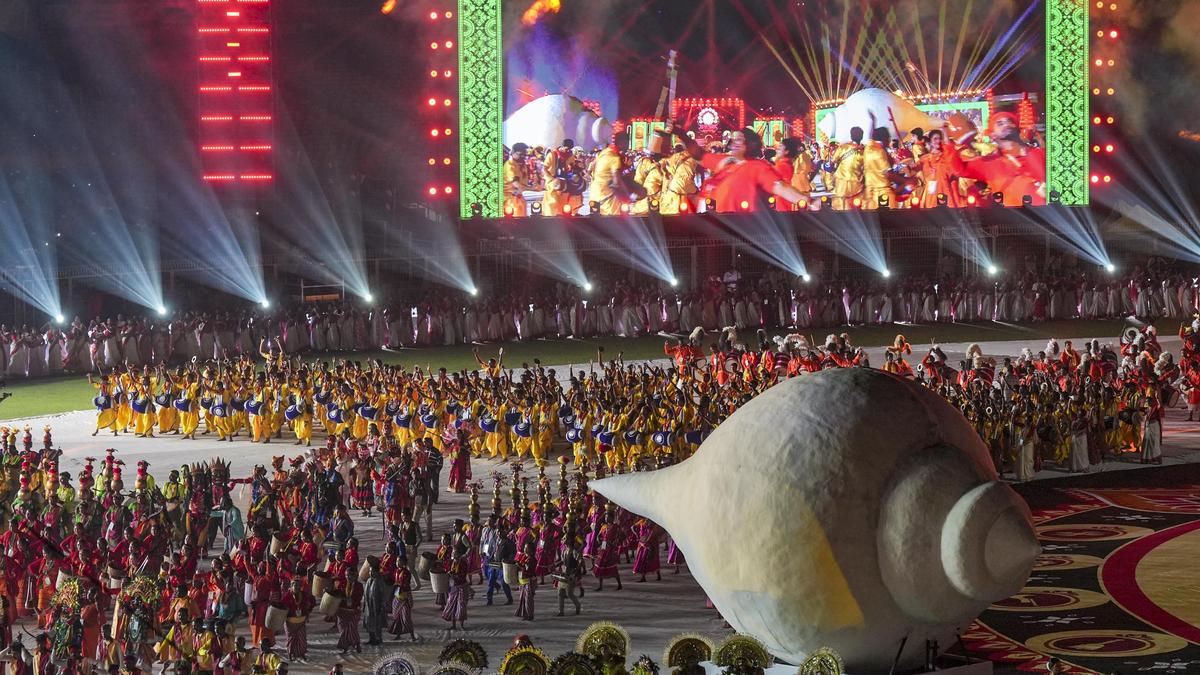
About 40,000 people gathered to witness the event despite the humid October evening. The event featured the synchronised beats of about 10,000 dhakis (West Bengal’s traditional folk drummers who play the barrel-shaped drum called dhak), the blowing of 1,000 conch shells, performances by well-known artistes and singers, and 3,000 drones lighting up the sky above the stadium.
In scale and spectacle, the BJP’s Durga Puja event was little different from the carnivals organised under the TMC government. The shift lay in the political and cultural messaging: nationalist themes at pandals, changes in puja committees’ political patrons, disputes over non-vegetarian food, and restrictions on bookstalls near pandals. Together, these changes reveal how the new regime is reshaping the politics of Bengal’s biggest festival.
The event featured the synchronised beats of about 10,000 dhakis (West Bengal’s traditional folk drummers who play the barrel-shaped drum called dhak), the blowing of 1,000 conch shells, performances by well-known artistes and singers, and 3,000 drones lighting up the sky above the stadium.
| Photo Credit:
PTI
At the Eden Gardens, Mr. Adhikari said, “All Durga Pujas will follow proper religious traditions this year”. He took a swipe at his predecessor and accused Ms. Banerjee of disregarding the festival’s rituals by inaugurating pujas before the onset of Debi Pokkho. “This is the first time pujas have not been inaugurated before time. This is our tradition; everybody has to follow the religious scripture and traditions. Every religion has its own rules and regulations. No chief minister has enough power to change the dates of religious events on their own will,” he said.
Moulding artists’ expressions
About five kilometres from Eden Gardens, in the narrow lanes of Kumartuli, artisans were responding to the new regime’s emphasis on tradition. Every year, the riverside potters’ colony produces nearly 4,000 clay idols of Goddess Durga. The colony has a history of more than 2,000 years, dating back to when Kolkata’s zamindars brought artisans from Krishnagar to make idols for Durga Puja.
This year, the idols were sculpted amid repeated appeals by BJP leaders and ministers to Durga Puja organisers to adhere to “traditional” depictions of the Goddess and avoid distortions. Over the past few decades, however, Durga Puja has evolved beyond traditional worship to embrace theme-based art, with the Goddess depicted in diverse forms.
This year, the artists favoured traditional representations, known as sabeki idols. A sabeki idol retains the classic Bengali look: the familiar face of Durga with large, elongated eyes, the entire divine family arranged on a single chala (backdrop), and traditional decorations such as white shola work.
Bankim Pal, a veteran artist at Kumartuli, said that many organisers of Durga Puja celebrations were cautious about the artwork in their pandals after the new government issued unwritten diktats about the size and form of the Goddess’s idol. He remained defiant, saying that no government directive could stop art. “We may or may not like theme pujas, but with evolving times we also have to let art evolve into new techniques and forms. That is the very nature of art,” he said.
Caught between sabeki and theme-based idols, some idol makers and sculptors like Samir Pal say that the business is slow. “I generally sell at least 20 idols; this year, I got only 16 orders. Some of the puja committees that used to buy Durga idols from me have closed down because they were Trinamool-backed,” Samir added. Artists at Kumartuli have also faced a severe shortage of clay during the peak festive season. Delayed work and the need to pay premium prices for good-quality clay have further cut into their profits.
Celebrating nationalism
Even as tradition dominates Durga Puja festivities under the BJP government, theme-based pandals have not disappeared. Instead, new themes have emerged, reflecting how political change is all-pervasive. The prominent themes at big-ticket Durga Pujas in Kolkata are Vande Mataram and Syama Prasad Mookerjee, the founder of the Jana Sangh and a new cultural icon for the BJP in West Bengal. For instance, New Alipore Suruchi Sangha’s 2026 Durga Puja theme draws inspiration from Bengal’s rural landscape and pays tribute to Syama Prasad Mookerjee.
Tributes to the national song ‘Vande Mataram’ and its writer, Bankim Chandra Chattopadhyay, to mark the song’s 150th anniversary are among the most common themes across Durga Puja pandals in Kolkata. The most notable example is Santosh Mitra Square Durga Puja, themed ‘Sanatani Chetanay Vande Mataram’ (Vande Mataram in Sanatani thought).
Santosh Mitra Square, where BJP leader Sajal Ghosh organised a Durga Puja during the TMC regime, has adopted a theme centred on nationalism. Several other prominent puja committees in Kolkata, including 66 Pally, Kalighat, Kankurgachi Milan Mela Samity and Bijoypur Sarbojanin Durga Puja Committee in Sodepur, have also chosen Vande Mataram as their theme this year.
Committed to new patrons
In just five months Durga Puja committees, which were previously associated by local TMC leaders, councillors and ministers, now have BJP leaders as their new patrons. Locals in the Rajdanga area of South Kolkata, who live near a well-known club Rajdanga Naba Uday Sangha, are using the phrase “Ghosh in Ghosh out” to explain the political shift. Till last year, the community Durga Puja was held under the leadership of TMC leader Sushanta Ghosh. The former TMC councillor was arrested on June 18 by Kolkata Police on charges of extortion, corruption and criminal conspiracy among others.
Left without a political heavyweight, the Durga Puja organisers have made BJP leader and spokesperson Keya Ghosh the president of the Puja committee. Almost every big-ticket Durga Puja in Kolkata has witnessed a similar change, with BJP leaders making inroads and TMC leaders being driven out.
For the past 15 years, Sreebhumi Sporting Club, famous for its grand theme-based Durga Puja celebrations in Kolkata, was synonymous with Sujit Bose, a former TMC MLA who also served as the State Minister in the Department of Fire and Emergency Services. This year, it was inaugurated by Mr. Adhikari and was among the handful of Durga Puja pandals visited by Union Home Minister Amit Shah on October 18.
Debajit Chatterjee, the general secretary of the club, has nothing to say about the old patron who is now behind bars. “People are taking a breath of fresh air now that the regime has changed. It is our good fortune that the CM came here and spent so much time. We are reimagining this whole puja and the celebrations with the new government,” Debajit said.
Kolkata: Artists perform during the Mahalaya Durga Puja celebrations organised by state government, at Eden Gardens, in Kolkata, Saturday, Oct. 10, 2026. (PTI Photo/Manvender Vashist Lav)(PTI10_10_2026_000542B)
| Photo Credit:
PTI
Other big-ticket pujas were not far behind in falling in line with the new regime. The Durga Puja committee at New Alipore Suruchi Sangha, which was previously under the supervision of former State minister for Power and Housing Aroop Biswas, has appointed BJP MLA Sourav Sikdar as its new patron. The Mohammad Ali Park Durga Puja in central Kolkata used to be inaugurated by Trinamool MP Sudip Bandyopadhyay. This year, the baton was taken over by West Bengal Commerce and Industry Minister Tapas Ray. Chetla Agrani Durga Puja, associated with former Kolkata Mayor and former Minister Firhad Hakim, was also inaugurated this year by Mr. Adhikari.
Historian and academic Tapati Guha-Thakurta, in an interview with The Hindu, explained why Durga Puja clubs and organisers are switching sides. “Durga Pujas have always been a political issue, especially in the context of local clubs and area politics. Mamata did not just claim the pujas as a significant cultural event, but also as an important political platform. She took it to an extreme and made it a State-run event. Because TMC had such a strong hold on the pujas, now the knives are out, and puja committees,” Tapati said.
Tapati, who played a key role in drafting the dossier which led Durga Puja in Kolkata to be included in the Representative List of the Intangible Cultural Heritage of Humanity in 2021, said that the present government wants “to imitate each and everything that was done by the previous government”.
Creative economy
Durga Puja is also a major driver of West Bengal’s economy. Many of the State’s big-ticket pujas have been running for over 50 years, with budgets exceeding ₹20 crore. They are funded through subscriptions from local residents and businesses, as well as corporate sponsorships, often in exchange for banners and hoardings around the pandals.
In 2019, the British Council, at the behest of the West Bengal Tourism Department, mapped the creative economy associated with Durga Puja and estimated its value at ₹32,377 crore, equivalent to 2.58% of the State’s GDP. In 2018, the State government began providing financial assistance to Durga Puja committees, with the grant rising to ₹1.10 lakh per puja in 2025. The BJP government continued the scheme in 2026 but urged committees with large budgets not to apply for the grant.
This year, the Adani Group entered the festival’s sponsorship landscape with the Durga Puja Adani Preview, held from October 10 to 12. Each of the eight selected pujas was promised a grant of ₹25 lakh. Since 2022, previews of Durga Puja had been organised by massArt, a not-for-profit organisation. Its organisers, including former State Tourism Minister Indranil Sen, are being investigated by the Enforcement Directorate over alleged financial irregularities and a ticket-selling scam linked to the preview shows.
What’s on your plate?
About 40 days before Durga Puja celebration, Dhirendra Krishna Garg also known as Baba Bageshwar Dham, who is the head of Bageshwar Dham Balaji Temple, Madhya Pradesh, stirred up a controversy during an event in West Bengal by asking Bengalis to keep non-vegetarian food away from Durga Puja pandals. He described the non-vegetarian food served in Bengal during Durga Puja as “dirty”. “People who eat such food are not religious; they are pakhandis (hypocrites)”, he said.
The entire BJP leadership, including Suvendu and State BJP president Samik Bhattacharya, had to make statements to assuage the anger among the people of the State, who did not want an “outsider” to lecture them on their dietary preferences and how to fest during puja.
Durga Puja organisers, including Kolkata’s Bonedi Bari (aristocratic households) that have organised Durga Pujas in their household for centuries, have said that offering and eating non-vegetarian food is part of the Shakta tradition of worship. “Ours is a 417-year-old Durga Puja; no man or Baba coming from outside will tell us what to do in our puja. Every religion has its own traditions; no one can tell us what to eat and what to wear. It is our fundamental right,” said Srimant Roy Chowdhury, a member of the 35th-generation of Sabarna Roy Chowdhury family that organises Durga Puja in Behala, south Kolkata.
The controversy over food, however, did not end with Dhirendra’s comments. In the second week of October, a billboard advertising a biryani outlet featured an image of Goddess Durga next to a pot of biryani. It sparked controversy in the State’s Hooghly district. A local BJP MLA alleged that it had hurt the religious sentiments of Hindus. The billboard, displayed outside a high-rise residential complex in Uttarpara’s Hindmotor area, had a Bengali tagline that translates to ‘Devotion to the Goddess this puja… rockstar flavour’. It had to be removed.
The politics of biriyani sparked a divisive campaign in north Bengal when an organisation, Hindu Jagaran Manch, set up posters urging people to buy biryani and puja items from shops owned by Hindus. These posters resulted in widespread condemnation in political and social circles.
Rainbow roads, banned bookstalls
BJP’s brush with Durga Puja festivities was not just limited to pandals. To give the city’s roads a makeover for Durga Puja celebrations, the government applied rainbow-coloured paints at different places, including two flyovers in Kolkata — Chingrighata flyover and Gariahat flyover. The move generated praise until the videos of three bikes skidding after a brief spell of rain and falling on the Chingrighata flyover surfaced. The authorities tried to scrub off the paint in haste, installed road studs on the rainbow-painted flyover and roughened its surface.
Minister for Urban Development Agnimitra Paul, who is believed to have allowed the painting on flyovers, said that anti-skid paints were applied. “Officials have been directed to investigate the cause of the accident. Some people are saying that the colours are straining the eyes while driving. If that is the case, an alternative arrangement will be made. Whatever is convenient, for the people’s needs, will be done,” he said. The commissioner of Kolkata Police, Ajay Kumar Nand, added that there was no conclusive proof that the bike accidents were linked to the paint on the flyover, but stated that Chingrighata flyover will be closed for motorbikes if it rains.
Restrictions on setting up bookstalls by Left parties have also emerged as a flashpoint this festival season. Leaders of the Left parties, including the Communist Party of India (Marxist), have said that the police is denying permission to set up bookstalls near Durga Puja pandals. The parties have cited several instances where such stalls were allegedly attacked over the past few days. “The books are just an excuse; they actually want to crack down on anything related to education and culture. They have declared war on these creative fields,” Mohammad Salim, the CPI(M) State secretary, said.
Fireworks light up the sky during the Mahalaya Durga Puja celebrations organised by the BJP government, at Eden Gardens
| Photo Credit:
PTI
The practice of having book stalls at Durga Puja pandals has a long tradition. The CPI(M)and other Left parties do not directly associate themselves with the ritual aspect of the Durga Puja and these stalls are not only a way to popularise their ideology but also to connect with the people.
Mr. Adhikari, more than a month ago, on September 10, urged Durga Puja committees to deny any space near the pandals to those who refer to Durga Puja as “Sharodotsav” or an autumn festival. Mr. Adhikari, who claims that Durga Puja will be observed traditionally, said that the use of Sharadotsav was part of a concerted attempt by the Left parties to dilute the religious character of the festival and impose communist culture.
Notwithstanding the controversies surrounding the festival, the West Bengal government claims that the number of Durga Puja pandal in the State has increased by 12,400 and the total number Durga Puja pandals in the State stands at 57,400.
While inscribing Kolkata’s Durga Puja on its Representative List of the Intangible Cultural Heritage of Humanity, in 2021, UNESCO had described the festival as the “best instance of the public performance of religion and art” where “divides of class, religion and ethnicities collapse as crowds of spectators walk around to admire the installations”. As West Bengal undergoes another phase of political paribortan (change), Durga Puja is adapting to the new order. Whether this shift will transform the festival into something new and different only time will tell.
shivsahay.s@thehindu.co.in
shrabana.chatterjee@thehindu.co.in