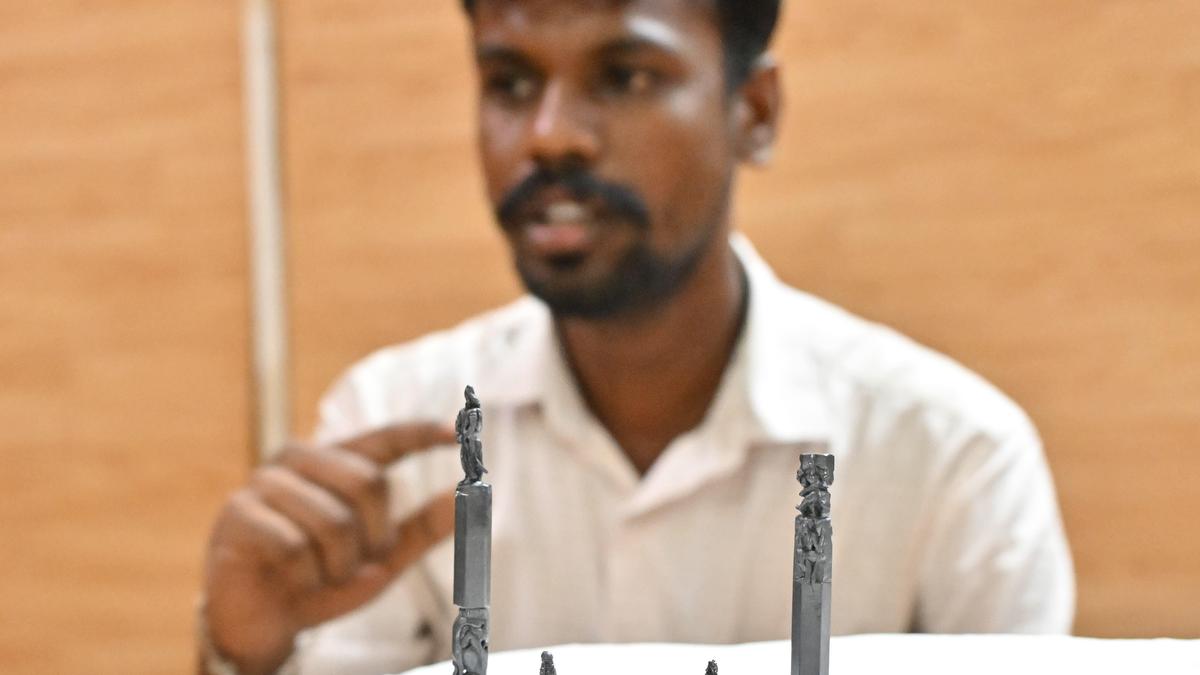
Kaviarasan from Dharmapuri shows his carved graphite sculptures at Manidha Neyam IAS Academy in Chennai on Monday.
| Photo Credit: VELANKANNI RAJ B
On surfaces as tiny as pencil lead, chalk, and sandalwood, intricate temple sculptures come alive through the work of a self-taught micro artist in Chennai.
S. Kaviyarasan, 27, hopes to take his art to international competitions and showcase the State’s sculptural heritage. The artist, a native of Dharmapuri, began practising when he was ten years old, driven by a fascination with the sculptures he saw in temples.
“I started trying to carve when I was in class five. I looked at sculptures in temples and practiced on my own,” he says, sitting cross-legged in a classroom in the Manidheya Neyam IAS Academy, Chennai, where he came in 2022 to prepare for government examinations, run by former Mayor Saidai Duraisamy.
He studies the details of sculptures, their design and the ideas they convey, using them as the starting point for his miniature works. “When I go to temples, I look at the sculptures and try to understand what they are trying to tell us, and how they have been designed,” he says.
Mr. Kaviyarasan’s interest led him to explore the engineering and artistic ingenuity embedded in Tamil Nadu’s temple architecture. The stone chains at Varadaraja Perumal Temple in Kancheepuram, the rotating stone ball inside a yazhi’s mouth at Kailasanathar Temple, and stone carvings of Sri Margabandeeswarar Temple in Virinjipuram, near Vellore, also informed his work.
Elements from these appear in one of his notable creations, a sandalwood sculpture of Nataraja, which also features the sages Patanjali and Vyaghrapada, and Ravana lifting the Himalayas. Carved from a single piece, the overall structure casting a shadow resembling a person in prayer.
His interest in history also influences his work. He speaks of Rajendra Chola I, whom Mr. Kaviyarasan has carved in a piece of chalk, and the temple at Gangaikonda Cholapuram, stressing the importance of understanding the historical context behind the structures and figures he recreates. “In common history textbooks Rajaraja Chola is more famous, but Rajendra Chola also has a great history. He built Gangaikonda Cholapuram. He carved his own legacy, but he also paid homage to his father’s legacy,” he said.
Mr. Kaviyarasan’s work has earned him recognitions such as the Guinness World Records for making 617 interlinked chain links from pencil lead, the Asian Book of Records in 2019, and the Indian Book of Records in 2019 and 2021. He is currently pursuing a digital art course.
His journey, however, began with practice at home, without his family’s knowledge. His father, Selvam, is a tailor, while his mother, Manjula, manages the household. It was only later, when teachers and others recognised his work, that he began to see micro art as something he could pursue seriously.
“I was doing this at home without telling my family in the beginning. Later, some teachers in college supported me. They told me that this was a form of art and that I could take part in competitions,” he says.
Not limiting his ambition to collecting awards, Mr. Kaviyarasan says he wants to introduce more people to the intricacies of Tamil Nadu’s temple heritage and demonstrate how these forms can be interpreted through micro art.
Mr. Duraisamy said micro art is a rare skill that demands considerable effort, patience and dedication, and must be encouraged.
Published – October 19, 2026 12:14 am IST