Estonian energy-storage company Skeleton Technologies has reached a valuation of more than USD1 billion after a strategic investment led by Siemens, as it prepares to expand manufacturing and research in the United States to serve the fast-growing AI data-centre market.
The companies did not disclose the investment’s value or the terms of the deal. Skeleton chief executive Taavi Madiberk described it as a nine-figure round. The investment will support a planned expansion of US manufacturing, including domestic production of cells, and research and development in Silicon Valley.
Powering the AI boom
Skeleton said it planned to invest more than USD200 million in the US scale-up and research programme, working with hyperscalers – large cloud and computing companies – to develop power systems for AI data centres. Its ambition is to build a US supply chain spanning cells through to complete systems.
The deal builds on a relationship that began before the current AI boom. Siemens supported Skeleton’s expansion in 2023, while Siemens Digital Industries designed and automated the Estonian company’s manufacturing facility in Leipzig, Germany. The two groups plan to combine Siemens’ electrical infrastructure expertise with Skeleton’s power systems for data centres.
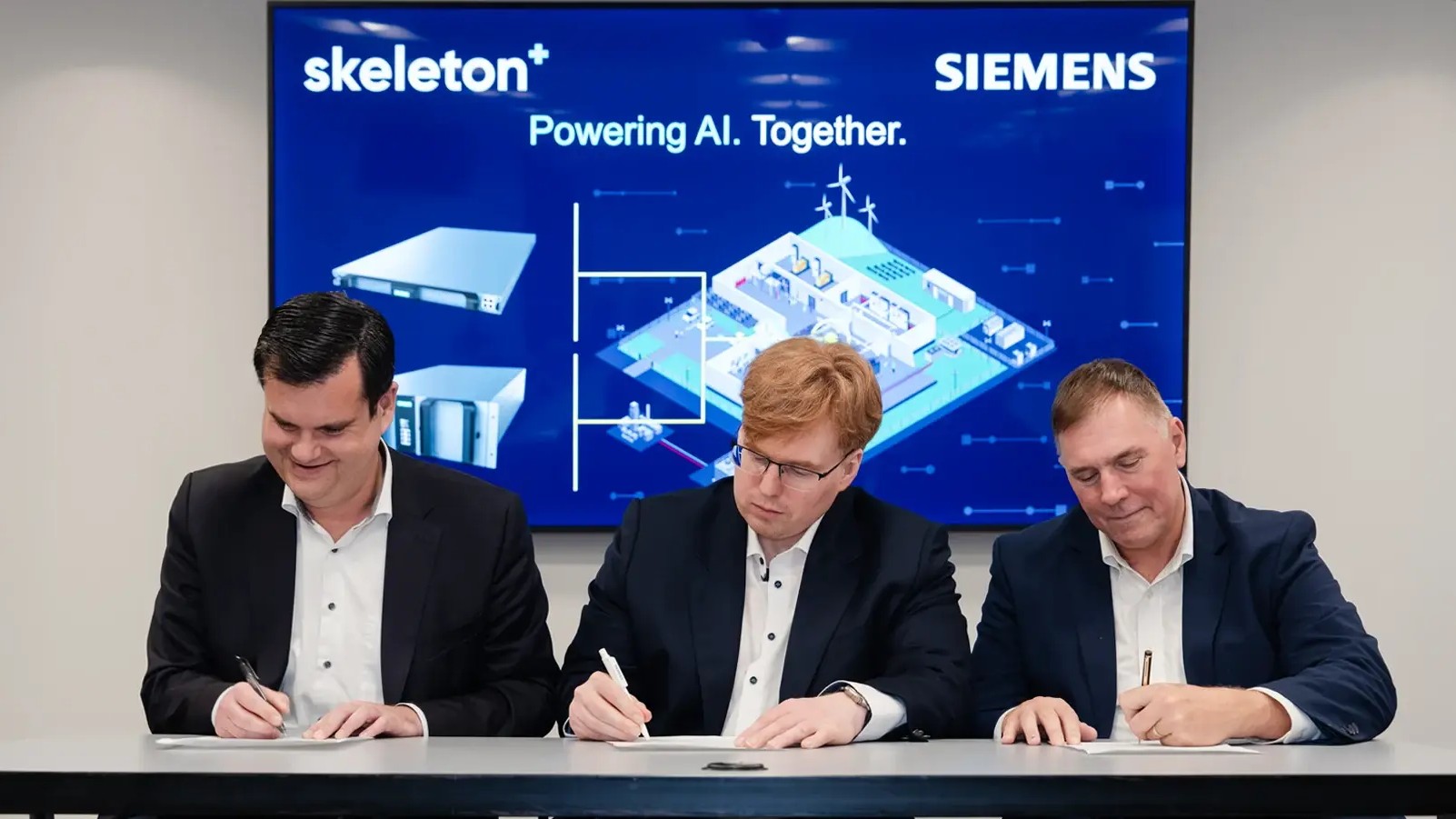
From left, Markus Grabmeier, president of electrical products at Siemens AG; Skeleton Technologies chief executive Taavi Madiberk; and Barry Powell, president and regional chief executive of Siemens Electrical Products, mark the announcement of Siemens’ investment in the Estonian company. Photo: Skeleton.
AI computing places unusual demands on electricity networks. Graphics processing units can shift power consumption in milliseconds, causing sudden fluctuations that can affect performance and efficiency. Skeleton says its systems can smooth those swings and reduce energy use by up to 40 per cent, while improving GPU performance by double-digit percentages. Those figures are company claims.
The International Energy Agency expects global data-centre electricity consumption to rise from about 485 terawatt hours in 2025 to 950 terawatt hours by 2030. Electricity use by AI-focused data centres is forecast to triple over the period, with data centres accounting for about half of US electricity-demand growth.
From Tartu to the US market
Skeleton’s systems combine power electronics and controls with cells made using its proprietary “curved graphene” material, which the company says enables rapid power delivery and long cell life. The group was founded in the Estonian town of Tartu in 2009 and has spent years developing and manufacturing energy-storage technology in Europe.
Skeleton’s founders, Taavi Madiberk and Oliver Ahlberg, in 2020. Photo by Skeleton.
“AI is scaling faster than the power infrastructure behind it,” Madiberk said. “The constraint is not how many GPUs you can buy, but how much compute you can extract from every GPU and every megawatt available.”
He called the investment a milestone, but said the company had achieved only a fraction of its broader mission. The new valuation makes Skeleton one of a small group of Estonian-founded companies to reach unicorn status.